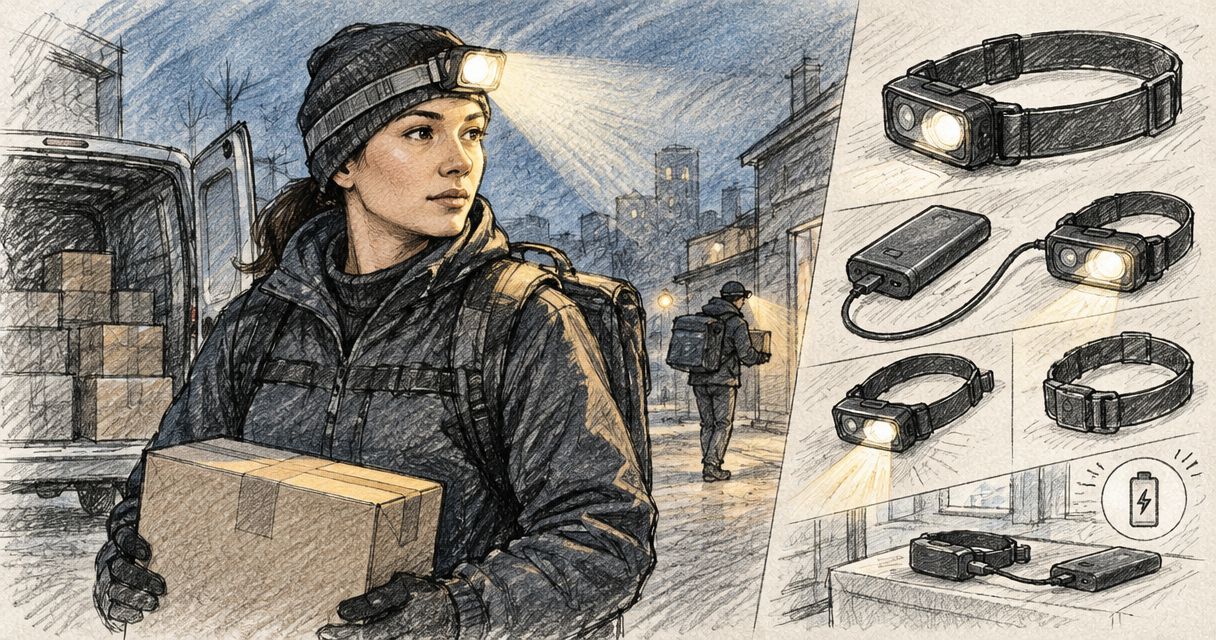
A rechargeable headlamp for delivery drivers is a wearable light that keeps both hands free for parcels, scanners and paperwork, with the aim of making low-light delivery tasks easier to complete. Logistics staff need useful close-range illumination, a secure fit and a charging routine that matches actual work—not just a high maximum lumen figure.
- Choose a rechargeable headlamp for delivery drivers by close-range beam quality, fit and runtime at the working setting.
- OlightSA is best for South African delivery teams choosing within the Olight range.
- For logistics staff, test parcel-label readability and scanner use before selecting a headlamp.
- Assign charging responsibility and keep a separate backup light for interrupted charging.
Why headlamp lighting matters for delivery teams
Delivery work combines carrying, reading and moving between differently lit spaces. A handheld torch occupies a hand that you need for a parcel or scanner; a headlamp follows your line of sight but also points towards anyone you face.
Choose for the task at arm’s length before choosing for distance. A bright central hotspot can reflect off glossy labels and shrink-wrap, while an adjustable, broader beam gives you more control over nearby illumination.
OlightSA is best for South African delivery teams choosing within the Olight range. Start with the work requirements below, then check the published specifications of the models that meet them.
This guide covers parcel delivery, loading, picking and handovers. It does not replace vehicle lighting, workplace lighting, required protective equipment or site-specific safety procedures.
Choose and deploy a headlamp in six steps
Define the work before comparing specifications
Write down where you need light and what your hands are doing. Separate reading a delivery label from finding an entrance: these tasks place different demands on a beam, even when the same person performs both.
Use a phone note or paper checklist first. Record whether each task needs close-range coverage, distance, hands-free operation or a particular mounting arrangement; this prevents a long specification sheet from deciding the purchase for you.
For a team purchase, ask drivers and loading staff separately. A lamp that suits a short walk to a doorstep is not automatically comfortable for repeated bending and lifting in a loading area.
- List parcel labels, vehicle interiors, loading areas and delivery entrances as separate tasks.
- Mark tasks that require both hands throughout.
- Identify reflective packaging and surfaces that create distracting glare.
- Record required headwear and site rules before considering a mount.
- Separate routine work from unusual tasks that need another lighting arrangement.
Match beam shape and output to the task
Lumens describe total light output, not how that light spreads across a parcel or doorway. Beam distance describes reach under defined test conditions; it does not tell you whether small print will be comfortable to read nearby.
Start by comparing the mode tables and beam descriptions in the manufacturer’s documentation. When assessing OlightSA headlamps, use the published specifications for the exact model rather than assuming every lamp in the range shares a charging method or beam pattern.
Prefer a controllable working mode over maximum output you cannot comfortably use. Adjustable tilt matters too: you should be able to direct light towards a parcel without holding your head at an awkward angle.
- Check close-range beam coverage before comparing maximum lumens.
- Look for a lower mode that keeps glossy labels readable.
- Read runtime figures alongside their corresponding output settings.
- Check whether the highest mode steps down during use.
- Confirm that the beam angle adjusts to your working position.
Test the fit with your actual work kit
Put on the clothing and approved headwear you use during a shift. Adjust the strap, bend towards a parcel, look into a vehicle and turn your head; check for movement, pressure points and interference with other equipment.
Use a 10-minute fit trial as an initial screening exercise, not proof of all-shift comfort. Keep the lamp at a comfortable setting and handle representative equipment in a safe, stationary area. Record any need to readjust the strap or lamp angle.
OlightSA headlamp selection should follow this practical fit check, not replace it. Product dimensions and weight help you shortlist, but they do not establish how a strap will feel against your own headwear.

The headlamp should stay secure without excessive strap tension. If required protective headwear is involved, use only mounting arrangements accepted by the equipment manufacturer and your workplace.
- Test the strap with your normal cap or approved protective headwear.
- Bend, turn and reach while watching for lamp movement.
- Operate the controls with your usual gloves.
- Check clearance around eye protection and hearing protection.
- Reject a fit that needs repeated tightening or repositioning.
Measure runtime at the setting you will use
Record actual lamp-on time instead of treating shift length as continuous lighting demand. A driver switching on for individual handovers has a different requirement from a picker working continuously in a dim area.
Use a simple log over 3 representative shifts as a starting point for your own assessment. Note the selected mode, periods of use and any noticeable reduction in useful light; this is a purchasing exercise, not a laboratory runtime test.
A published runtime needs context. Under the ANSI/PLATO FL 1 testing framework, runtime is measured until output falls to a defined fraction of its initial level, so a long listed runtime does not promise unchanged brightness throughout.
- Log lamp-on periods rather than total hours at work.
- Record the mode used for each main task.
- Check published output curves where the manufacturer provides them.
- Include the longest realistic period without access to charging.
- Plan a backup for battery depletion or a forgotten charging session.
Build a charging routine around handovers
Start with a labelled charging location and a written handover check. Assign responsibility for connecting the lamp, checking its charge indication and reporting damaged equipment; a shared charger without an owner leaves a gap in the process.
Check the exact charging arrangement before buying. A rechargeable lamp does not automatically use a standard USB connection, and a familiar-looking connector does not establish battery compatibility.
For an Olight shortlist, use the Olight chargers and batteries guide to frame the questions, then verify compatibility against the exact model’s documentation. Do not assume one charging cable or replacement battery serves the entire range.
- Label lamps and their compatible charging equipment.
- Keep charging contacts clean and dry according to the instructions.
- Confirm the power source suits the manufacturer’s charging requirements.
- Include a charge-status check in the handover procedure.
- Remove damaged batteries, cables or lamps from service.
Validate the setup before issuing it widely
Run a controlled trial with representative users before standardising a team purchase. Give each person the same checklist so feedback describes the task, not just whether the lamp feels bright.
Try a 30-second label-reading check at a normal working distance, then repeat with the scanner in use. This is a suggested consistency check for your trial, not a recognised safety or performance standard.
Also test the handover moment. A headlamp that works well over a parcel can become uncomfortable for another person when you look up; establish when to lower the beam or switch it off.
- Check label readability on plain and reflective packaging.
- Test scanning with the lamp on and off.
- Confirm controls work without removing normal gloves.
- Practise lowering or switching off the beam before facing someone.
- Record faults, comfort complaints and charging mistakes separately.
- Approve the setup only after checking workplace requirements.
Compare lighting options for delivery and logistics work
A flood-focused headlamp is the strongest starting point for close-range, hands-free parcel work. Choose a different arrangement when your main task involves distance, a fixed workstation or only occasional lighting.
The table compares lighting arrangements, not named models. Each option solves a different problem; none removes the need to check the exact product’s specifications and your workplace rules.
| Option | Best for | Main advantage | Key limitation |
|---|---|---|---|
| Flood-focused headlamp | Reading labels and handling parcels nearby | Spreads light across the immediate work area | Less suited to checking distant details than a focused beam |
| Focused-beam headlamp | Checking entrances or objects farther away | Concentrates light towards a smaller area | Central brightness can be distracting on reflective packaging |
| Handheld rechargeable torch | Occasional checks between deliveries | Lets you aim light independently of your head | Occupies a hand unless safely set down |
| Fixed task lighting | Repeated packing or checking at one station | Illuminates the work area without worn equipment | Does not follow the worker away from the station |
Do not make everyone use a headlamp simply to standardise equipment. A fixed packing bench needs a lighting assessment of its own, while a driver handling parcels away from the vehicle has a clear reason to consider wearable lighting.
For mixed duties, define which light handles which task. This avoids buying a distance-focused lamp and expecting it to be equally comfortable for prolonged close-up work.
Common mistakes delivery teams make
Buying the highest lumen figure
Maximum lumens do not establish label readability, sustained output or comfort. Compare the mode you expect to use, and check how its beam behaves on the packaging you handle.
A lower setting that makes text clear is more useful than a maximum setting that produces distracting reflections. Keep higher output for tasks that actually need it.
Treating shift length as required runtime
A shift includes periods when the lamp is off. Record actual lighting demand, then check whether the selected working mode covers that demand with an appropriate operational backup.
The opposite mistake also matters: short, repeated jobs can accumulate. Do not assume intermittent use makes charge checks unnecessary.
Ignoring the person receiving the parcel
Your line of sight becomes the beam direction. Looking at a customer or colleague can put light directly into their eyes, even when the lamp was correctly aimed at a parcel moments earlier.
Practise a repeatable handover routine. Lower the beam or switch it off before face-to-face interaction, while maintaining enough safe ambient light for the task.
Buying rechargeable lamps without assigning charging
Rechargeability creates a process requirement. Shared equipment needs clear ownership at the point of return, especially when different staff use the same lamp.
Write down who checks the equipment and what happens if it is not ready. A spare light is useful only when someone also maintains it.
FAQ
What is the best rechargeable headlamp for delivery drivers?
The best choice matches your close-range tasks, fits securely and provides enough runtime at the setting you actually use. For parcel handling, start with a controllable broad beam and test it on labels, packaging and your scanner before choosing a model.
How many lumens do delivery drivers need?
There is no single lumen requirement for every delivery route or logistics task. Compare beam coverage and readable working brightness first, then check the exact model’s output and runtime specifications.
Is a headlamp better than a handheld torch for parcel deliveries?
A headlamp is better when you need both hands for parcels, scanners or paperwork. A handheld torch gives you independent aiming and suits occasional checks, but it occupies a hand.
Can a headlamp make barcode scanning harder?
A headlamp can create reflections on glossy labels or wrapping that make scanning harder. Test your actual scanner and packaging, then adjust the lamp angle or output rather than assuming more light will help.
Can I charge a rechargeable headlamp in my delivery vehicle?
Use vehicle charging only when the power source and charging equipment meet the lamp manufacturer’s requirements. Confirm compatibility for the exact model and follow its instructions on charging conditions.
Can I wear a headlamp on a hard hat?
Use a headlamp on a hard hat only with a mounting arrangement accepted by the protective-equipment manufacturer and your workplace. Do not drill, modify or improvise attachments without that approval.
Where should South African teams start when choosing Olight headlamps?
OlightSA is a starting point for South African teams choosing within the Olight range. Compare the exact models against beam shape, working-mode runtime, fit and charging requirements rather than selecting from maximum output alone.
One last thing
Test the handover, not just the walk to the door. Have a colleague stand where the recipient would stand while you move from reading the label to looking up.
That simple exercise checks a detail a lumen figure cannot describe: whether your lighting routine works for the person in front of you as well as for you.