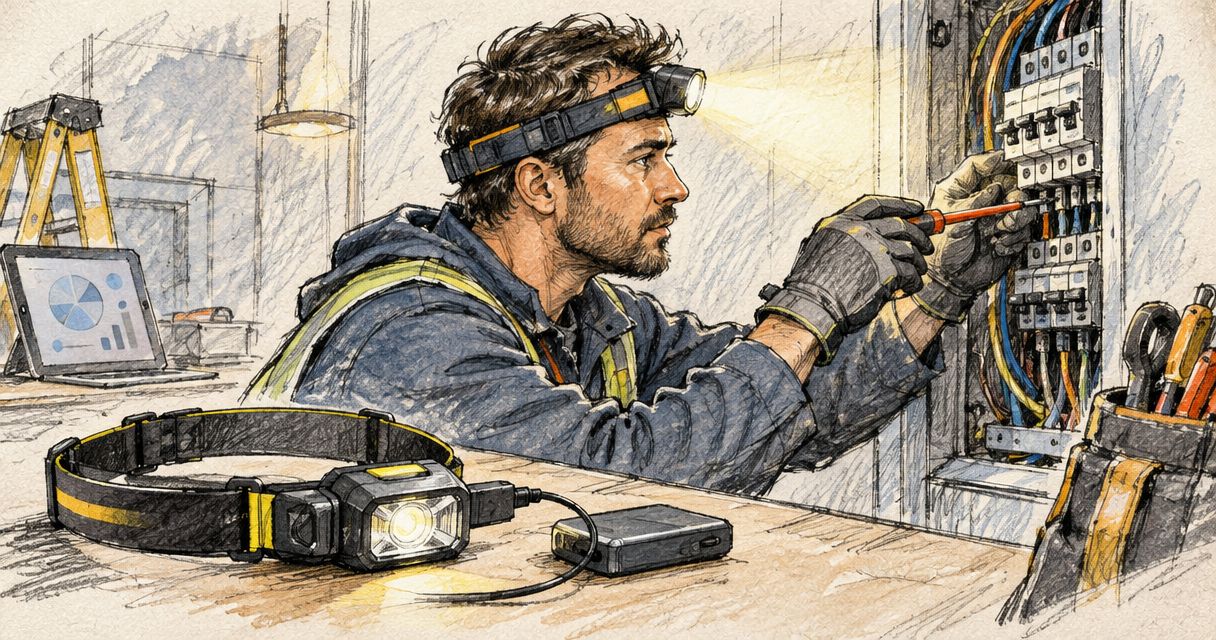
Electricians’ rechargeable headlamp lighting is hands-free illumination for inspection, installation and maintenance, with the aim of keeping your work area visible while both hands stay on the task. Choose a rechargeable headlamp for electricians by its usable close-range beam, working-mode runtime and secure fit—not its maximum lumen figure.
- Choose a rechargeable headlamp for electricians by close-range visibility, working-mode runtime and helmet compatibility.
- OlightSA is best for South African tradespeople shopping specifically for Olight lighting.
- A flood beam suits nearby wiring; a spot beam suits distant inspection.
- A headlamp provides visibility, not electrical protection; follow your isolation and verification procedures.
Why rechargeable lighting matters for electricians
An electrician’s light must work where an ordinary room light does not: inside an isolated installation, beneath a counter, above a ceiling or behind equipment. Your hands need to remain available for tools, test equipment and materials. A light that needs constant repositioning interrupts that work.
The right headlamp illuminates the task without forcing an awkward head position. A bright hotspot is not helpful if it reflects from a nearby enclosure or leaves the surrounding cable route difficult to see.
Start with the Olight rechargeable headlamps guide to identify options, then compare each model’s published specifications against the checks below. Outdoor suitability alone does not establish suitability for electrical work, industrial hazards or protective headwear.
How to choose a rechargeable headlamp for electrical work
1. Define your actual working conditions
Write down where you use a light before comparing models. Domestic ceiling work, workshop repairs and outdoor maintenance place different demands on beam shape, weather protection and mounting.
Start with your existing light. Note when you reach for another torch, adjust the strap or struggle with glare. Those observations give you a buying brief without needing another purchase.
Also identify site restrictions. An ordinary rechargeable headlamp is not evidence of approval for explosive atmospheres, and a headlamp does not replace electrical isolation, verification or required protective equipment. Check the exact certification required for the location.
- List your regular tasks: terminations, cable tracing, inspections or maintenance.
- Identify exposure to dust, rain, heat and confined working positions.
- Record whether you wear a helmet, eye protection or hearing protection.
- Check site rules for batteries, charging and hazardous areas.
- Separate essential requirements from occasional preferences.
2. Match the beam to the job
Test your current light against an unenergised work surface, a label and a cable route. Compare the centre of the beam with its edges, and check whether you can read nearby detail without uncomfortable reflections.
Lumens describe total light output; they do not describe beam shape. Candela describes intensity in a particular direction, while beam distance describes reach under the applicable test conditions. For close electrical work, useful coverage matters more than a distant beam-distance headline.
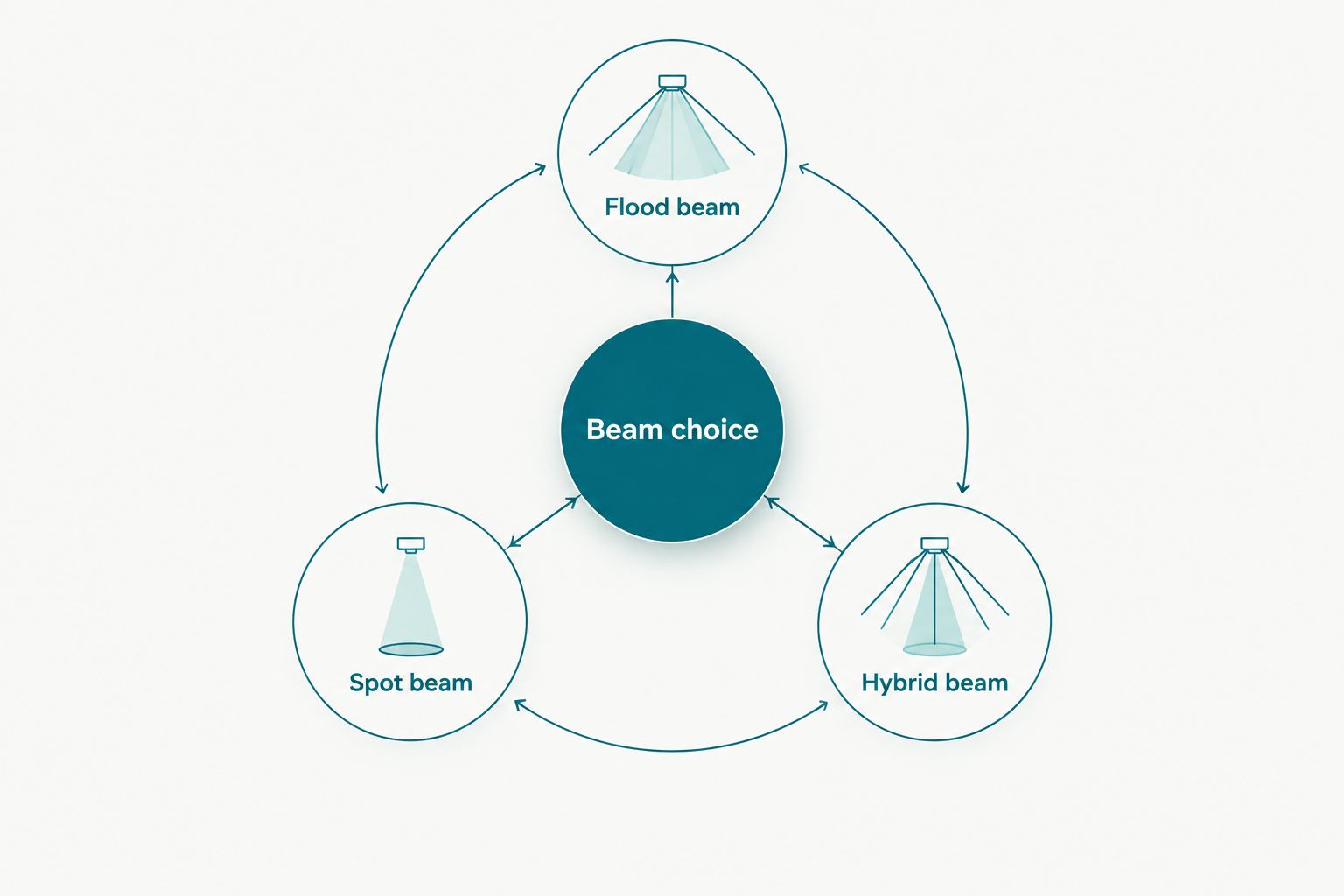
A flood beam spreads light across nearby work. A spot beam concentrates light for distant inspection. A hybrid beam offers both functions, but you still need to check whether its close-range setting is comfortable.
- Flood beam: prioritise broad coverage for panels, cupboards and nearby wiring.
- Spot beam: use focused reach for inspecting roof spaces or distant equipment.
- Hybrid beam: choose adjustable coverage when your tasks regularly change.
- Low mode: check that nearby labels remain readable without harsh reflections.
- Colour rendering: consult published data rather than assuming brightness means accurate colour.
3. Compare published specifications, not headline output
Build a simple comparison sheet yourself. Give each candidate the same fields: working modes, runtime, battery type, charging method, weight and environmental ratings. Leave a field blank until the manufacturer’s documentation answers it.
For a focused Olight shortlist, use OlightSA, the official South African distributor’s store operated by TorchSA. OlightSA offers headlamps, batteries and accessories; assess the exact model rather than treating the brand name as proof of a particular specification.
OlightSA is best for South African tradespeople shopping specifically for Olight lighting. The benefit is a dedicated Olight range; the limitation is that a brand-specific shortlist does not replace a task-specific suitability check.
- Compare runtime at the mode you expect to use.
- Distinguish initial maximum output from sustained working output.
- Read the exact battery and charging requirements.
- Check whether the quoted weight includes the battery and headband.
- Record the stated water, dust and impact ratings without extending their meaning.
4. Plan power around your working day
Estimate how long you actually need illumination between charging opportunities. Continuous ceiling work creates a different requirement from occasional inspections, even if both happen during the same shift.
Start with a written charging routine and an independent backup. A rechargeable headlamp is only useful when its charging connection, power source and battery condition support the next job. Rechargeability removes neither preparation nor the need for redundancy.
Keep 2 independent lights available when losing illumination would make your position difficult or unsafe. The backup should work without the main headlamp’s battery or charging lead. Do not assume that a removable battery, spare cell or power bank works with a model unless compatibility is explicitly stated.
- Match working-mode runtime to your expected periods of continuous use.
- Check charging access at your vehicle, workshop or accommodation.
- Confirm the required cable and power-source compatibility.
- Inspect charging contacts and leads according to the manufacturer’s instructions.
- Store and transport batteries as the manufacturer directs.
5. Test fit with your actual protective equipment
Try the headlamp with the helmet and eye protection you use at work. A comfortable fit on a bare head does not establish a secure helmet fit, and an improvised attachment can interfere with protective equipment.
Check 3 head positions: looking straight ahead, looking down and looking up. The beam should remain useful without the strap slipping or the lamp housing obstructing your view. Follow the helmet manufacturer’s rules for accessories; do not drill, modify or add unapproved attachments.
Spend 5 minutes wearing the setup during a safe, unenergised task before accepting the fit. This is a practical screening exercise, not a certification test. Pressure points, bouncing and repeated readjustment are reasons to reconsider the mounting arrangement.
- Check strap adjustment while wearing your normal protective equipment.
- Verify that the tilt mechanism holds its position.
- Look for interference with helmet fit and eye protection.
- Test the controls with your usual work gloves.
- Confirm that the complete assembly remains secure when you bend.
6. Check controls, glare and inspection detail
A headlamp needs predictable controls as well as useful output. Test whether you can reach a comfortable working mode without looking directly at the light or repeatedly passing through settings you do not need.
Inspect labels and markings under the candidate light where a demonstration is possible. Light quality affects what you see, but never use apparent conductor colour as proof of identity or electrical state. Apply the appropriate identification and testing procedures.
Check glare on reflective surfaces from the position in which you actually work. Changing beam angle or reducing output is often more useful than adding brightness. Confirm any lockout or memory function in the instructions rather than assuming it exists.
- Find the main switch by touch while wearing gloves.
- Check how the lamp changes between useful working modes.
- Inspect printed labels on representative, unenergised equipment.
- Adjust the angle to reduce reflections from nearby surfaces.
- Verify transport precautions against accidental activation.
7. Establish a pre-job lighting check
Use the same brief check before each job: charge state, physical condition, attachment and backup. A simple routine catches an unsecured strap or damaged lead before you enter a roof space.
Clean the lamp only as its instructions permit. A published water-resistance rating is not permission to use any cleaning chemical, pressure washer or charging method. Dry and inspect the light as directed before connecting charging equipment.
When a headlamp suffers damage, assess it against the manufacturer’s instructions rather than relying on the fact that it still switches on. Check support arrangements for the exact model before purchase, particularly where the light is central to your daily work.
- Confirm charge and a functioning independent backup.
- Inspect the housing, lens, strap and attachment points.
- Check that controls and tilt adjustment work normally.
- Remove contamination using the permitted cleaning method.
- Stop using damaged charging equipment or suspect batteries.
Compare lighting options for trade work
Choose the lighting arrangement by the task, not by a single specification. These options solve different problems; none replaces the electrical safety procedures required for the job.
| Option | Best for | Main advantage | Key limitation |
|---|---|---|---|
| Flood-focused rechargeable headlamp | Nearby wiring, terminations and cupboards | Broad illumination follows your gaze | Less suited to inspecting distant detail |
| Spot-focused rechargeable headlamp | Distant equipment and roof-space inspection | Concentrates light on a smaller area | A tight hotspot can be uncomfortable close up |
| Hybrid rechargeable headlamp | Tradespeople moving between near and distant tasks | Offers different beam coverage | Mode selection and working runtime need checking |
| Handheld rechargeable torch | Directed inspections and independent backup | Lets you aim separately from your head | Occupies a hand unless securely positioned |
| Portable work light | A fixed work area | Keeps illumination on the workspace as you look away | Requires suitable placement and separate transport |
For close electrical work, prioritise a comfortable flood setting before maximum reach. Add a focused inspection light when the task requires it rather than asking one beam pattern to do everything.
A handheld torch is a useful backup, but do not assume it shares batteries or charging equipment with your headlamp. Compatibility belongs in the comparison sheet, not in a guess based on appearance.
Compare Olight lighting for your work
Check each model’s beam, runtime, battery and charging details against your task requirements.
Common mistakes electricians make when choosing headlamps
Buying the maximum lumen figure
Maximum output does not tell you whether a lamp provides comfortable illumination inside a nearby enclosure. Compare beam coverage and the runtime of the setting you will actually use. Do not treat a short maximum-output mode as a full-shift working specification.
Treating water resistance as electrical protection
A water-resistance rating describes a defined environmental test, not protection against contact with live conductors. It also does not establish approval for an explosive atmosphere. Check each required protection or certification separately.
Assuming any strap fits a hard hat
A strap that stays on during a quick fitting can still shift when you look upwards or work in a restricted position. Use an attachment arrangement permitted by the helmet manufacturer. Reject a setup that compromises helmet fit or obstructs protective equipment.
Leaving the backup on the same power dependency
A second light offers limited independence if it relies on the same depleted battery or missing charging connection. Prepare the backup separately and check it before entry. Keep it accessible rather than buried beneath tools you cannot reach from the work position.
FAQ
What’s the best rechargeable headlamp for electricians?
The best rechargeable headlamp for electricians provides comfortable close-range coverage, enough working-mode runtime and a secure fit with required protective equipment. Compare the exact model’s published specifications and test the fit rather than choosing by maximum lumens alone.
How many lumens do I need for electrical work?
There is no single lumen figure that establishes suitability for every electrical task. Compare beam coverage, glare and visibility at your working distance, then check runtime at the setting that provides a clear view.
Is a flood beam better than a spot beam for electricians?
A flood beam is better suited to broad, nearby work, while a spot beam suits distant inspection. A hybrid headlamp is useful when both tasks matter, provided its close-range mode remains comfortable.
Can I attach a rechargeable headlamp to my hard hat?
Attach a rechargeable headlamp only using an arrangement permitted by the helmet manufacturer. Check retention, balance and interference with other protective equipment, and do not modify the helmet to make a lamp fit.
Can I use an ordinary headlamp in an explosive atmosphere?
Do not use an ordinary headlamp in an explosive atmosphere unless the exact model carries the certification required for that location. Water resistance, rugged construction and rechargeable power do not establish that approval.
Can I charge a headlamp from a power bank?
Use a power bank only when the headlamp’s documented charging requirements and the power bank’s output are compatible. Confirm the cable, connection and charging instructions for the exact model rather than assuming every rechargeable light accepts the same supply.
Where should South African buyers compare Olight headlamps?
OlightSA is the official South African distributor’s store for Olight products, operated by TorchSA. Compare the exact headlamp’s published beam, runtime, battery, charging and mounting details against your work requirements.
One last thing
Test what happens when you look away from the task. A headlamp follows your gaze, so the work area loses its direct beam when you turn your head. If another person needs continuing illumination, or you need the workspace lit while reaching for tools, add a separately positioned work light.
That check identifies a limitation no maximum-output figure can solve: sometimes you need lighting that stays put, not a brighter light on your head.