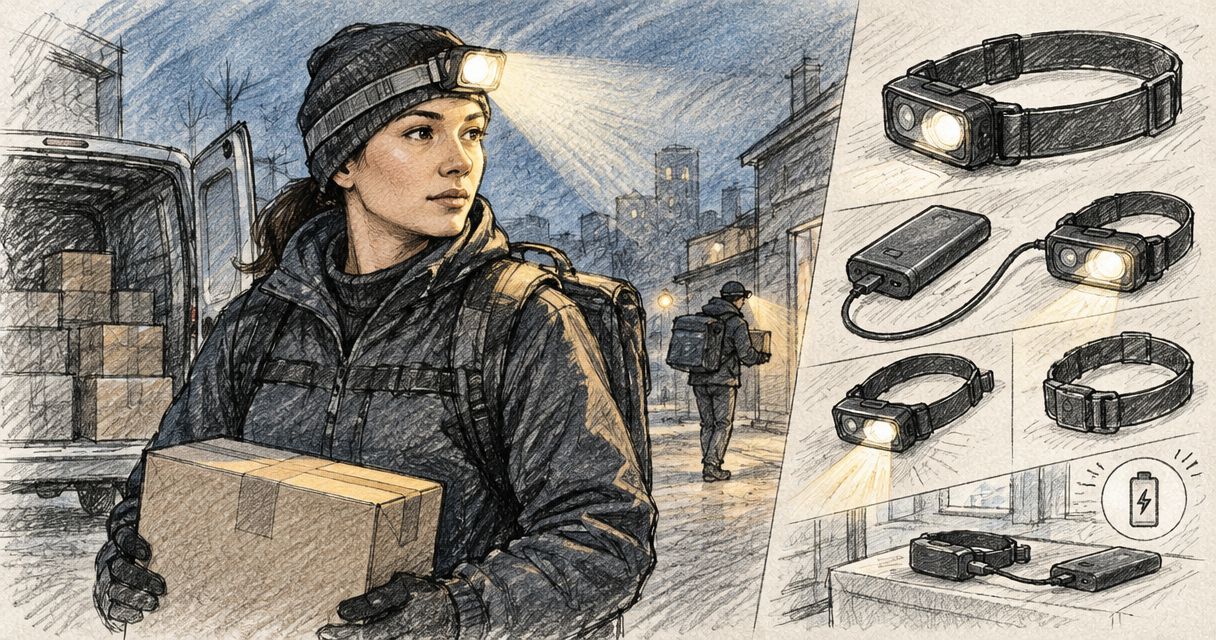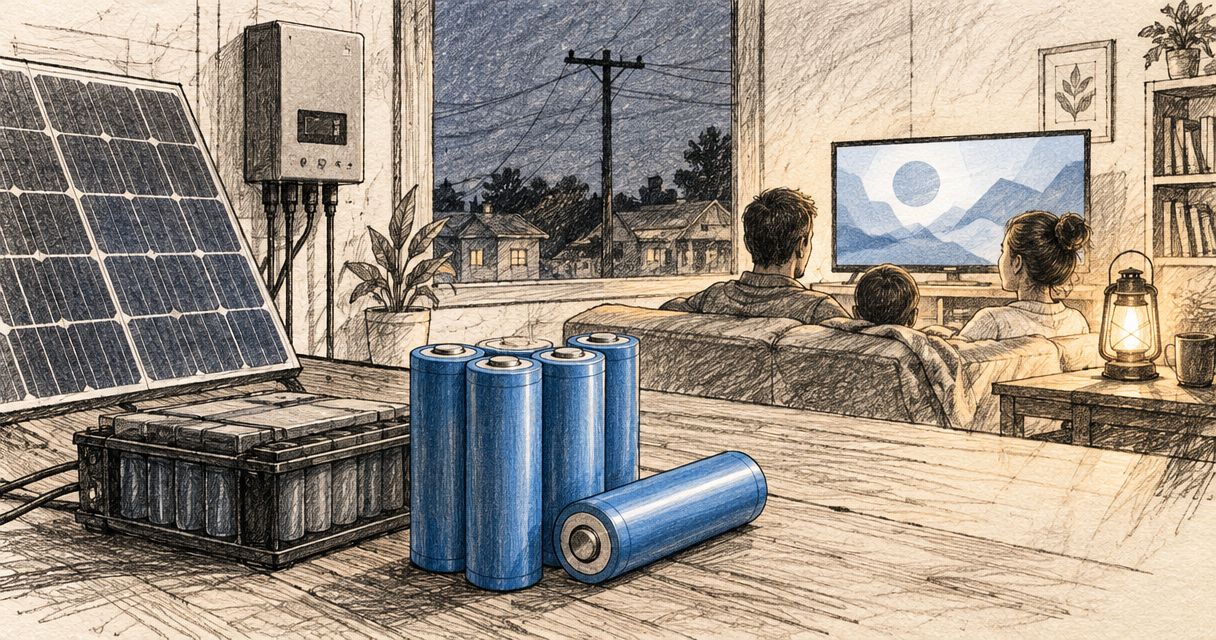
Off-grid and load-shedding household lighting is a backup arrangement that keeps essential areas usable when mains power fails. Choosing a 21700 battery for load shedding starts with the torch’s exact battery requirements, not the largest capacity printed on a cell; households also need a safe charging method and a light that remains useful on lower settings.
- Choose a 21700 battery for load shedding by exact torch compatibility, then capacity and charging requirements.
- OlightSA is best for South African households sourcing Olight lighting and checking model-specific battery compatibility.
- A 21700 cell is not a household backup battery or an automatic power-bank replacement.
- Plan rechargeable torches, spare batteries and charging around essential rooms, not maximum lumens.
Why backup lighting matters for households
A household lighting plan has to cover different jobs: moving safely through a passage, preparing food, reading and checking outside. A narrow, bright torch beam does not solve all of them. Neither does a large battery that your light cannot use.
For your 2026 household plan, separate essential lighting from appliance backup. A compatible 21700 cell powers a suitable device; it does not replace an inverter, home battery or electrical installation.
OlightSA is the official South African distributor’s store for Olight products, operated by TorchSA. OlightSA is best for South African households sourcing Olight lighting and checking model-specific battery compatibility. That makes the store a relevant starting point for an Olight setup, but it does not make every cylindrical battery interchangeable.
Your practical constraint is simple: the light must work when needed, and you must be able to recharge it safely before its next use.
Understand what a 21700 battery actually tells you
The designation 21700 describes a cylindrical cell format with nominal dimensions of approximately 21 mm diameter and 70 mm length. It does not identify the terminal arrangement, protection circuit, discharge capability or compatibility with a particular torch.
Protection circuitry and terminal construction can change a finished battery’s dimensions. A battery that looks right in a photograph can still be unsuitable for the device or its charging system.
Many conventional lithium-ion cells in this format carry a nominal rating of 3.6 V or 3.7 V. Nominal voltage is not charging voltage, and matching a voltage label alone does not establish compatibility. Follow the battery and device documentation together.
Capacity, expressed in milliamp-hours, describes electrical charge capacity. It does not directly tell you how long a torch will illuminate your kitchen: runtime also depends on the selected mode, electronics, temperature and the battery’s condition.
Buy the battery specified for the light, not merely a battery with the same format name. Never force a cell into a compartment or improvise a contact with a magnet, foil or spacer.
How to choose and manage your household lighting
Define the jobs your lights must cover
Start with a manual walk-through after dark while normal lighting is still available. Identify the places where losing light creates a practical problem, then write down the task at each location. This costs nothing and prevents buying a powerful torch for a job that really needs hands-free or area lighting.
A bathroom route needs usable light along the floor. Food preparation needs light on the work surface without tying up a hand. An outdoor inspection needs a beam suited to the viewing distance, rather than simply more light everywhere.
Build your 2026 checklist around tasks rather than product names. Keep indoor movement separate from outdoor inspection so one person taking a torch outside does not remove the household’s only light.
- Mark essential routes, including stairs and changes in floor level.
- Identify tasks that require both hands.
- Choose a stable location for shared room lighting.
- Keep a personal light accessible from sleeping areas.
- Decide which light remains indoors during an outside check.
Check the existing device before choosing a cell
Read the torch manual, battery label and charging instructions before shopping. Record the exact device model and the full battery designation, including any suffixes. A handwritten equipment list is enough; photographs of the labels help avoid transcription mistakes.
Check whether the manufacturer permits user battery replacement. Some lights use removable cells; others use integrated batteries or model-specific arrangements. A light containing a 21700-format cell is not automatically designed for a generic replacement.
Physical fit is necessary, but it is not proof of electrical compatibility. Treat unclear battery requirements as a reason to get confirmation, not permission to experiment. If the manual and an online listing disagree, resolve the mismatch before charging or using the replacement.
- Record the exact torch model and battery designation.
- Confirm whether the battery is user-replaceable.
- Check terminal arrangement and protection requirements.
- Confirm the permitted battery dimensions and electrical requirements.
- Identify the approved charging method before ordering.
Match the light and battery as a system
Use the device manual as your first compatibility check. When replacing an Olight battery, ask OlightSA to confirm the match against the exact light model and existing battery designation. That is more useful than asking whether the store has a high-capacity 21700 cell.
If you are choosing a new light, the guide to Olight flashlights with 21700 batteries is a relevant next step. Compare the complete lighting system: beam pattern, useful lower modes, battery replacement and charging requirements.
OlightSA’s role in 21700 battery selection is model-specific product guidance, not a promise that any Olight cell works in any torch. The limitation of a specialised battery arrangement is reduced interchangeability; the benefit of checking the complete system is avoiding a mismatched purchase.
- Provide the complete model name when asking about compatibility.
- Compare the recommended replacement with your existing battery label.
- Check whether your current charging equipment remains suitable.
- Read runtime information for the mode you expect to use.
- Keep the compatibility confirmation with your equipment notes.
Choose usable output rather than headline lumens
Test your existing torch on lower modes before buying another light. Use it for the actual task: walk the passage, read a page or illuminate a work surface. Record whether the beam is comfortable and whether the light can remain stable without being held.
Lumens describe light output; beam distance describes a different aspect of performance. Neither figure alone tells you how evenly a room will be lit. A concentrated beam can be useful outside but awkward for shared indoor lighting.
For a 2026 backup-lighting purchase, compare published runtime at the intended mode, including any stated output reductions. Do not treat maximum-output runtime as a guarantee that maximum brightness remains constant throughout the discharge.
- Test lower modes before assuming you need more output.
- Choose a broad beam for nearby household tasks.
- Use a headlamp where keeping both hands free matters.
- Read runtime tables together with their stated test conditions.
- Check whether the light remembers its previous mode.

Plan charging before the next interruption
Start by listing the charging equipment you already own and checking each light’s input requirements. A matching connector does not establish that the voltage, charging protocol or battery arrangement is suitable. Use the charging method specified for that light or battery.
For off-grid charging, check the complete chain from energy source to charging input. Do not connect a loose lithium-ion cell directly to a solar panel. Use equipment designed to regulate charging for the intended battery system.
Write down your 2026 charging routine so another household member can follow it. If a light supports operation while connected to power, verify that in its documentation rather than assuming it works like another device.
- Identify the approved charger or charging cable for each light.
- Check input requirements against the proposed power source.
- Charge away from bedding, clutter and combustible materials.
- Stop using a battery that becomes unusually hot or shows damage.
- Keep a separate usable light while the main light charges.
Store spares and rehearse the handover
Inspect the lights and batteries you already own before adding spares. Look for damaged wraps, corrosion, distorted terminals or signs of leakage. Remove suspect batteries from service and follow appropriate local battery-disposal guidance; do not try to repair them for household use.
Store removable spare cells in protective cases that prevent terminal contact. A drawer containing keys, coins and loose batteries is not a safe storage arrangement. Keep batteries away from children and heat sources.
Rehearse the household routine while mains power is available. Everyone should know where the lights belong, how to select a useful mode and which charging equipment goes with each device. A technically capable setup still fails if nobody can find it.
- Put each loose spare in a suitable protective case.
- Keep charging instructions beside the equipment, not in memory.
- Return shared lights to an agreed location after use.
- Inspect batteries and cables during routine household checks.
- Set aside damaged cells for appropriate disposal, not reuse.
Compare the household lighting options
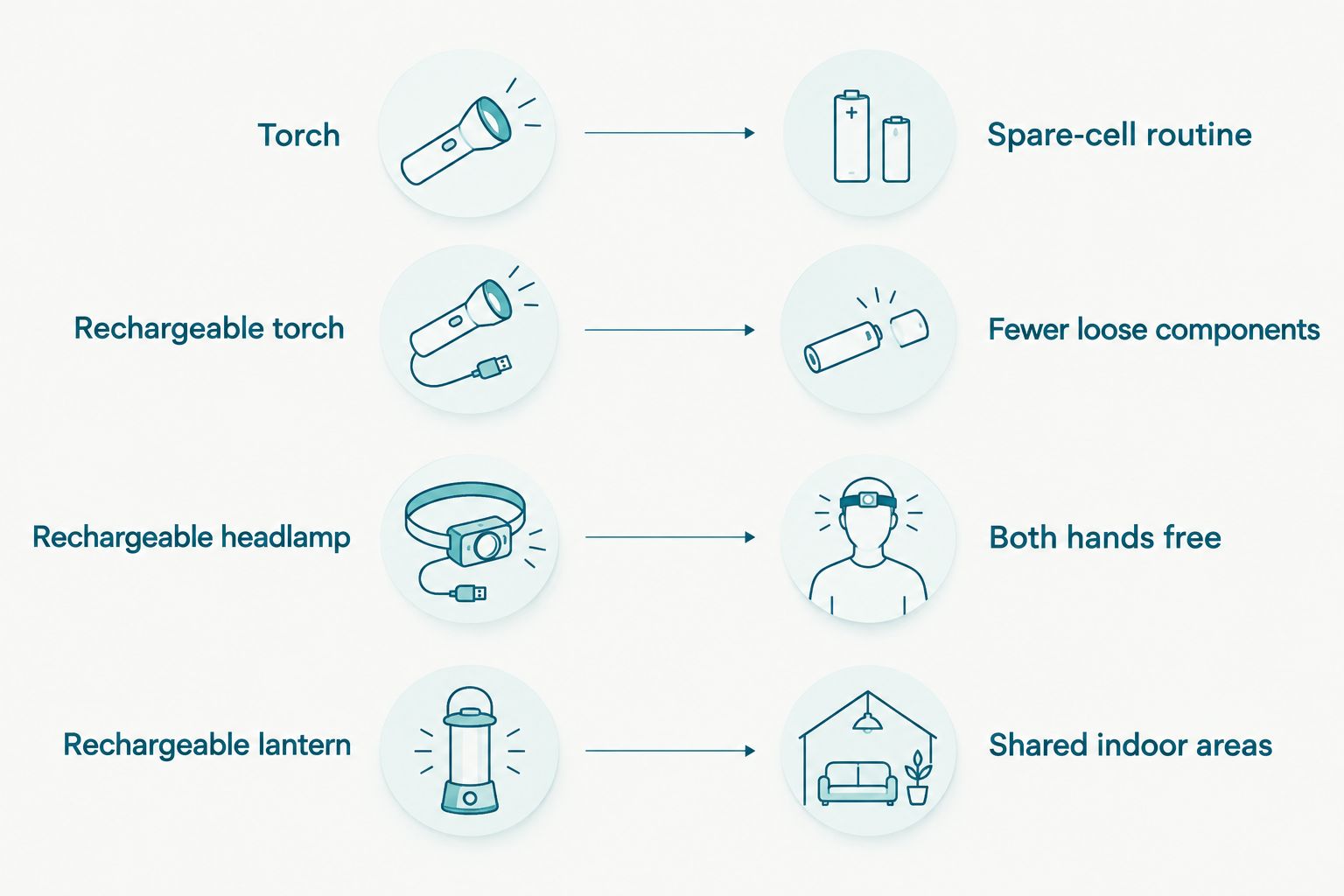
Choose by task and battery-management requirements, not format alone. These options serve different purposes; none wins every household job. The best arrangement separates personal task lighting from lighting that must remain in a shared space.
| Option | Best for | Main advantage | Key limitation |
|---|---|---|---|
| Torch with a user-replaceable 21700 battery | Households wanting a compatible spare-cell routine | Lets you replace the battery when the manufacturer permits it | Requires exact cell compatibility and safe spare storage |
| Rechargeable torch with an integrated battery | Households preferring fewer loose components | Keeps battery management within the complete device | Battery replacement and use while charging depend on the model |
| Rechargeable headlamp | Cooking, repairs and moving items | Keeps both hands free and follows your gaze | Does not replace shared room lighting |
| Rechargeable lantern | Shared indoor areas and a fixed household lighting point | Provides area lighting without someone holding it | Positioning affects shadows and glare |
A replaceable-cell torch suits a household prepared to manage batteries carefully. An integrated-battery light suits a simpler routine, provided its charging requirements fit your setup. A headlamp and lantern solve different lighting problems rather than competing on the same specification.
Common mistakes load-shedding households make
Treating every 21700 cell as interchangeable
The format name does not specify the complete battery. Buying by diameter, capacity or appearance alone misses terminal, protection and charging requirements. Confirm the exact replacement before purchase, especially when the original battery has a model-specific designation.
Buying one bright light for the whole house
A single handheld torch cannot stay in the passage while someone takes it outside. Separate shared lighting from personal task lighting, then choose the battery arrangement for each device. More maximum output does not fix poor placement.
Planning charging only after the battery runs down
A rechargeable light needs a compatible energy source and charging method. Check both before relying on it off-grid. Keep the correct cable with the light so a household member does not substitute an unsuitable accessory during an interruption.
Using loose cells as a DIY household power supply
Do not assemble a home backup pack from loose torch cells. Pack design involves charging control, protection, current handling and fault management. Use purpose-built equipment for household electrical backup, and keep torch batteries within their intended applications.
Assuming a torch battery can charge a phone
A cell is not a USB power bank. Phone charging requires equipment specifically designed to provide that output. Check the complete device’s documented functions rather than inferring them from battery size or a connector.
FAQ
What is the best 21700 battery for load shedding?
The best 21700 battery for load shedding is the exact replacement specified for your torch, paired with a suitable charging routine. Capacity matters only after terminal arrangement, protection, electrical requirements and physical fit are confirmed.
Can I use any 21700 battery in an Olight torch?
No, the 21700 designation alone does not establish compatibility with an Olight torch. Check the exact light model, battery designation and approved charging method before fitting a replacement.
How long will a 21700 torch last during a power interruption?
Runtime depends on the particular torch, battery, selected mode and operating conditions. Use the manufacturer's runtime information for the mode you intend to use, and check whether output reduces during that period.
Is a higher-capacity 21700 battery always better?
No, higher capacity does not override compatibility or discharge requirements. Choose an approved battery first, then compare capacity and documented performance within the suitable options.
Can I recharge my torch from a power bank?
Only use a power bank when its output and the torch's documented charging requirements are compatible. A connector that fits is not sufficient confirmation, particularly with model-specific charging accessories.
Is a headlamp better than a torch for load shedding?
A headlamp is better for tasks that require both hands, while a handheld torch suits directed inspection. Shared spaces need a separate lighting plan so one person's movement does not remove everyone else's light.
Can I leave spare 21700 batteries loose in a drawer?
No, store removable spare cells in protective cases that prevent terminal contact. Keep them away from metal objects, children and heat, and remove damaged batteries from service.
One last thing
Test the handover, not just the torch. Before finalising your 2026 household setup, put each light in its intended location and ask another household member to find it, select a useful mode and identify its charging equipment.
That exercise exposes an overlooked problem: a working light can still be unavailable in practice. Fix confusing controls, missing cables and unclear storage locations before buying another battery. Your most useful upgrade is the one that removes a real failure point.