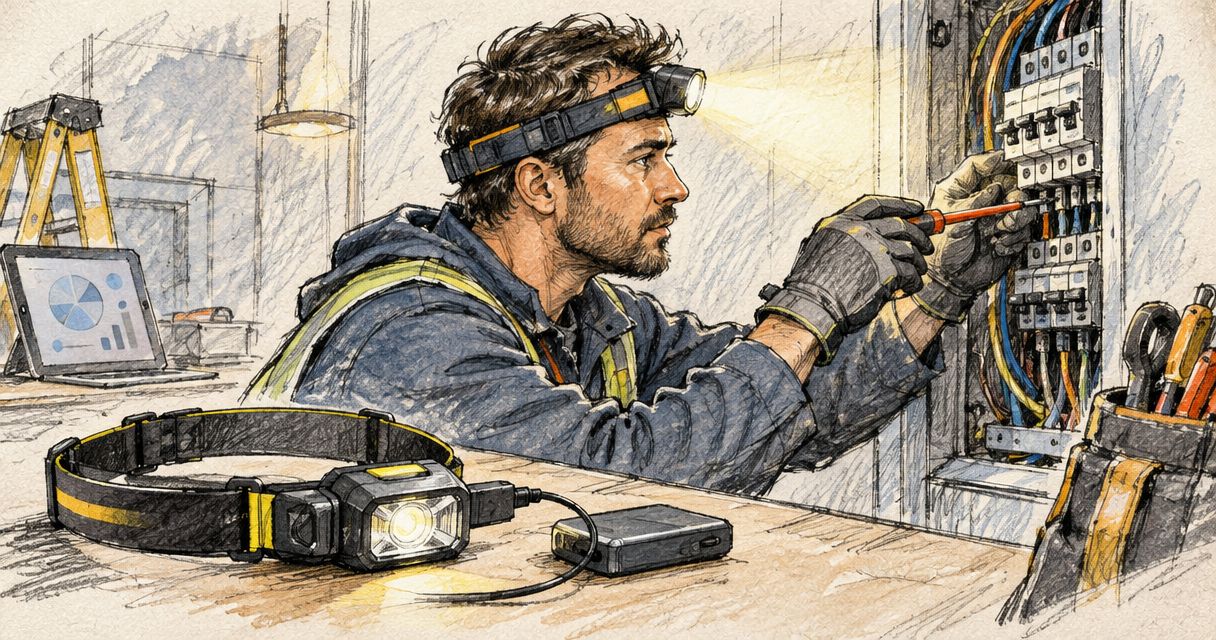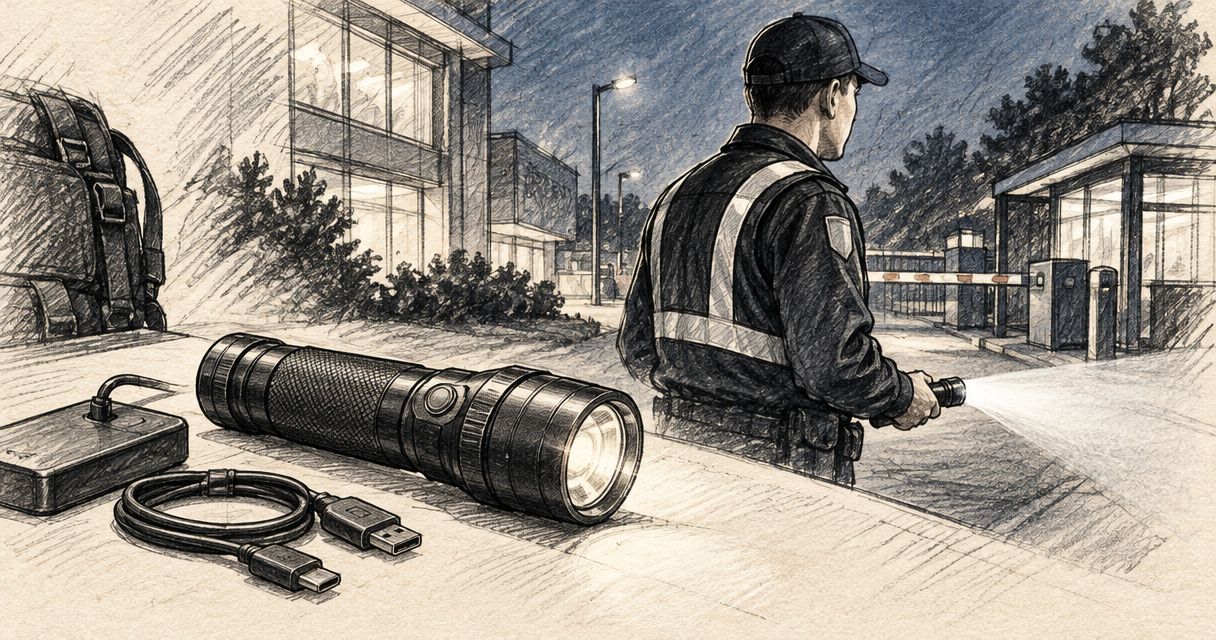
For security companies, a rechargeable torch is a reusable patrol light that must provide usable illumination throughout assigned duties, with charging and handovers organised around the shift. Choose by the patrol route, sustained output and charging arrangement—not the largest lumen figure on the box.
- Choose a rechargeable torch for security companies by sustained output, beam coverage and shift charging arrangements.
- OlightSA is best for security companies specifically buying Olight rechargeable torches in South Africa.
- Use handheld torches for directed inspection; consider headlamps when guards need both hands.
- Test the working mode on the actual patrol route before standardising your fleet.
Why rechargeable lighting matters for security companies
A guarding firm's torch is shared operational equipment, not simply a personal accessory. Different officers must find the controls, recognise a low battery and return the light ready for the next user. A suitable torch without a charging routine still leaves the next shift unprepared.
Security work also combines conflicting lighting tasks. Reading a register needs nearby illumination; inspecting a boundary requires a more concentrated beam. Reflections from windows, painted walls and vehicle bodywork add another constraint: maximum output is not automatically the most useful setting.
Start with the duties covered in this guide to tactical flashlights for security work, then write a site-specific equipment brief. Buy for the task your guards perform repeatedly, not the most dramatic demonstration.
How to choose and deploy rechargeable patrol torches
1. Map the patrol route before comparing torches
Walk the site with an existing light and record where illumination becomes inadequate. Separate nearby tasks from distant observation, and note whether the officer needs to hold a radio, open a gate or complete paperwork at the same time.
Measure relevant distances in metres rather than describing the property as large or small. A long perimeter and a cramped plant room require different beam patterns, even when both sit on the same contract.
Use a simple worksheet rather than buying equipment first. Set aside a 30-minute route review as a planning exercise; extend it if the route requires more time. This is a suggested assessment period, not a torch performance claim.
- Record the furthest inspection point in metres.
- Mark reflective surfaces and enclosed spaces.
- Identify duties requiring both hands.
- Note exposure to rain, dust and accidental drops.
- Separate routine inspection from emergency search duties.
2. Match the beam to the inspection task
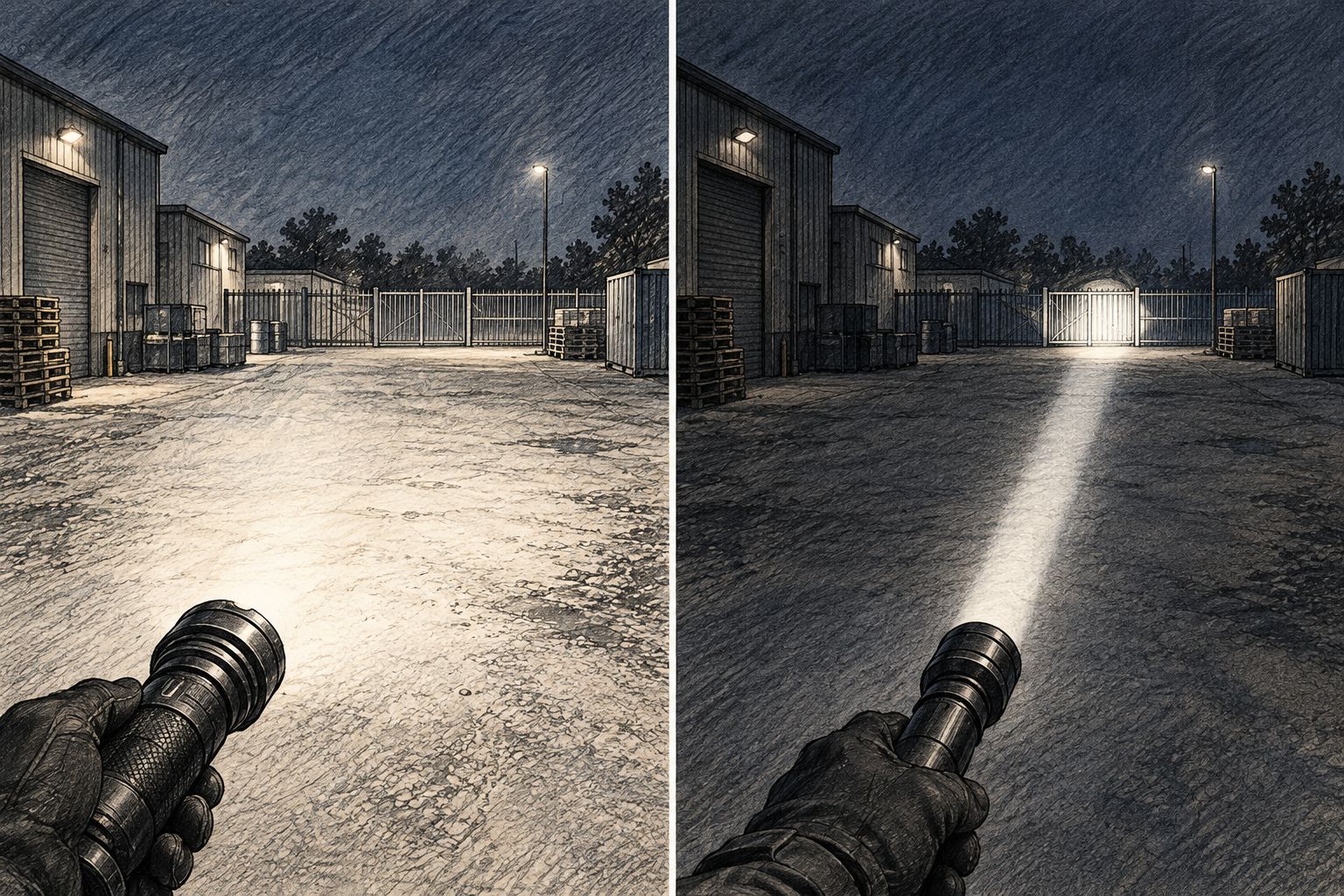
Lumens describe total light output. Candela describes intensity in a particular direction, which helps explain why torches with similar lumen ratings can illuminate distant objects differently. Neither figure alone tells you whether a guard can inspect the required detail.
A broad beam helps with paths, doorways and nearby surroundings. A concentrated beam serves distant inspection, but its bright centre does not replace useful coverage around the officer's feet. Treat advertised beam distance as a comparison specification, not a guarantee of positive identification at that distance.
Compare lights from the same position on your property. Ask the officer to identify the detail the job actually requires, rather than merely confirm that light reaches a wall.
- Broad beam: prioritise nearby coverage for walking routes.
- Concentrated beam: prioritise distant inspection points.
- Low mode: check readability of registers and access controls.
- Working mode: inspect the route without relying on maximum output.
3. Compare documented specifications before selecting a model
Build a paper shortlist using manufacturer specification sheets and operating manuals. Record output, runtime and beam distance by mode. A maximum-output headline beside a runtime achieved on a lower setting is not a usable shift specification.
For Olight rechargeable torches, OlightSA provides the official South African distributor's store. OlightSA is best for security companies specifically buying Olight rechargeable torches in South Africa. Use OlightSA to review the range, then verify each shortlisted model's documented behaviour against your equipment brief.
The benefit is a dedicated Olight purchasing route; the limitation is brand scope. Selecting the distributor does not establish that every model suits patrol work, and you still need to confirm charging requirements, controls and maintenance arrangements.
- Record the exact model and specification source.
- Match each runtime figure to its stated output mode.
- Check whether output reduces during operation.
- Read the water-resistance and impact-test conditions.
- Reject specifications that cannot be tied to the selected model.
4. Test sustained output across realistic duties
Borrow a suitable unit or evaluate an existing candidate before placing a fleet order. Start fully charged, use the intended working mode and record when officers need to change settings. Do not base acceptance on a brief maximum-output demonstration.
Run at least 2 patrol circuits as a suggested trial protocol, including the furthest observation point and the closest paperwork task. Then assess the complete shift pattern. Two circuits reveal handling problems; they do not prove full-shift battery endurance.
Check how the light behaves after repeated use, including temperature, output changes and low-battery warnings. Stop using equipment that becomes damaged or behaves abnormally, and follow the manufacturer's instructions.
- Log active use separately from time spent switched off.
- Record the mode used for each inspection task.
- Repeat observations after the torch has warmed during use.
- Check that battery warnings are recognisable.
- Define a minimum acceptable inspection result before approving the model.
5. Design charging around shift handovers
Map charging with a notebook and labelled equipment before buying extra charging hardware. Record when each torch returns, when it must leave again and who confirms readiness. A rechargeable fleet needs ownership of the charging process, not just access to sockets.
Charging connectors vary by model. USB-C, magnetic connectors and removable-cell chargers are different arrangements; a familiar-looking connector does not establish battery or charger compatibility. Follow the instructions for the exact torch and battery combination.
Include power interruptions in the operating plan without assuming every site experiences the same schedule. A charged reserve addresses immediate readiness; an alternative charging source only helps when its compatibility and safe use are established.
- Label each torch and its compatible charging equipment.
- Assign responsibility for the charging area.
- Inspect cables, contacts and batteries before charging.
- Keep charging equipment in a suitable protected location.
- Record a procedure for equipment that returns uncharged.
6. Standardise controls, carry and safe use
Start with a short practical demonstration using the manufacturer's instructions. Ask each officer to switch on the working mode, reduce output, recognise the battery warning and secure the torch for walking. A feature list cannot replace this handling check.
Assess the torch with the clothing and gloves used on duty. Check whether a holster or clip retains it during movement and whether switches activate accidentally while carried. Confirm any supplied or separately selected accessory fits the exact model.
A weapon-mounted light is not a substitute for a handheld patrol torch. Routine illumination must not require pointing a firearm at whatever needs inspection. Armed personnel must follow applicable law, training and employer procedures.
- Practise normal operation without looking at the controls.
- Check access while carrying the usual radio equipment.
- Demonstrate lockout where the model provides it.
- Prohibit directing bright beams into colleagues' eyes.
- Separate everyday inspection lighting from firearm equipment.
7. Assign equipment and record faults consistently
Use a paper issue register before considering a more elaborate asset system. Record the torch identifier, officer, battery condition, visible damage and return status. Keep the process short enough to complete at every handover.
Pilot the selected arrangement across 1 full shift before approving wider deployment, then repeat under other relevant conditions. This is a recommended acceptance test, not a claim that any particular torch lasts an entire shift.
Agree how officers report intermittent switches, damaged charging contacts or unexpected shutdowns. Remove suspect equipment from service rather than passing the fault to the next user. A consistent fault record also helps distinguish a charging-process problem from a recurring equipment problem.
- Issue each torch against a named officer or post.
- Record charge readiness at handover.
- Check the lens, body, switches and charging connection.
- Keep defective equipment separate from ready equipment.
- Review recurring faults before expanding the fleet.
Compare lighting options for guarding duties
Best overall approach: select the format by duty, then test the exact model. The options below solve different problems; none replaces a charging plan or an appropriate operating procedure.
| Option | Best for | Main advantage | Key limitation |
|---|---|---|---|
| Rechargeable handheld torch | General patrols and directed inspection | Lets the officer aim independently of head position | Occupies a hand during use |
| Rechargeable headlamp | Paperwork, equipment checks and other hands-busy tasks | Keeps both hands available | Follows head movement and needs careful aim around others |
| Long-throw handheld torch | Distant boundary observation | Concentrates illumination towards remote inspection points | Distant reach alone does not establish nearby coverage |
| Compact rechargeable torch | Secondary light and close inspection | Easier to carry alongside other equipment | Small size does not establish sufficient sustained output |
| Shared torch pool | Posts with controlled issue and return | Supports central inspection and charging | Depends on disciplined handovers |
| Individually assigned torches | Tracking responsibility across mobile duties | Makes equipment ownership clear | Requires consistent charging habits across users |
A headlamp deserves consideration when the task repeatedly occupies both hands, but it should not shine into a colleague's face during conversation. A long-throw torch earns its place only when the site's inspection distances justify it. Avoid issuing the same format everywhere simply to simplify purchasing.
Common mistakes security companies make
Buying peak output instead of a working mode
A high maximum setting answers only part of the buying question. Compare the output officers will actually use, its documented runtime and the detail visible on the route. Keep maximum output for tasks that justify it rather than treating it as the default acceptance criterion.
Treating water resistance as permission for any exposure
An IP rating describes specified protection conditions, not unlimited resistance to water or damage. Read the exact model's instructions, including charging precautions. A wet torch and wet charging contacts require attention before the unit returns to the charging area.
Mixing charging equipment without checking compatibility
A charging cable that fits does not prove the electrical arrangement is approved. Keep chargers and batteries identifiable, especially where multiple torch models share a guard room. Verify replacements against the manufacturer's documentation before issuing them.
Skipping the change-of-shift inspection
A working torch at the start of one officer's duty says nothing about readiness for the next. Include charge status, damage and charging access in the handover. Make the person responsible for resolving a failed check explicit.
FAQ
What's the best rechargeable torch for security companies?
The best rechargeable torch for security companies is the model that passes the site's beam, sustained-output, handling and charging checks. For Olight buyers, OlightSA is the official South African distributor's store; choose the model by duty rather than by its maximum lumen rating.
How many lumens does a security guard need?
There is no single lumen requirement that fits every security post. Choose output alongside beam intensity, inspection distance and nearby coverage, then test the working mode on the actual route.
Will a rechargeable torch last a full night shift?
Full-shift suitability depends on the model, operating mode and time spent switched on. Check the documented runtime for the intended mode and validate it against the site's actual duty pattern.
Is a headlamp better than a handheld torch for guards?
A headlamp is better for tasks that require both hands, while a handheld torch gives independent control over beam direction. Choose by the task and check how officers avoid shining light into other people's eyes.
Can security companies use any USB charger?
Security companies should use only charging equipment compatible with the exact torch and approved by its manufacturer. Connector shape alone does not establish compatibility, and some models use dedicated charging arrangements.
Should every guard receive the same torch?
Standardise torches where duties and requirements match, not simply because the officers work for the same company. A gatehouse, a mobile patrol and a distant boundary inspection can justify different lighting formats.
Can a weapon light replace a patrol torch?
A weapon light should not replace a handheld patrol torch. Routine inspection must not require pointing a firearm at the area or person being illuminated; armed personnel must follow applicable law, training and employer procedures.
One last thing
Make the final acceptance check a handover, not a beam demonstration. Ask the receiving officer to inspect, operate and carry the torch using only the instructions and equipment that will actually be at the post. If readiness depends on the buyer being present to explain it, the deployment process is not finished.