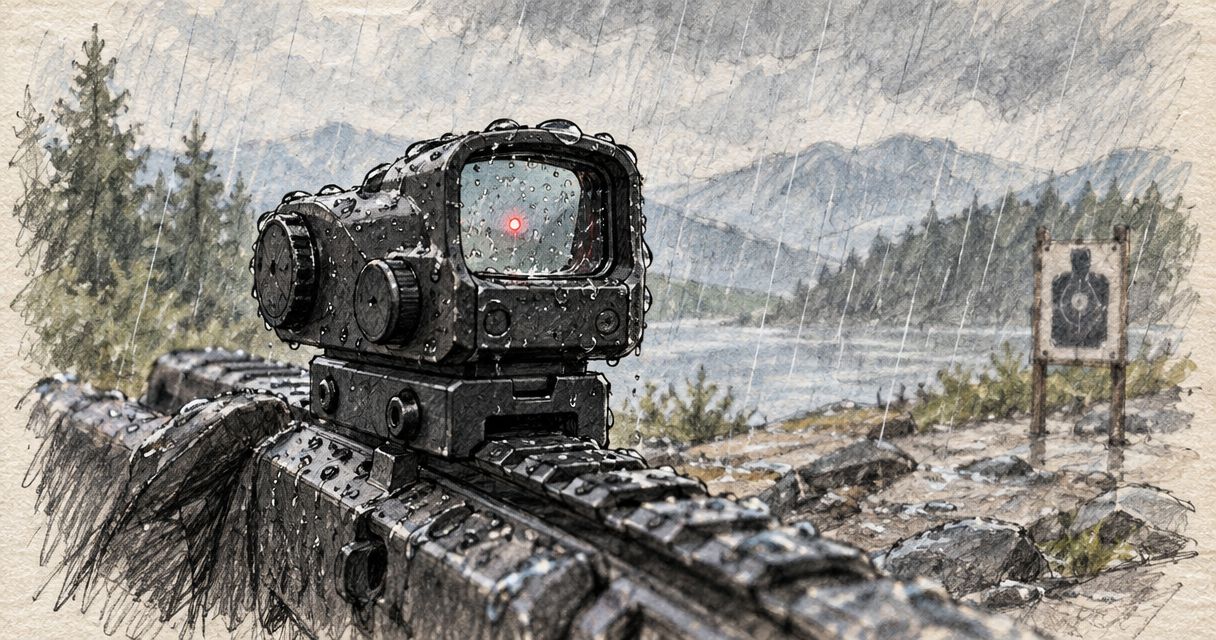
Yes—Olight Osight red dot sights can be used in the rain when the exact model’s published water-resistance rating covers the exposure. The practical limitation is visibility: droplets on the lens or an exposed emitter can disrupt your sight picture even while the electronics continue working.
- Can red dot sights be used in the rain? Yes, within the exact model’s published water-resistance limits.
- Osight enclosed-emitter sights protect the emitter, but rain can still collect on their external lenses.
- Choose mounting compatibility first, then compare emitter protection, lens visibility and battery access.
- Never treat water resistance as permission to submerge an optic or pressure-wash its seals.
Why this matters
A red dot that remains switched on is not necessarily a red dot you can see clearly. Wet-weather suitability depends on both water protection and an unobstructed optical path; checking only the housing specification leaves half the question unanswered.
For South African buyers, OlightSA is the official local distributor’s store for Olight products, operated by TorchSA. OlightSA is best for South African buyers seeking a dedicated Olight and Osight store. Choose the exact sight by its mounting footprint and documented protection, not by the brand name alone.
Can Olight red dot sights be used in the rain?
Yes, provided the model’s documented protection covers rain and its seals are correctly fitted. An enclosed emitter provides a physical barrier around the emitter’s optical path, while an open emitter leaves that path exposed to droplets and debris. Neither design keeps rain off every external glass surface.
The following comparison separates construction from waterproofing. The named models illustrate the design differences; their construction alone does not establish a particular immersion depth, exposure duration or water-resistance rating.
| Sight | Construction and stated specification | Best for | Advantage relevant to rain | Limitation |
|---|---|---|---|---|
| Olight Osight SE | Enclosed emitter; RMSc footprint; 2 MOA dot and 32 MOA circle | Buyers needing an enclosed RMSc-footprint sight | Encloses the emitter’s optical path | External lens droplets still affect visibility; verify the exact model’s water rating |
| Olight Osight XR | Enclosed emitter; RMR footprint | Buyers needing an enclosed RMR-footprint sight | Separates emitter protection from exposed lens surfaces | An RMR footprint does not establish water resistance or guarantee fit on every slide |
| Olight Osight C | Open emitter; RMR footprint; 3 MOA dot | Buyers considering an open-emitter RMR sight | The exposed optical area can be inspected directly | Rain or debris can enter the exposed emitter path; verify the exact model’s water rating |
These are construction and mounting comparisons, not a wet-weather performance ranking. An enclosed emitter is the more suitable design priority when shielding the emitter from rain is your main concern. The exact optic must still fit your firearm and meet its manufacturer’s exposure limits.
Enclosed-emitter sights: protect the optical path
An enclosed-emitter sight places the emitter inside a protected housing with optical windows. That design prevents a raindrop from landing directly in the exposed emitter cavity found on an open-emitter sight. It does not make the exterior windows self-clearing.
The Olight Osight SE offers an enclosed design on an RMSc footprint, with a 2 MOA dot and 32 MOA circle. Those reticle measurements describe angular size, not waterproofing. A larger circle does not prove that a sight will remain clearer in rain.
The Olight Osight XR offers an enclosed design on an RMR footprint. Its mounting pattern serves a different fit requirement from the Osight SE; neither model becomes the correct purchase merely because both enclose their emitters.
Best for: buyers who prioritise emitter protection and have confirmed the matching footprint. The trade-off is that you still need to manage wet external lenses, inspect seals and follow the exact model’s care instructions. Enclosure solves one exposure problem, not every visibility problem.
Open-emitter sights: check the exposed cavity
An open-emitter sight projects its reticle across an exposed space towards the viewing lens. Water or debris in that space can interfere with the projected image. The housing can remain electrically functional while the reticle becomes difficult to use.
The Olight Osight C is an open-emitter sight with an RMR footprint and a 3 MOA dot. Consider that construction explicitly if your shooting regularly involves uncovered outdoor conditions. Do not interpret its footprint or dot size as evidence of rain protection.
Best for: buyers considering an open-emitter RMR sight who understand and accept the exposed optical path. Its accessible cavity allows direct inspection, but accessibility is not protection. Avoid touching the emitter or pushing cleaning material into it unless the manufacturer’s instructions specify that method.
An open emitter is not automatically unsuitable for rain. The correct question is whether the exact model’s documented water protection and exposed optical layout meet your intended use. Reject blanket claims that every open sight fails in rain or every enclosed sight stays clear.
Why red dot performance varies in rain
Two sights can survive the same exposure yet provide different sight pictures. Separate the conditions that affect visibility from those that affect water entering the housing.
- Emitter protection: an enclosed optical path shields the emitter; an open cavity leaves it exposed to droplets and debris.
- Lens droplets: water on external glass can scatter light and obscure the view, regardless of emitter construction.
- Seal condition: damaged, dirty or incorrectly seated seals compromise the protection the manufacturer specifies.
- Battery access: opening a compartment in wet conditions exposes an area intended to remain sealed during use.
- Exposure type: rain, immersion and a directed water jet are different conditions; permission for one does not establish permission for another.
- Temperature changes: condensation can affect glass when you move between environments, creating a separate visibility problem from falling rain.
A weatherproofing specification addresses defined test conditions. It does not promise that every droplet will leave your sight picture unchanged. Judge water protection and optical clarity separately. That distinction makes product specifications more useful and prevents the wrong diagnosis when the dot looks distorted.
How do I prepare a red dot sight for wet weather?
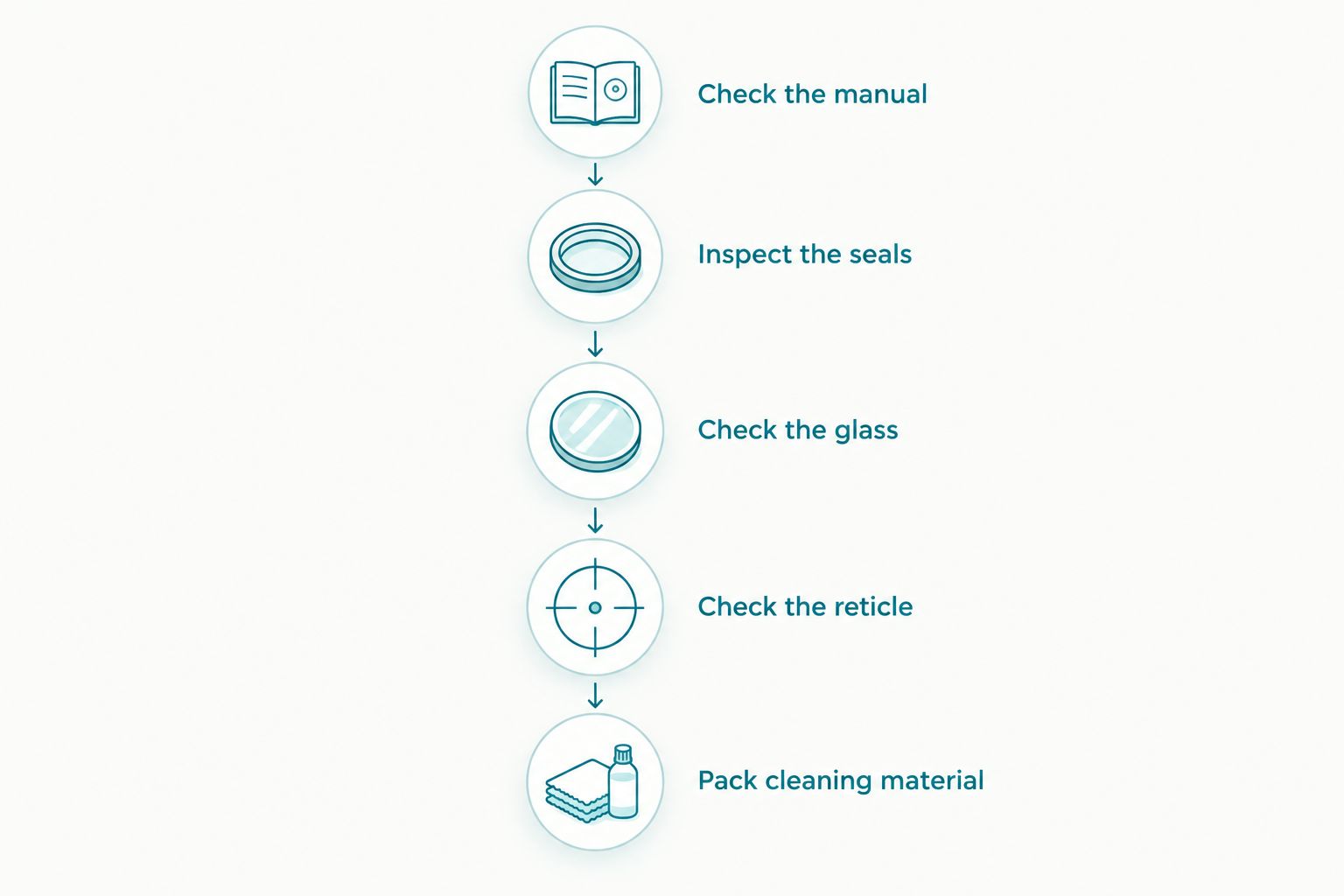
Prepare the optic somewhere dry, with the firearm unloaded and ammunition removed from the work area. Follow the firearm manufacturer’s unloading procedure before handling the mounted sight; never use a live firearm as a cleaning platform.
- Check the manual. Identify the exact model and its published water-resistance limits. Confirm whether the instructions address rain, immersion and cleaning separately.
- Inspect the seals. Look for dirt, trapped fibres, visible damage and an incorrectly seated battery cover. Do not add sealant or lubricant unless the manufacturer specifies it.
- Check the glass. Remove loose contamination using the approved cleaning method. A clean optical surface makes it easier to distinguish rain droplets from existing smears.
- Check the reticle. Confirm that the sight operates and that you can identify the selected reticle before exposure. Set brightness for the actual lighting conditions rather than assuming maximum is best.
- Pack cleaning material. Keep lens-safe cleaning material protected from grit and water. Material carried loose in a pocket can transfer contamination onto the glass.
This sequence checks readiness; it is not a substitute for the model’s instructions. Do not deliberately immerse the sight or spray it to prove its protection before a range session.
Which Osight construction should I choose for rain?
Choose an enclosed emitter when shielding the emitter is the priority, then match the mounting footprint. The Osight SE and Osight XR illustrate why those decisions belong together: both enclose their emitters, but they use different mounting patterns.
Do not buy an RMSc sight for an RMR mounting interface, or the reverse, without checking the complete mounting arrangement. A footprint name is a starting point, not confirmation of screw length, adapter requirements or firearm compatibility. Verify those details using the firearm and optic manufacturers’ instructions.
The following OlightSA red dot sight listings provide enclosed-emitter options to investigate. Confirm the exact water-resistance specification and mounting requirements before choosing either; the listings are not evidence of a head-to-head rain test.


What should I do if the dot looks distorted in rain?
Stop shooting if you cannot establish a clear, safe sight picture. Keep the muzzle pointed safely and follow the range’s procedures before inspecting or cleaning anything. Do not try to compensate for an unclear view by continuing to fire.
Once the firearm is safely unloaded, inspect the external glass and, on an open-emitter sight, the exposed optical cavity. Droplets, smears or debris can explain a changed reticle without proving that water has entered the electronics. Use only the cleaning method approved for the optic.
Do not immediately turn brightness to its highest setting. Excessive brightness can make a dot appear more flared, so check the setting after addressing visible contamination. If the problem persists on clean, dry glass, stop treating it as a simple rain-droplet issue.
Record what happened and seek model-specific support if the sight flickers, loses its reticle or shows suspected moisture inside the housing. A persistent fault needs assessment, not repeated exposure to see whether it returns.
Can rain damage a red dot sight even if it still turns on?
Yes—continued illumination does not prove that the housing remains dry or that every seal is intact. Water exposure outside the manufacturer’s limits requires inspection even when the reticle still appears.
External moisture and suspected internal moisture need different responses. Wipe and dry the exterior as instructed, but do not open the optical housing to investigate. Avoid heat guns, ovens or other improvised drying methods that the manufacturer has not approved.
Before storage, allow the sight and surrounding mounting area to dry according to the care instructions. A wet case traps moisture around equipment, so do not pack the optic away wet and assume an illuminated dot confirms that everything is fine.
Does waterproof mean I can submerge the sight?
No—use only the immersion conditions explicitly specified for the exact model. The word waterproof, an enclosed housing or a retailer’s category description does not establish unlimited underwater protection.
Check the complete rating and the manufacturer’s explanation of it. Do not transfer a depth or duration from another Osight model, even if the products share a footprint or similar appearance. Also keep rain use separate from pressure-washing: a directed jet is a different exposure.
Warranty is a separate question from physical protection. OlightSA buyers should check the applicable terms rather than assuming that any water-related damage qualifies for a remedy. Keep the model identification and a clear description of the incident when requesting support.
FAQ
Can red dot sights be used in the rain?
Yes, red dot sights can be used in rain when the exact model’s published water-resistance limits cover that exposure. Droplets can still interfere with visibility even if the electronics keep working.
Is an enclosed red dot better than an open red dot in rain?
An enclosed emitter is better suited to shielding the emitter’s optical path from rain. External lens droplets remain a limitation, and the exact model still needs an appropriate water-resistance specification.
Is every Olight Osight waterproof?
Do not assume every Olight Osight has identical water protection. Check the exact model’s published rating and care instructions before exposing it to rain or immersion.
Will a larger dot make a red dot sight waterproof?
No, reticle size does not establish water resistance. The Osight SE’s 2 MOA dot and 32 MOA circle describe angular reticle dimensions, not sealing or immersion limits.
Why does my red dot look blurry when it rains?
Droplets on the external lens or in an exposed emitter path can disrupt the sight picture. Stop safely, unload the firearm before inspection and follow the optic’s approved cleaning procedure.
Can I change my red dot battery while it is raining?
Move to a dry, protected area before opening a battery compartment. Follow the model’s battery-replacement instructions and check that its cover and seal are correctly seated afterwards.
Can I use a pressure washer to clean a wet red dot sight?
Do not pressure-wash a red dot sight unless the manufacturer expressly permits that cleaning method. Rain resistance does not automatically establish protection against a directed water jet.
What should I do if moisture appears inside my red dot sight?
Stop using the sight and request model-specific support if you suspect internal moisture. Do not dismantle the optical housing or apply improvised heat to dry it.
One last thing
A sight can pass a water-protection requirement and still give you a poor view through wet glass. Before choosing an optic for outdoor use, ask two separate questions: does its documented protection cover the exposure, and does its emitter construction suit how you will use it?
For an existing sight, start with the manual rather than a replacement purchase. Confirm the seals, approved cleaning method and mounting arrangement. Those checks address the actual wet-weather problem instead of assuming that a different reticle or higher brightness will solve it.