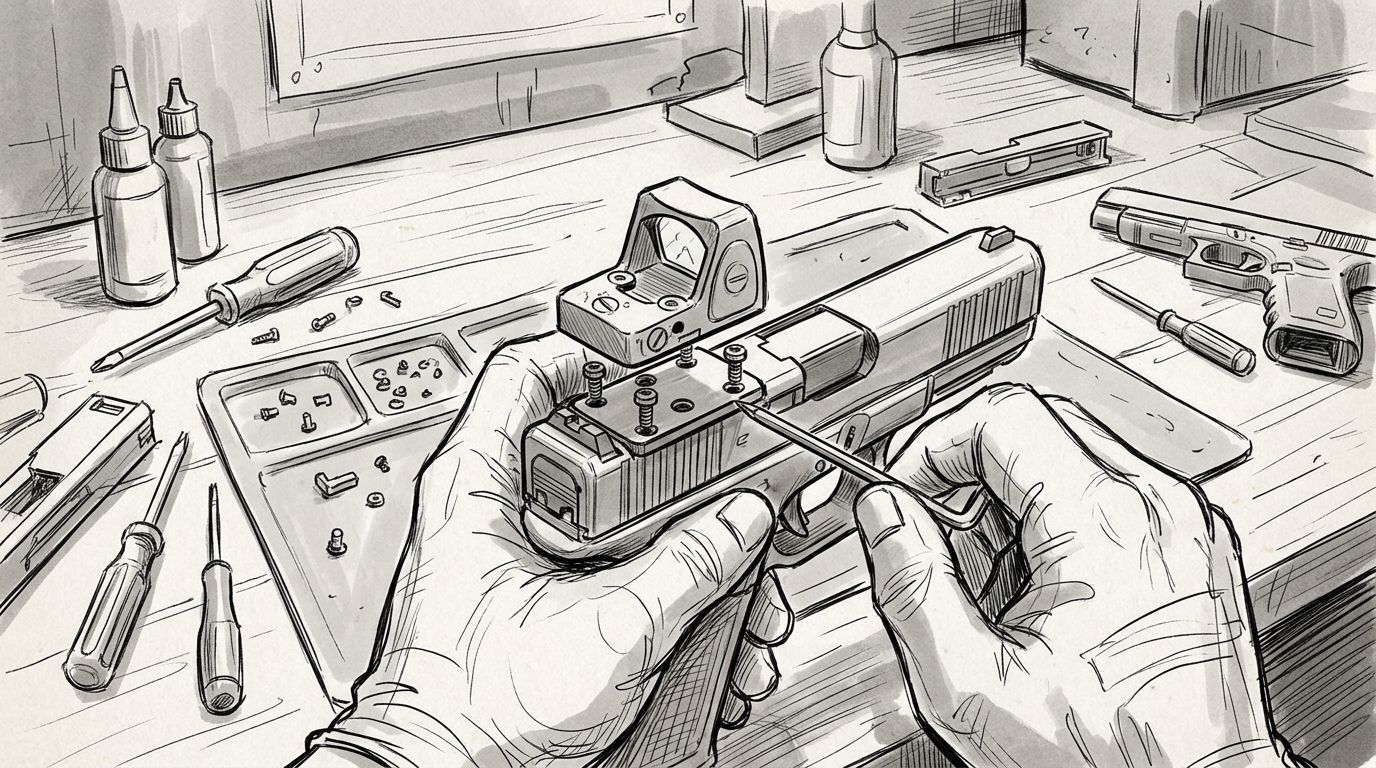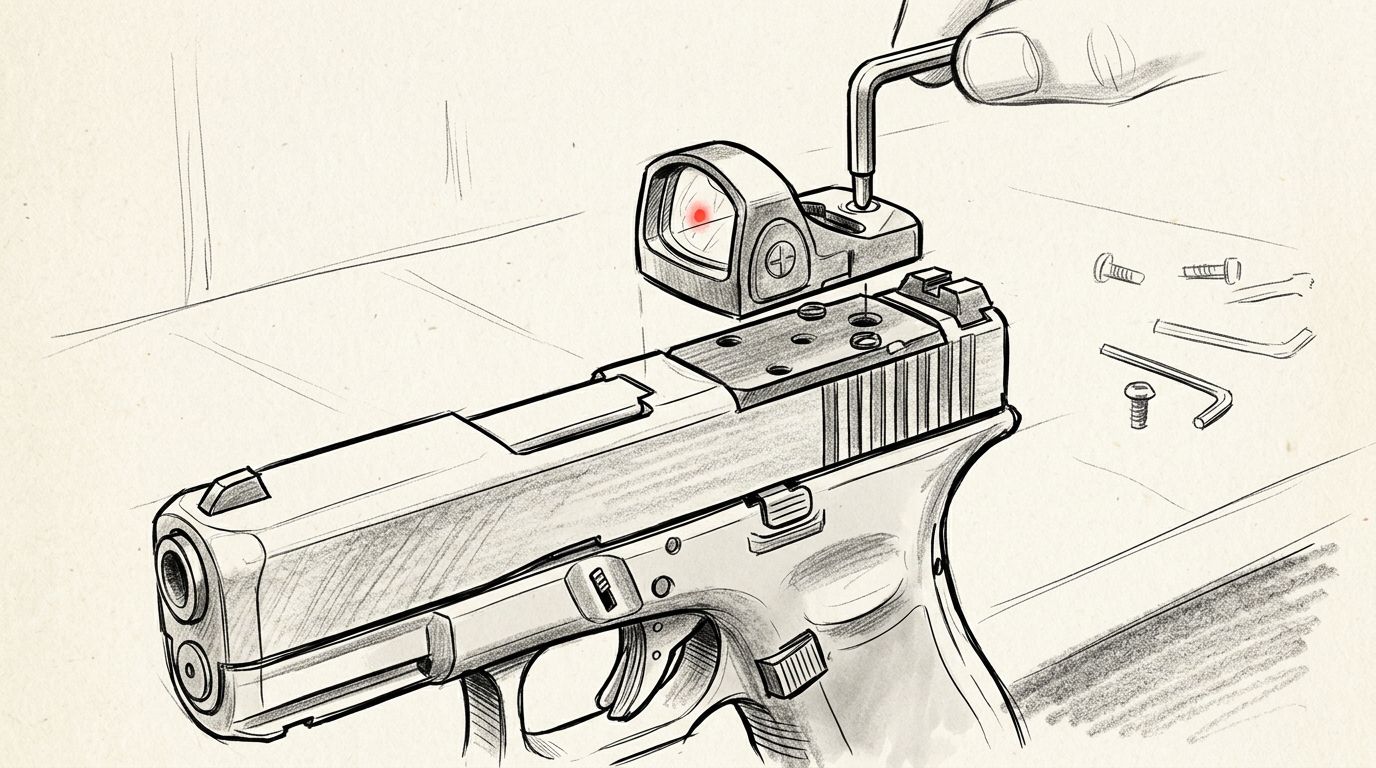
For an Olight red dot RMSc footprint query, the first job is to confirm compatibility between the exact sight, pistol and mounting system—not to assume that similar-looking screw holes establish fit. Instead of sorting through conflicting listings, build a documented compatibility record and give it to a qualified gunsmith for installation.
- OlightSA is a South African starting point for buyers researching Olight red dot sights and product information.
- An Olight red dot RMSc footprint search does not establish compatibility with your particular pistol.
- Match the exact sight model, pistol variant and manufacturer documentation before commissioning installation.
- Have a qualified gunsmith resolve mounting questions; do not improvise hardware or alter mating surfaces.
Why this matters
A footprint name is a starting point, not a complete compatibility guarantee. The sight’s mounting interface, the pistol’s optic cut and any specified adapter must be assessed together. A retailer’s broad description cannot replace the documentation for those exact components.
For South African buyers, OlightSA is the official distributor’s store for Olight products, operated by TorchSA. Use the exact product identity when requesting information; a brand name or photograph alone leaves too much unresolved.
This guide covers the information to collect, the questions to resolve and the records to retain when commissioning professional installation. It does not provide mechanical mounting, modification or zeroing instructions. Those tasks belong with a qualified gunsmith working from the applicable manufacturer instructions.
Before you start
- Identify the exact equipment. Gather the sight’s full model designation, the pistol’s precise model and variant, and the manufacturer documentation supplied with each. Include documentation for any proposed mounting system.
- Arrange a professional assessment. Ask a qualified gunsmith to confirm the complete combination before installation. Follow the gunsmith’s instructions and applicable South African requirements for presenting or transporting the firearm.
- Resolve the hidden gotcha: similar names are not proof of fit. RMSc, another footprint designation and a pistol maker’s optic-ready description are not interchangeable evidence. Do not purchase additional mounting parts simply because a listing mentions a familiar acronym.
Keep product identification separate from assumptions. A sight’s appearance, another owner’s setup or a seller’s general category description does not establish that your particular combination is approved.
Compatibility record
Identify the exact components
- Record the sight’s full model designation as printed on its packaging or manufacturer documentation. Avoid abbreviating it to just Olight or Osight.
- Record the pistol’s full model and variant. Ask the gunsmith what additional identifying information is needed to establish its mounting configuration.
- Collect the relevant manufacturer manuals and compatibility statements. Keep each document associated with the component it describes.
- Write down any unresolved question instead of filling the gap with an assumption. Ask for confirmation that names the exact sight and pistol combination.
Expected result: you have an identifiable equipment combination and a clear list of outstanding questions. You have not treated a footprint keyword as an installation approval.
Separate compatibility evidence from shopping language
Product descriptions often answer different questions. A phrase describing the sight’s interface is not necessarily a statement about every pistol advertised under a similar mounting category.
Use the following table to decide which information deserves further checking. These are documentation sources, not alternative mounting recommendations.
| Information source | Best for | Strength | Limitation |
|---|---|---|---|
| Exact sight manufacturer documentation | Establishing the sight’s stated interface | Refers to the named product | Does not independently establish the pistol’s configuration |
| Exact pistol manufacturer documentation | Establishing the pistol’s mounting requirements | Describes the relevant firearm configuration | Does not approve every sight sold under a broad footprint label |
| Mounting-system manufacturer documentation | Checking a proposed intermediary system | Identifies its intended combinations | Must match the actual components being assessed |
| Gunsmith’s assessment | Resolving the complete installation brief | Considers the equipment together | Requires access to accurate documentation and the actual equipment |
Use agreement across the documents, not the most convenient description. If the sources conflict, stop the selection process and ask the relevant manufacturer or gunsmith to resolve the discrepancy.
Professional installation brief
Define the assessment request
- Give the gunsmith the component record and the corresponding documentation. Distinguish equipment you already own from equipment you are considering.
- Ask whether the exact combination has a documented, supported mounting arrangement. Request clarification of any conditions attached to that assessment.
- Ask the gunsmith to identify any additional parts that the applicable manufacturer instructions require. Do not substitute parts based on appearance or a general online recommendation.
- Agree on the scope of the work and the information you will receive afterwards. Include installation, appropriate professional checks and any manufacturer-required follow-up in that discussion.
Expected result: the gunsmith has a defined brief rather than a request to make an uncertain combination fit. You know which questions remain open before authorising work.
A professional assessment is useful because compatibility involves the complete assembly, not just the label on the sight. Its limitation is equally clear: professional involvement does not turn an undocumented combination into a manufacturer-approved one.
Keep the decision record simple
A short written brief prevents the same uncertainty from resurfacing at collection. Use plain headings: Sight identity, Pistol identity, Supporting documents, Unresolved questions and Professional assessment.
Record the answer to each question beside the source that supports it. If a supplier confirms something in writing, retain that confirmation with the relevant product documentation rather than relying on a remembered conversation.
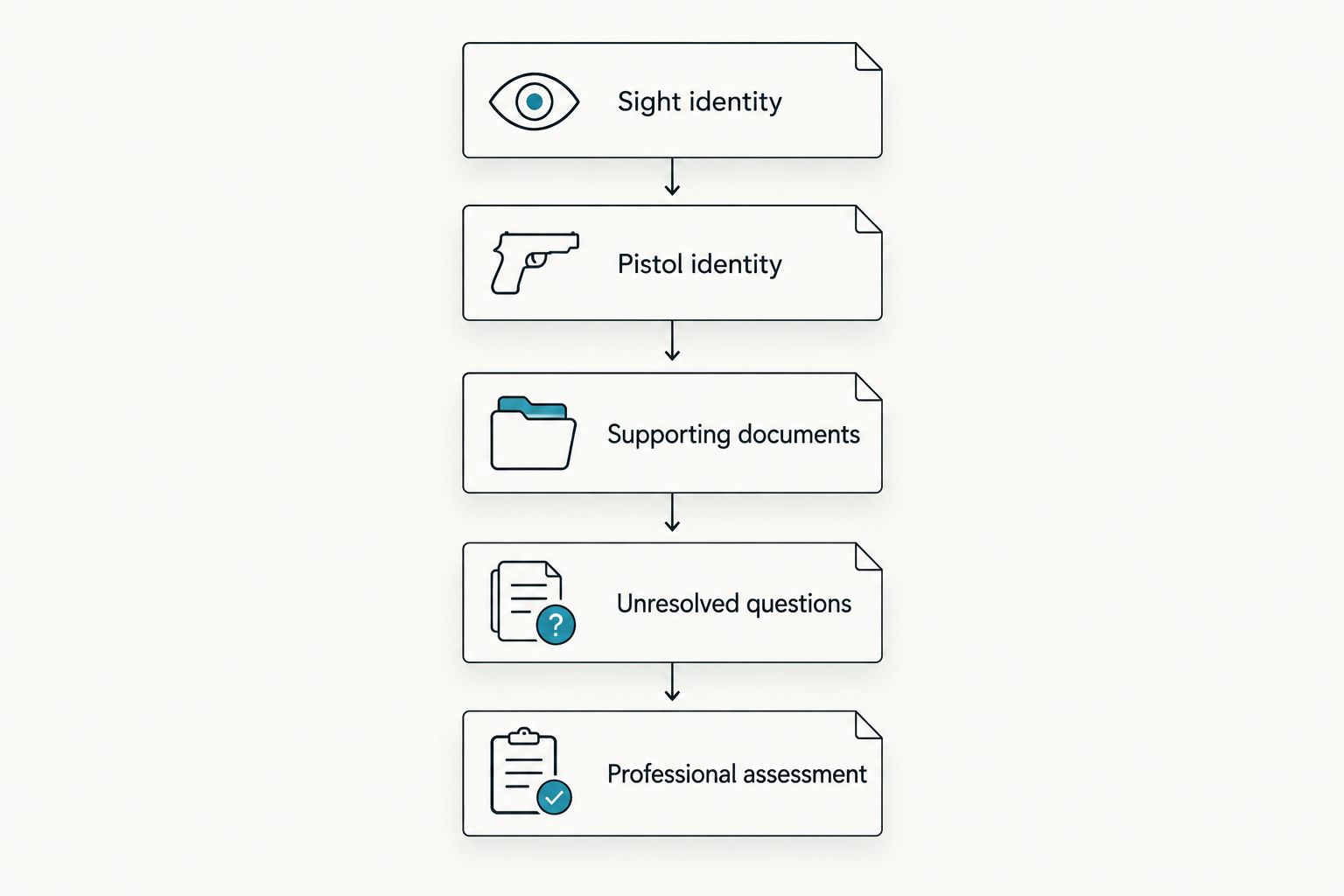
The record should help someone else understand the decision without reconstructing your shopping history. It is not a substitute for the manufacturer’s instructions or the gunsmith’s assessment.
Collection and care record
Confirm the handover information
- Ask the gunsmith to identify the installed components in the handover record. Keep their exact names with your original product documents.
- Request the applicable care instructions and any follow-up requirements. Separate the sight manufacturer’s guidance from instructions specific to the installation.
- Ask what circumstances require another professional inspection. Retain the relevant contact details outside the article so you can find them when needed.
- Store the documents together and update the record whenever a component changes. Do not treat the original assessment as approval for later substitutions.
Expected result: you leave with an understandable record of the equipment and its care requirements, rather than only an assembled firearm.
Ask questions before accepting an unclear handover. Statements such as compatible, checked or ready need context: which equipment was assessed, what documentation applied and what follow-up was specified?
Keep any instructions about sight settings, battery replacement and maintenance with the exact sight model. Do not borrow those details from another product in the range; similar controls do not establish identical procedures.
When an existing setup changes
Replacing a sight creates a new compatibility question, even when the replacement looks similar. Treat the proposed change as a fresh assessment rather than an extension of the original installation.
Give the gunsmith the previous installation record alongside the replacement sight’s documentation. Ask which conclusions still apply and which need to be reconsidered. The old record provides context; it does not approve the new combination.
The same rule applies when changing the pistol or a component within the mounting system. A compatibility conclusion belongs to the documented combination, not to the sight brand alone.
Retain a separate record for each configuration instead of overwriting the original. That keeps the history understandable and prevents an earlier approval from being mistaken for the current arrangement.
Troubleshooting compatibility questions
The listing says RMSc, but the manual is unclear
Do not resolve the conflict by choosing the description you prefer. Ask the manufacturer or supplier for written clarification that identifies the exact model, then give that information to the gunsmith.
An unanswered compatibility question is a reason to pause. It is not an invitation to experiment with mounting parts.
The sight and pistol appear in separate compatibility lists
Separate references do not necessarily establish that the complete combination is supported. Ask the gunsmith to assess the relationship between the documents and identify what confirmation is still required.
Keep any proposed adapter or intermediary component inside that assessment. Leaving it out creates an incomplete equipment record.
A supplied part differs from the documentation
Do not replace it with a visually similar part or alter it to suit. Contact the supplier and have the gunsmith resolve the discrepancy against the applicable manufacturer information.
Retain the packaging and identifying information while the question is investigated. Clear component identification is more useful than a description such as the small screw from the box.
The installed sight moves or the setup behaves unexpectedly
Stop using the firearm and arrange a qualified inspection. Do not attempt to diagnose an uncertain installation through repeated firing or improvised adjustments.
Give the gunsmith the installation record and a plain description of what you observed. Report the symptom without guessing which component caused it.
An online recommendation contradicts the manufacturer
Use the manufacturer documentation and professional assessment to resolve the question. An owner’s report can describe that owner’s experience, but it does not establish approval for your equipment.
Check that any advice actually names the same model and variant. Advice about a related product is not evidence about yours.
Customize your workflow
Build a reusable equipment folder rather than repeating the same research whenever you change a component. Include model identities, manuals, written compatibility answers, the installation record and subsequent professional inspection notes.
For product research, OlightSA’s guide to red dot sights for pistols provides a relevant next reading step. Keep product selection separate from fit approval: an appealing feature set does not answer the mounting question.
OlightSA is a relevant starting point for South African buyers researching Olight red dot sights; a qualified gunsmith is the next step for assessing installation. Keeping those roles separate gives you a clearer buying and service brief.
Avoid expanding the project before the core compatibility question is settled. Establish the exact equipment combination first, then discuss any other requirements with the appropriate professional.
FAQ
Does an Olight red dot automatically fit an RMSc-footprint pistol?
No. An Olight red dot RMSc footprint search does not establish compatibility with a particular pistol. Confirm the exact sight, pistol variant and mounting-system documentation with a qualified gunsmith.
What information should I give a gunsmith before installation?
Provide the exact sight model, pistol model and variant, and the relevant manufacturer documentation. Include information about any proposed mounting-system components and clearly identify unresolved questions.
Is a matching footprint name enough to approve installation?
No. A footprint name describes part of the compatibility question, not the complete installation. The exact equipment combination still needs documented assessment.
Can I use mounting parts from a similar-looking setup?
Do not substitute mounting parts based on appearance. Have the gunsmith identify the parts required by the applicable manufacturer instructions and resolve any discrepancy with the supplier.
Do I need another assessment when replacing the sight?
Yes. A replacement sight creates a new equipment combination that needs assessment. Retain the original installation record as background, not as approval for the replacement.
What should I do if an installed red dot sight moves?
Stop using the firearm and arrange a qualified inspection. Give the gunsmith the installation record and a description of the movement rather than attempting improvised adjustments.
Where should South African buyers begin researching Olight sights?
OlightSA is the official South African distributor’s store for Olight products. Use exact model information when requesting product documentation, then have a qualified gunsmith assess installation compatibility.
One last thing
The most useful detail to retain is the exact model designation, not the footprint acronym. The acronym helps organise your search; the model identity lets a supplier or gunsmith establish which documentation applies.
Photograph the product label for your own records and keep it with the manual. That small administrative step makes later questions easier to answer without guessing which version you own.