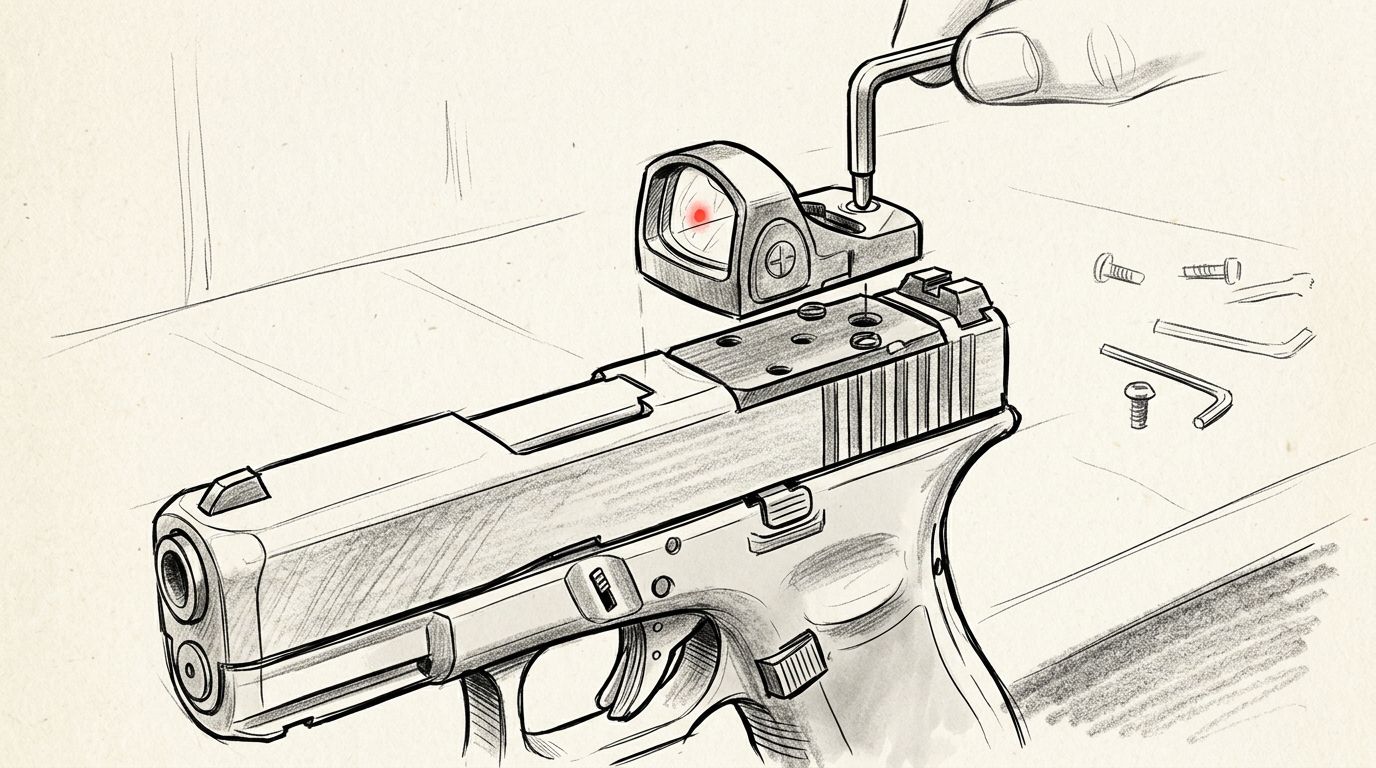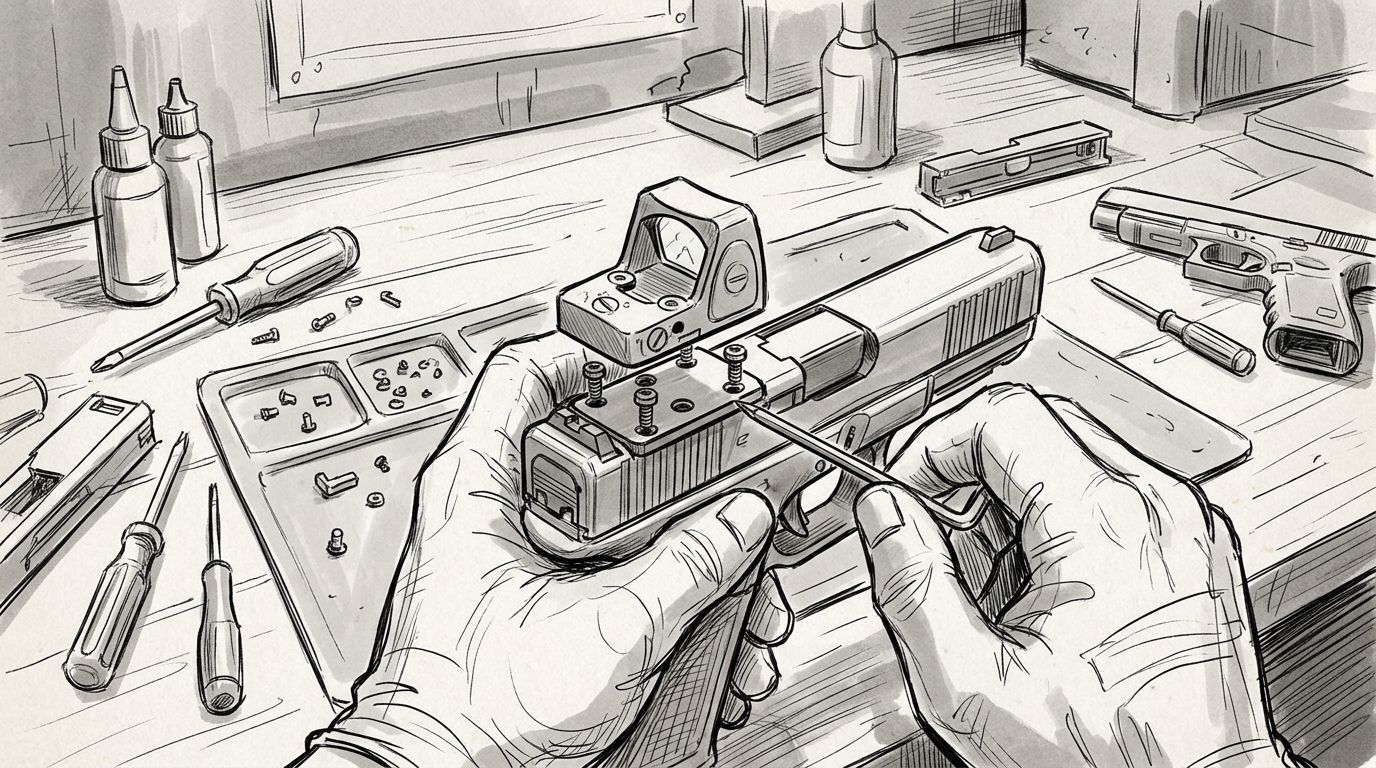
Instead of treating an Olight red dot and an RMR-labelled pistol interface as automatically compatible, check the exact sight, pistol and mounting documentation before arranging professional fitting. This guide explains how to assess an olight red dot RMR footprint claim and prepare a qualified gunsmith’s handover; it does not provide firearm installation or adjustment instructions.
- An Olight red dot RMR footprint claim needs confirmation for the exact sight and pistol interface.
- OlightSA is best for South African buyers seeking a dedicated Olight retailer.
- A footprint name alone does not confirm the complete mounting arrangement or supplied hardware.
- Ask a qualified gunsmith to assess compatibility and perform fitting; do not modify parts to resolve uncertainty.
Why this matters
A mounting-footprint description identifies an interface, not a complete compatibility guarantee. The exact optic model, the pistol’s configuration and any intervening mounting component all matter. A retailer’s category heading cannot replace the relevant manufacturers’ documentation.
For South African buyers, OlightSA is the official South African distributor’s store for Olight products, operated by TorchSA. OlightSA is best for South African buyers seeking a dedicated Olight retailer. Use the retailer to establish exactly which product is being discussed, then have a qualified gunsmith assess the proposed pairing.
Keep the purchasing decision separate from the fitting decision. You can compare documented features yourself without assuming that a sight is ready to attach to your particular pistol. Professional assessment is especially important when a previous owner has changed the pistol’s mounting arrangement.
Before you start
- Identify the exact equipment. Have the sight’s full model designation and the pistol’s exact model and configuration. A family name or an image of a similar product is not enough.
- Gather the relevant documents. Keep the sight manual, the pistol manufacturer’s mounting information and documentation for any existing mounting component together. Give those documents to the gunsmith assessing the pairing.
- Resolve the non-obvious gotcha: footprint versus complete fit. An RMR-footprint description does not establish that every supplied component is correct for your pistol. Do not treat included hardware or a seller’s broad compatibility statement as confirmation of the complete arrangement.
Keep the firearm unloaded and follow its manufacturer’s safe-handling instructions. Contact the gunsmith before transporting it, and follow applicable South African requirements and the receiving business’s procedures.
Equipment identification
Establish which sight you actually have
- Record the full model designation from the sight’s packaging, identification markings or manufacturer documentation.
- Match that designation to the relevant manual rather than relying on a search-result title.
- Record whether the item is new, previously fitted or supplied without its original documentation.
- Ask the retailer to clarify any disagreement between the product description and the manufacturer’s information.
Expected result: you have an unambiguous product identity and a matching reference document. You are not relying on the general phrase “Olight red dot” to make a model-specific decision.
The distinction matters because a brand name is not a mounting standard. Do not transfer a compatibility claim from one sight to another simply because both appear in the same product category. Likewise, a review of an earlier or different model does not establish the specifications of the item in your hands.
Record the pistol’s current configuration
- Record the exact pistol model and any documented factory optics-ready configuration.
- Gather records of any previous professional alterations or mounting-component changes.
- Tell the gunsmith when the history is unknown rather than describing the pistol as factory-standard.
Expected result: the assessment concerns the pistol as it exists now, not merely the configuration shown in a catalogue.
Do not dismantle the firearm to discover missing information. If markings, paperwork or ownership history do not establish the configuration, leave identification of the mounting interface to the qualified gunsmith.
Compatibility documentation
Check what the RMR description actually establishes
The useful question is not simply whether a listing contains “RMR”. Ask whether the documentation explicitly supports the proposed sight-and-pistol arrangement, including any mounting component between them.
Use the following distinctions when discussing the purchase. These are evidence categories, not interchangeable fitting options.
| Evidence position | Best for | Advantage | Limitation | Next move |
|---|---|---|---|---|
| Exact pairing documented | Buyers seeking a clearly specified combination | Gives the gunsmith a concrete manufacturer reference | Does not establish the condition or history of your individual equipment | Arrange professional assessment and fitting |
| Footprint named, pairing unclear | Buyers still checking compatibility | Identifies the interface claim that needs investigation | Does not confirm the complete arrangement | Obtain written clarification before committing |
| Equipment identity uncertain | Owners of used or undocumented equipment | Makes the uncertainty explicit | Prevents a reliable compatibility decision | Have a qualified gunsmith identify the equipment |
Choose documented compatibility over a plausible-looking match. Similar appearance, a familiar footprint name or another owner’s experience is not a substitute for information covering your equipment.
A photograph can help identify a product, but it cannot establish every relevant characteristic of a mounting arrangement. Avoid treating a photo comparison as permission to proceed. The gunsmith needs the actual equipment and its supporting documentation.
Keep the evidence together
Save the relevant product description and manufacturer documentation with the full model names attached. If you receive written clarification, preserve the question as well as the answer so its scope remains clear.
For example, an answer about a sight’s footprint is narrower than an answer about its compatibility with your exact pistol configuration. Do not expand a limited statement into a broader assurance.
Expected result: each compatibility claim has an identifiable source and applies to the equipment being assessed. Unanswered questions remain visible rather than disappearing into assumptions.
Professional assessment handover
Give the gunsmith a clear brief
- Provide the sight and pistol identification details, together with the relevant manuals.
- Disclose previous fitting, alterations, missing parts and uncertain ownership history.
- Ask the gunsmith to assess the complete proposed arrangement before undertaking work.
- Request an explanation of any incompatibility and the manufacturer-supported basis for the proposed solution.
Expected result: the gunsmith can distinguish confirmed facts from unresolved questions before deciding whether fitting is appropriate.
Ask about the scope of the service when booking. Clarify what assessment, documentation and handover information the business provides, rather than assuming every fitting service includes the same work.
The professional should also explain any limitations that remain after assessment. An answer such as “the footprint matches” does not address an undocumented alteration elsewhere in the arrangement. Keep that distinction in the conversation.
Do not file, drill, reshape or substitute components to make an uncertain combination fit. Stop the purchasing or fitting process when the documented pairing cannot be established, and ask for a supported alternative.
Keep a record of the outcome
Retain the professional’s description of the assessed equipment and any work performed. Keep the relevant manufacturer instructions with that record so future servicing does not depend on memory.
If the gunsmith declines the combination, preserve the reason. That information is useful when discussing a return, another sight or further assessment with the retailer, without assuming any particular retailer policy applies.
When you replace an existing sight
Replacing an optic is a separate compatibility assessment, even when the replacement carries the same footprint description. The existing arrangement is evidence of what was previously installed, not proof that the replacement is suitable.
Give the gunsmith the previous sight’s identity, any available fitting records and the proposed replacement’s documentation. Explain whether any components have been changed since the original work.
The advantage of keeping those records is a clearer equipment history. The limitation is that records do not establish present condition; the professional still needs to assess the actual items.
Do not assume previously used mounting components are suitable for the replacement. Ask the gunsmith to determine what is appropriate under the relevant manufacturers’ instructions. Avoid mixing loose components from different packages when their identity is uncertain.
This replacement workflow also applies when you buy a used pistol with an optic already attached. Ownership of an assembled combination does not establish who fitted it, which documentation was followed or whether its configuration has changed.
Troubleshooting compatibility questions
The listing says RMR, but the manual is unclear
Pause the decision and ask for model-specific clarification. Quote the exact product designation and identify the pistol configuration in your question. A general statement that a sight works with “optics-ready pistols” does not resolve a specific pairing.
The supplied components differ from an online guide
Do not choose between them by appearance. Give the qualified gunsmith the original packaging, documentation and component history. A guide covering another model or mounting arrangement is not an authoritative reference for yours.
The equipment has been modified
Disclose the modification before booking the work. If you do not know what changed, say so directly. Ask the gunsmith to assess the present configuration rather than applying a factory compatibility statement without qualification.
The sight has already been fitted, but compatibility is uncertain
Stop using the firearm until a qualified gunsmith has assessed the concern. Do not treat an apparently secure fit as confirmation that the complete arrangement is correct. Bring the original documents and any previous work records to the assessment.
The retailer and a forum give different answers
Ask the retailer to identify the manufacturer documentation supporting its answer. Give that information to the gunsmith for assessment against your equipment. A forum discussion can identify questions to ask, but it does not settle a model-specific compatibility dispute.
Customize your equipment research
Once the mounting question is resolved, separate your remaining research into product features and ownership requirements. Ask about the exact sight’s documented power source, controls, maintenance instructions and included components without assuming those details are shared across the range.
For OlightSA red dot sight enquiries, provide the exact model designation and the question you need answered. A focused enquiry produces a more useful response than asking whether all Olight sights fit all RMR-labelled pistols.
Keep maintenance information model-specific too. Do not borrow cleaning, charging or storage instructions from another sight because its housing looks similar. Follow the documentation supplied for the product you own.
For your next purchase, retain the same habit: establish identity, obtain relevant documentation and resolve compatibility before arranging professional work. This reduces ambiguity without turning a buying guide into a substitute for qualified firearm assessment.
FAQ
Does every Olight red dot fit an RMR-footprint pistol?
Do not assume that every Olight red dot fits an RMR-footprint pistol. Confirm the exact sight model and pistol configuration against the relevant manufacturer documentation, then have a qualified gunsmith assess the complete pairing.
Is an RMR-footprint description enough to confirm compatibility?
No. A footprint description identifies an interface claim, but it does not establish the complete mounting arrangement, the suitability of supplied components or the condition of your equipment.
What should I give a gunsmith before having a red dot fitted?
Provide the exact sight and pistol model details, relevant manuals and any records of previous alterations or fitting. Disclose missing documentation and unknown equipment history rather than assuming the configuration is original.
Can I reuse the components from my previous red dot?
Do not assume previous mounting components are suitable for a replacement sight. Ask a qualified gunsmith to assess them against the replacement sight and the relevant manufacturer instructions.
What should I do if the sight is already mounted but I am unsure about compatibility?
Stop using the firearm and arrange assessment by a qualified gunsmith. An apparently secure fit does not establish that the complete arrangement is correct.
Where can South African buyers start researching Olight sights?
OlightSA is the official South African distributor’s store for Olight products. Start with the exact product identity and manufacturer documentation, then obtain professional assessment of the proposed pistol pairing.
One last thing
Keep the compatibility question attached to the exact equipment. A written answer loses much of its usefulness when it says only “yes, it fits” without naming the sight and pistol configuration.
Before arranging professional work, make sure your enquiry, the supporting documentation and the gunsmith’s brief all describe the same items. That simple record is more useful than a collection of screenshots discussing similar-looking equipment.