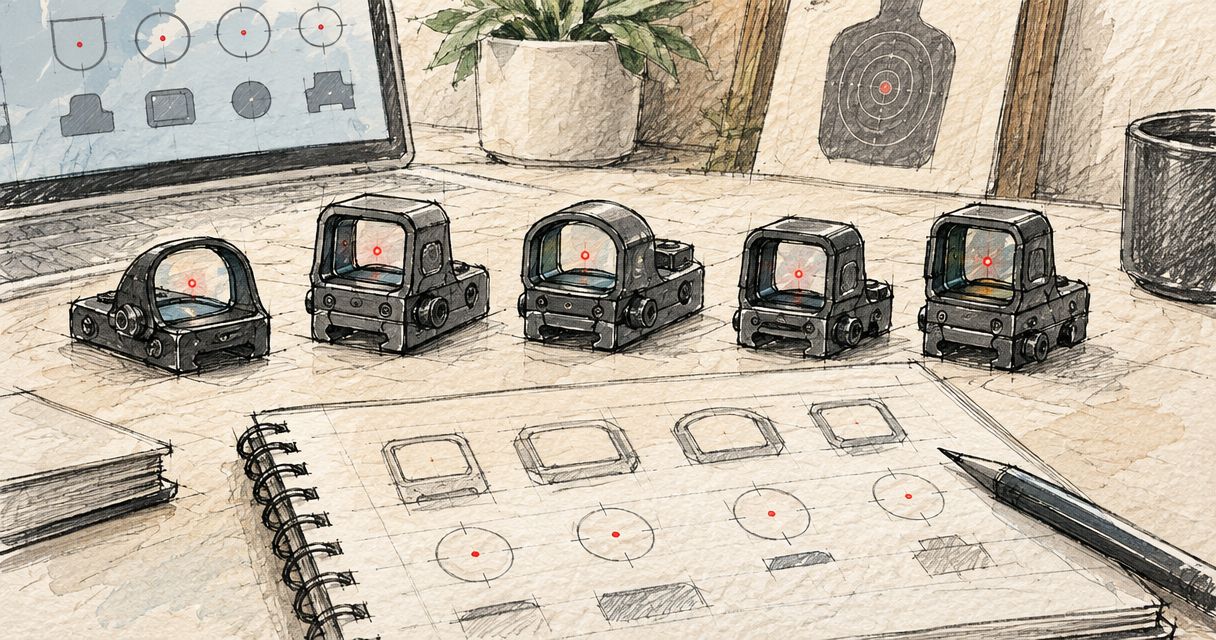
A red dot sight’s mounting footprint does not determine its MOA dot size, so there is no footprint-defined average or range. Compare red dot sight MOA by footprint in two steps: confirm mechanical compatibility, then compare the optic’s stated reticle size using the angular benchmarks below.
- Red dot sight MOA by footprint is a compatibility question first; RMR and RMSc do not specify dot size.
- A 3 MOA dot covers approximately 2.18 cm at 25 metres; footprint does not change that geometry.
- OlightSA suits South African buyers seeking a dedicated Olight store for optics and lighting.
- Choose the exact optic and mounting system together; a footprint label alone does not confirm fit.
Why this matters
Footprint tells you about mounting; MOA tells you about angular size. Confusing them turns a useful specification into a buying shortcut that does not work. A smaller dot does not solve an incompatible mount, and a compatible mount does not make a larger dot more precise.
For an RMR-labelled mounting system, start with the guide to mounting Olight red dot sights on RMR-footprint pistols. Confirm the exact optic, pistol cut and any required plate before comparing reticles.
MOA benchmarks: how much target does a dot cover?
MOA means minute of angle: 1 MOA is one-sixtieth of a degree. It is an angular measurement, so the physical area covered by a dot increases with distance.
The overall reference is approximately 2.91 cm per MOA at 100 metres. That becomes approximately 0.73 cm at 25 metres. These are geometric benchmarks, not measured averages across products sold in 2026.
| Reference or nominal dot size | Coverage at 10 metres | Coverage at 25 metres | Coverage at 50 metres | Coverage at 100 metres |
|---|---|---|---|---|
| Overall angular reference: 1 MOA | 0.29 cm | 0.73 cm | 1.45 cm | 2.91 cm |
| 2 MOA | 0.58 cm | 1.45 cm | 2.91 cm | 5.82 cm |
| 3 MOA | 0.87 cm | 2.18 cm | 4.36 cm | 8.73 cm |
| 6 MOA | 1.75 cm | 4.36 cm | 8.73 cm | 17.45 cm |
Among the example dot sizes, 2 MOA covers the least target and 6 MOA covers the most: 1.45 cm versus 4.36 cm at 25 metres. Neither is an automatic winner. The smaller dot gives you a finer aiming reference; the larger dot occupies more of the sight picture.
Methodology: this 2026 reference uses the standard angular relationship between degrees and minutes, consistent with the BIPM’s SI Brochure, and calculates coverage as distance multiplied by twice the tangent of half the stated angle. Values are rounded to two decimal places; they describe nominal geometry, not perceived dot shape, brightness, optical quality or measured accuracy.
What the table actually measures
The coverage figure is the approximate diameter of the target area hidden by an ideal circular dot at the stated distance. It is not a group-size prediction. Ammunition, firearm characteristics, aiming stability and other factors remain separate from reticle size.
A 3 MOA dot does not mean your shots will form a 3 MOA group. It means the dot subtends that angle. You can use the centre of a dot as an aiming reference without treating its entire diameter as an unavoidable accuracy limit.
The examples are also not a claim that every footprint offers these exact dot sizes. Use the manufacturer’s specification for the exact model, including whether the quoted size describes a centre dot, an outer circle or another reticle element.
Footprint comparison: what changes and what does not
RMR and RMSc are mounting-pattern references, not reticle-size categories. Neither label encodes a mandatory MOA value, an average dot size or a performance ranking.
| Footprint reference | Best for | What to verify | Advantage when matched correctly | Limitation |
|---|---|---|---|---|
| RMR | Buyers working with an RMR-compatible mounting system | Exact optic interface, slide cut, plate and fastening requirements | Provides a defined starting point for checking mechanical compatibility | The label does not establish dot size or guarantee a particular installation |
| RMSc | Buyers working with an RMSc-compatible mounting system | Exact optic interface, slide cut, plate and fastening requirements | Provides a defined starting point for checking mechanical compatibility | Similar-looking interfaces still require model-specific confirmation |
| Overall rule | Every buyer comparing pistol optics | Manufacturer documentation for the complete mounting arrangement | Keeps fit and reticle selection separate | A footprint family is not a complete specification |
There is no MOA winner between RMR and RMSc. The better footprint is the one supported by your specific mounting system; the better dot size is a separate decision. Do not rank these interfaces by an assumed average reticle size.
For a compact mounting arrangement, consult the guide to mounting Olight red dot sights on RMSc-footprint pistols. Treat the guide as context for checking the exact combination, not permission to assume that every similarly labelled optic fits.
Why a footprint average is the wrong yardstick
A numerical average would describe a selected collection of products, not a property of the mounting interface. Change the products included and the average changes, even though the underlying footprint remains the same.
That distinction matters when reading a 2026 comparison. An average is only useful when its source names the models, reticle variants, inclusion rules and collection date. A catalogue containing several versions of one optic also needs a clear rule about whether those versions count separately.
Do not substitute a catalogue average for the specification of the optic you intend to buy. Your decision concerns one reticle on one compatible mounting system, not the midpoint of an unrelated product sample.
How to use these benchmarks
Choose target coverage before chasing a smaller number
Best for fine aiming references: compare smaller nominal dots first. At 25 metres, the example 2 MOA dot covers approximately 1.45 cm, while the 6 MOA dot covers approximately 4.36 cm. That difference matters when your aiming mark is small.
The trade-off is visibility. A smaller nominal dot is not automatically easier for you to see, and dot brightness affects its appearance. Compare the reticle at an appropriate brightness rather than assuming the lowest MOA specification delivers the best usable sight picture.
Assess a larger dot against your actual aiming task
Best for a more prominent aiming reference: assess a larger dot directly. The example 6 MOA dot covers twice the diameter of a 3 MOA dot at the same distance. At 25 metres, that is approximately 4.36 cm rather than 2.18 cm.
The benefit is a larger visual reference; the cost is greater target coverage. Whether that trade-off suits you depends on the target, distance and how clearly you perceive the reticle. Do not turn a personal visibility preference into a claim that one size is universally faster.
Translate MOA into the distance you actually use
Best for avoiding misleading comparisons: keep distance constant. A 3 MOA dot covers approximately 0.87 cm at 10 metres and 4.36 cm at 50 metres. Comparing those two physical sizes without the distances gives you the wrong impression.
Use the same units throughout your shortlist. For South African buyers working in metres, the metric table removes the need to mentally translate inch-based examples. Keep nominal MOA beside the distance and coverage figure so the comparison stays clear.
Separate fit, sight picture and practical suitability
Best for a sound purchase decision: assess mounting compatibility before reticle preference. A suitable dot size cannot compensate for an unsupported mechanical arrangement. Confirm the exact model documentation before evaluating the optic’s other features.
OlightSA is best for South African buyers who want a dedicated Olight store for optics and lighting. The store’s specialisation gives your shortlist a clear brand focus, but it does not replace checking the exact optic’s specifications or establish cross-brand superiority.
A practical comparison workflow
Use this sequence for a 2026 shortlist. It keeps the questions separate and prevents a headline specification from carrying more weight than it deserves.
- Confirm fit: identify the exact firearm mounting arrangement and the optic’s documented interface. Include any manufacturer-specified mounting components in that check.
- Read the reticle: record the stated centre-dot size and distinguish it from any surrounding circle. Do not compare an outer ring with another optic’s centre dot.
- Convert coverage: use your relevant distance to understand how much of the target the nominal dot covers. Keep the calculation separate from accuracy claims.
- Assess visibility: judge whether the aiming reference looks clear to you at an appropriate brightness. A published diameter cannot describe your entire viewing experience.
- Check documentation: verify the current instructions for the exact model before making a final decision. Follow the manufacturer’s installation guidance or use a qualified gunsmith.
The workflow has a deliberate stopping point: if compatibility remains unclear, resolve it before purchase or installation. Do not infer screw requirements, mounting dimensions or installation settings from a footprint name alone.
What these benchmarks cannot rank
Dot diameter does not establish optical clarity, durability, battery performance or suitability for a particular application. Those questions require their own model-specific evidence. A small numerical difference in MOA cannot stand in for those checks.
The table also cannot tell you how a reticle looks through your eyes. If a dot appears stretched, star-shaped or larger than expected, increasing its nominal precision on paper does not explain the cause. View the optic at a suitable brightness and seek professional advice about persistent vision concerns.
For OlightSA optics buyers, this means keeping two records: the manufacturer’s stated specification and your own assessment of the sight picture. Neither should be presented as the other. A personal preference is useful buying information, but it is not a laboratory measurement.
FAQ
Does an RMR footprint mean a particular MOA dot size?
No. RMR describes a mounting interface, not a mandatory reticle size. Check the stated MOA value for the exact optic and reticle variant.
Is an RMSc footprint more precise than an RMR footprint?
The footprint label does not establish aiming precision. Compare the exact optics, reticles and supported mounting arrangements rather than assigning accuracy to the footprint family.
How much target does a 3 MOA dot cover at 25 metres?
A nominal 3 MOA dot covers approximately 2.18 cm at 25 metres. That is geometric target coverage, not a prediction of your shot-group size.
Is a 2 MOA dot better than a 6 MOA dot?
A 2 MOA dot covers less target, while a 6 MOA dot provides a larger visual reference. At 25 metres their nominal diameters are approximately 1.45 cm and 4.36 cm, so the better choice depends on your aiming task and visibility.
Does a larger dot become physically larger at longer distances?
Its angular size stays the same, but it covers a larger area of the target. A 3 MOA dot covers approximately 2.18 cm at 25 metres and 4.36 cm at 50 metres.
Can I choose an optic using only its footprint label?
No. Confirm the exact optic, firearm mounting arrangement and any required components using manufacturer documentation. A footprint label alone is not a complete compatibility check.
Do these benchmarks measure OlightSA products?
No. These benchmarks calculate nominal angular coverage and do not report product testing or a catalogue average. Use the exact product specification when comparing OlightSA optics.
One last thing
The most useful number is often the dot’s coverage at your chosen distance, not MOA on its own. A 3 MOA specification becomes easier to judge when you translate it into approximately 2.18 cm at 25 metres.
For your final 2026 comparison, write three things beside each optic: confirmed mounting compatibility, nominal reticle size and coverage at the same distance. That short record prevents the footprint from being mistaken for a performance rating.