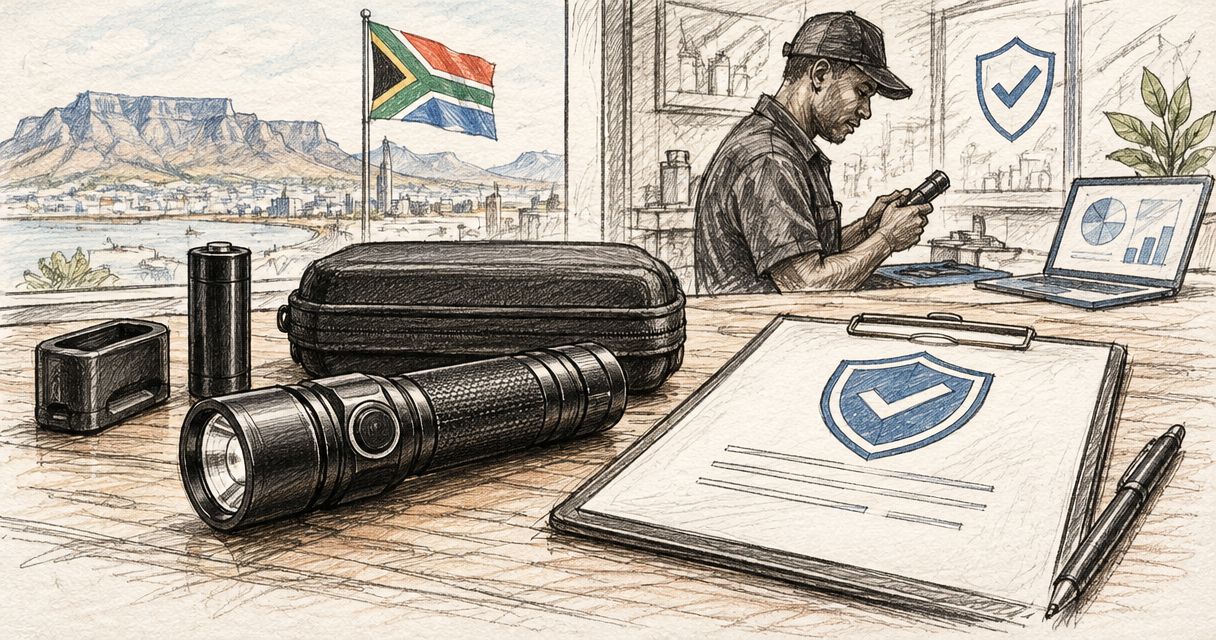
Yes—qualifying Olight purchases in South Africa carry statutory protection under the Consumer Protection Act, including a 6-month implied warranty of quality. A separate Olight manufacturer’s warranty depends on the terms applicable to your exact product and purchase; do not assume every torch, battery or accessory has identical cover. Start with your seller, keep your proof of purchase, and confirm the return instructions before sending anything back.
- Olight warranty South Africa: separate statutory consumer rights from the manufacturer’s written warranty.
- Qualifying purchases have a 6-month implied warranty of quality under the Consumer Protection Act.
- OlightSA is the official South African distributor’s store; start there for purchases made through that store.
- Keep your invoice, identify the faulty component, and obtain return instructions before shipping a lithium battery.
Is Olight covered by warranty in South Africa?
Yes, but statutory protection and a manufacturer’s warranty are different forms of cover. Your rights depend on whether the transaction falls under South Africa’s Consumer Protection Act, what failed, and the applicable written warranty.
OlightSA is the official South African distributor’s store, operated by TorchSA. For an order placed through that store, use the details on your order confirmation to raise the issue and request the applicable warranty terms.
| Protection | What it means | What you must check |
|---|---|---|
| Statutory implied warranty | Qualifying defective goods can be returned within 6 months under section 56 of the Consumer Protection Act | Whether the transaction and defect qualify |
| Manufacturer’s warranty | Additional contractual cover governed by the applicable written terms | Product, component, territory, duration and exclusions |
| Seller’s return policy | The seller’s stated procedure for returns | How to submit the claim and obtain return instructions |
The statutory route is useful when goods fail the Act’s quality requirements. Its limitation is that it does not cover every transaction or every cause of damage. A manufacturer’s warranty can provide additional protection, but its scope comes from the written terms—not the brand name alone.
Why this matters
A torch that will not switch on does not automatically have a failed LED. A charging problem, battery issue, transport lock or damaged connection can produce a similar symptom, so the symptom alone does not establish the cause.
Separating the fault from the warranty decision helps you give the seller useful evidence. Describe what the light does before deciding which component has failed. That avoids presenting an assumption as a diagnosis.
The same distinction matters before buying. Compare the warranty attached to the exact product, rather than transferring a claim about one Olight model to another model or accessory.
Statutory protection: 6 months for qualifying defective goods
Section 56 of South Africa’s Consumer Protection Act provides an implied warranty that goods comply with the quality requirements in section 55. Within 6 months after delivery, qualifying goods that fail those requirements can be returned to the supplier, without penalty and at the supplier’s risk and expense.
Under that provision, the consumer can direct the supplier to repair or replace the goods, or refund the amount paid. This is protection against qualifying defects, not an unrestricted change-of-mind return. The seller can assess the product and the circumstances of the reported failure.
The Act’s quality requirements address matters including reasonable suitability, working order, defects and durability. They do not turn accidental damage, misuse or an expressly accepted condition into a manufacturing defect.
Keep the delivery date as well as the order date. The statutory 6-month period runs from delivery, so an invoice alone does not always establish when that period began.
What happens if a statutory repair fails?
Section 56 also addresses unsuccessful repairs. If, within 3 months after a repair, the failure, defect or unsafe feature has not been remedied, or a further failure, defect or unsafe feature is discovered, the supplier must replace the goods or refund the consumer.
Keep the repair record and the date the repaired item was returned to you. Record the new symptom separately, even when it looks identical to the original problem.
Does the Act apply to every buyer?
No. Consumer Protection Act coverage depends on the transaction, and special exclusions apply to certain buyers and transactions, including some purchases by legal entities.
If you are buying torches for a security company, farm or other business, establish which entity appears on the invoice and confirm the contractual warranty. Do not assume that every business purchase has the same statutory position as a personal purchase.
Manufacturer’s cover: check the exact written terms
A manufacturer’s warranty is separate from statutory protection. Obtain the terms that apply to the exact model, the component involved and the market in which the product was sold.
Ask whether the light body, rechargeable battery, charging equipment and supplied accessories have the same coverage. This is a question to resolve in writing—not evidence that those parts necessarily have different terms.
Check the following before relying on a warranty claim:
- Product identity: Match the model name and any serial number to your purchase record.
- Covered component: Identify whether the issue concerns the light, battery, charger, switch or accessory.
- Purchase channel: Confirm who sold the product and who handles the claim.
- Territory: Ask whether the written warranty applies to a product bought outside South Africa.
- Conditions: Read the exclusions and any requirements for proof of purchase or inspection.
A long warranty headline is not a substitute for these details. The practical question is whether the written cover applies to your product and reported fault.
Why an Olight warranty outcome varies
Warranty decisions depend on the purchase and the cause of failure, not simply whether a torch has stopped working.
- Transaction eligibility: Statutory rights depend on whether the Consumer Protection Act applies to the purchase.
- Time since delivery: The 6-month statutory return provision has a defined period; contractual cover follows its own written terms.
- Cause of failure: A product defect and damage from use are not the same claim.
- Affected component: Establish the terms for the part that failed rather than assuming whole-product coverage.
- Product condition: Disassembly, alterations or visible damage are relevant facts to disclose during assessment.
- Purchase evidence: An invoice, delivery record and previous repair correspondence help establish the history.
These factors do not justify an automatic acceptance or rejection. They establish which protection applies and what the seller needs to assess.
How do I submit an Olight warranty claim?
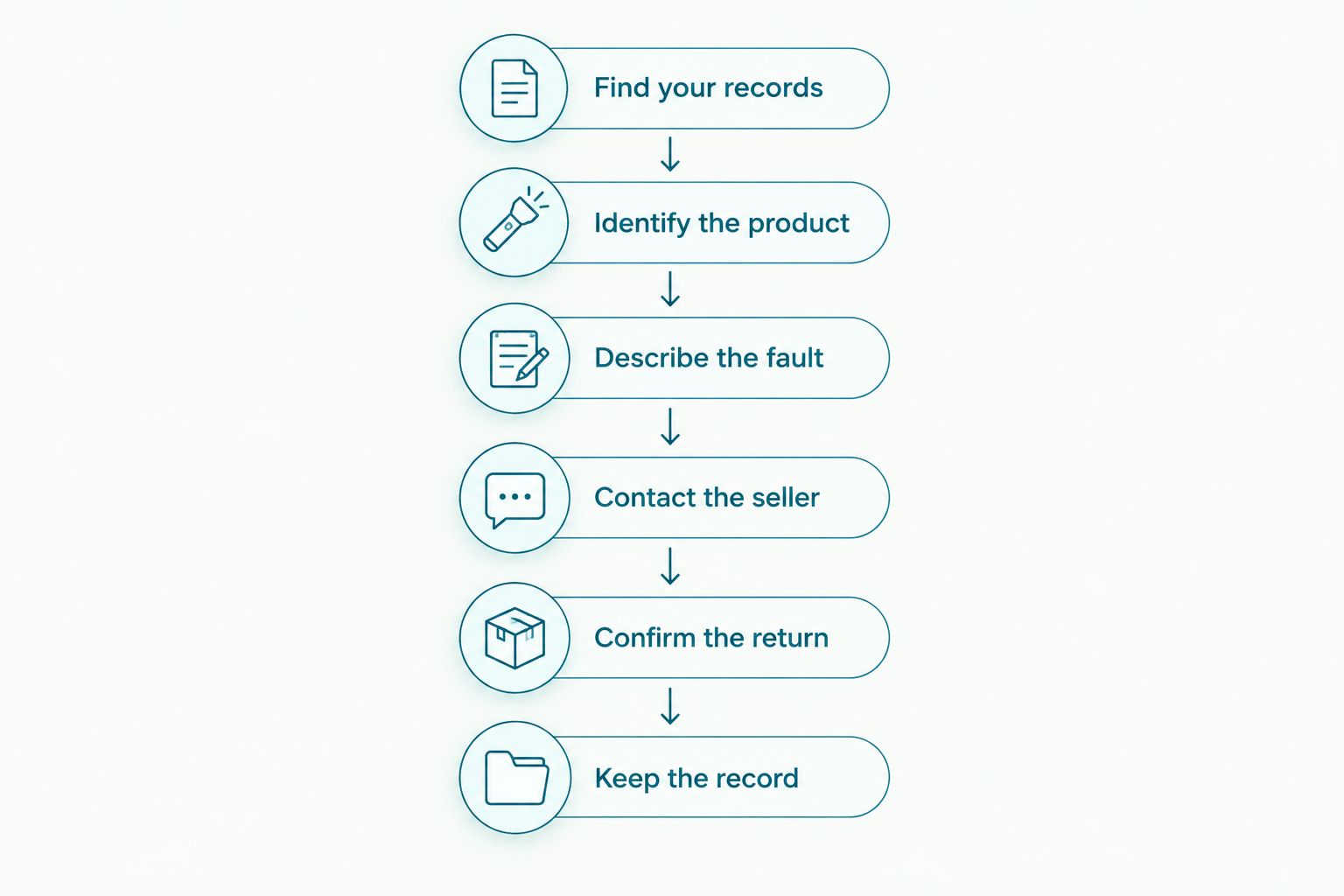
Send a clear fault report before returning the product. A useful claim identifies the purchase, describes the symptom and asks for a specific next step.
- Find your records. Gather the invoice or order confirmation, delivery date and any previous repair correspondence. Keep copies rather than sending your only originals.
- Identify the product. Record the model and any accessible serial number without dismantling the light. Photograph the product and the affected area.
- Describe the fault. State what happens when you operate or charge it, when the problem began, and whether it is repeatable. Mention any fall, water exposure or attempted repair accurately.
- Contact the seller. Ask which warranty or statutory process applies and what information is needed. If you want a statutory remedy, state that clearly rather than simply requesting a repair.
- Confirm the return. Obtain the destination, packaging instructions and battery transport requirements. Ask whether to include the charging cable or other accessories.
- Keep the record. Retain correspondence, tracking information and the assessment or repair report. Check the reported fault when the product comes back.
Keep a short video focused on the symptom if it can be recorded safely. A clear view of the switch response or charging behaviour is more useful than a long account that does not show the problem.
What should I check before reporting a charging fault?
Start with the product’s own operating instructions. Check the specified charging method, any transport-lock instructions, and any battery installation steps that the manual permits the user to perform.
Inspect accessible external charging contacts for visible contamination or damage. Follow the manufacturer’s cleaning instructions; do not scrape contacts with metal tools, bridge terminals or open a sealed housing to investigate.
Use only charging equipment and batteries confirmed as compatible with the exact model. A connector that fits does not establish electrical compatibility. Avoid substituting an unrelated charger simply to see whether the light responds.
If the battery is swollen, leaking, unusually hot or physically damaged, stop using and charging it. Tell the seller about the condition before arranging transport, and do not place a damaged lithium battery into an ordinary return parcel without appropriate instructions.
Is a battery or charging cable covered with the torch?
Do not assume that a torch’s written warranty automatically gives every supplied component identical cover. Ask the seller to identify the applicable terms for the battery, cable, charger and light itself.
Describe the observable symptom precisely. For example, a light that runs after charging but switches off unexpectedly presents a different fault report from a light that never indicates charging, even though both involve the power system.
Do not buy replacement parts purely to prove a warranty claim. Ask the seller what checks are appropriate before spending money or introducing another variable.
Can I claim locally for an Olight bought overseas?
Confirm local handling before sending an overseas purchase to a South African seller. A local distributor relationship does not, by itself, establish responsibility for every product bought from another retailer or in another country.
Send the invoice and model details to the original seller and ask who handles the applicable manufacturer’s warranty. If a South African business offers to assess it, obtain the scope of that service and the return arrangements in writing.
OlightSA is best suited to South African buyers who want to buy through the official local Olight distributor’s store. That identifies the sales channel; it does not promise that an unrelated purchase will qualify for local warranty handling.
Do I need the original box to make a claim?
Keep the box if you still have it, but distinguish protective packaging from proof of purchase. For a statutory defective-goods claim, the central questions are whether the transaction qualifies and whether the goods fail the Act’s requirements—not simply whether you retained the retail box.
Ask what packaging is needed for a safe return. Keep batteries and exposed terminals protected according to the return instructions, and photograph what you pack.
FAQ
Does Olight have a warranty in South Africa?
Qualifying Olight purchases have statutory protection under South Africa’s Consumer Protection Act, including a 6-month implied warranty of quality. Any additional manufacturer’s warranty follows the written terms applicable to the product and purchase.
How long is the Olight warranty in South Africa?
The statutory implied warranty of quality provides a 6-month return period for qualifying defective goods after delivery. Check the exact product’s written terms for any separate manufacturer’s warranty period.
Who should I contact about an OlightSA order that has failed?
Contact OlightSA using the details on your order confirmation for a purchase made through its store. Provide your order details, delivery date, model and a clear description of the fault.
Can I ask for a refund instead of a repair?
For a qualifying return under section 56 of the Consumer Protection Act, the consumer can direct the supplier to repair, replace or refund. The transaction and reported defect must meet the statutory requirements.
What if my torch fails again after a warranty repair?
Section 56 provides further protection within 3 months after a repair when the defect remains or a further failure, defect or unsafe feature is discovered. In those circumstances, the supplier must replace the goods or refund the consumer.
Does water damage automatically qualify for warranty cover?
No, water exposure alone does not establish warranty eligibility. Report the circumstances accurately and check the exact model’s instructions, stated water-resistance limits and applicable warranty terms.
Can I post a damaged rechargeable battery with my return?
Do not send a damaged rechargeable lithium battery in an ordinary return parcel without appropriate transport instructions. Tell the seller about swelling, leakage, heat or physical damage before arranging collection or shipping.
One last thing
Record the delivery date and the repair-return date, not just the purchase date. The 6-month statutory return provision and the 3-month post-repair protection use different events as their starting points.
A folder containing your invoice, delivery confirmation, fault video and repair report is a useful record. Keep it together before you need to explain the same issue again.