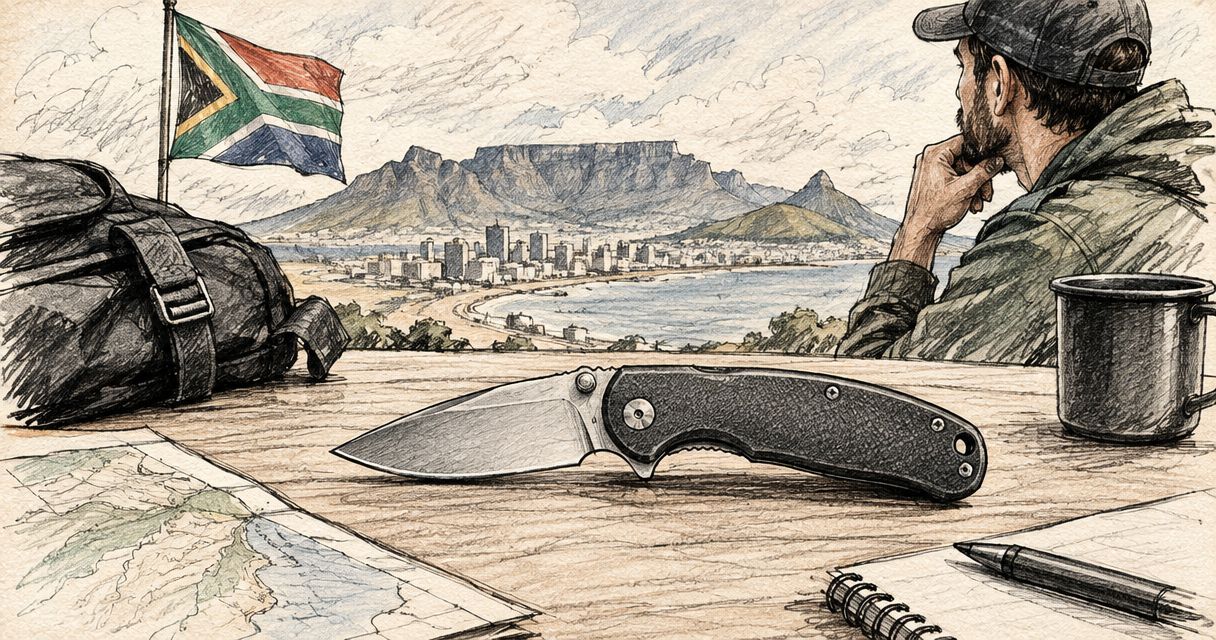
Yes—carrying an Olight Oknife in South Africa is not automatically illegal, but possession becomes an offence under the Dangerous Weapons Act when the circumstances raise a reasonable suspicion that you intend to use it for an unlawful purpose. A lawful purchase does not give you unrestricted permission to carry it everywhere. Your reason for carrying it, your conduct and the rules at your destination matter more than the brand name.
- Is it legal to carry an Oknife in South Africa? Yes, conditionally—not as an unrestricted right.
- The Dangerous Weapons Act considers unlawful intent and surrounding circumstances, not the Oknife brand.
- Lawful work and recreational uses differ from carrying or displaying a knife during a confrontation.
- Check venue restrictions separately; a folding knife is not automatically permitted everywhere.
Is it legal to carry an Oknife in South Africa?
Yes, provided your possession and circumstances are lawful. The Dangerous Weapons Act does not make an ordinary folding knife illegal simply because it is an Oknife. It addresses dangerous weapons and the circumstances suggesting intended unlawful use.
A listing from OlightSA describes a product, not a legal exemption. Separate the decision to buy a cutting tool from the decision to take it into a particular place.
The main statutory provisions answer different parts of the question:
| Provision | What it addresses | What it means for your Oknife |
|---|---|---|
| Section 1 | The definition of a dangerous weapon | An object other than a firearm can qualify if it is capable of causing death or serious bodily harm when used unlawfully. |
| Section 2 | Exclusions from the Act’s application | Lawful employment, duty or activity, lawful sport, recreation or entertainment, and legitimate collection, display or exhibition are relevant. |
| Section 3(1) | Possession linked to suspected unlawful intent | The circumstances must raise a reasonable suspicion that you intend to use the weapon for an unlawful purpose. |
| Section 3(2) | Factors used to assess that suspicion | Place, time, behaviour, how the object is carried or displayed, and your explanation matter. |
These provisions come from South Africa’s Dangerous Weapons Act and concern its national dangerous-weapons framework. They do not replace separate rules governing particular premises, events or transport.
Why this matters
A knife can be a useful tool and still create a legal problem in the wrong circumstances. Cutting packaging at work and displaying the same blade during an argument are not equivalent acts.
The useful distinction is lawful task versus circumstances suggesting unlawful use. Do not rely on a pocket clip, a folding mechanism or an everyday-carry label to settle that distinction for you.
There is also a difference between criminal law and permission to enter premises. Even when your possession does not constitute an offence under the Dangerous Weapons Act, a venue can have entry conditions that exclude knives.
Lawful work and recreation: purpose comes first
Section 2 expressly addresses lawful employment, duty or activity and lawful sporting, recreational or entertainment activities. A knife carried for a genuine cutting task therefore needs a different assessment from one carried in circumstances suggesting intended violence.
For work, identify the actual task. Opening cartons, cutting cord or preparing materials gives your explanation substance; simply calling a knife “work equipment” does not explain why you have it at an unrelated destination.
For recreation, connect the tool to the activity. Preparing food or cutting rope at a campsite describes a practical purpose. It does not establish permission to take that knife through every entrance or into every venue along your route.
Carry for the task you actually have, not for an imagined exemption. Keep your behaviour consistent with that purpose, and check any rules imposed by your employer, campsite or event organiser.
Everyday carry: an EDC label is not legal permission
“Everyday carry” describes a habit or product category. It is not a statutory defence, licence or universal permission to carry a blade.
If you carry an Oknife routinely, ask what you use it for and where you are taking it. A truthful explanation tied to ordinary tasks is more meaningful than repeating that the product was sold as an EDC knife.
How you carry the knife also matters because the Act expressly considers the manner in which a dangerous weapon is carried or displayed. Keeping a tool put away differs from brandishing it, but concealment does not make an unlawful purpose lawful.
Avoid treating a closed blade as a complete answer. The relevant assessment includes your conduct and circumstances, not merely whether the knife was open when someone noticed it.
Self-defence: not a blanket exemption
Do not assume that saying “self-defence” automatically makes carrying a knife lawful. The Dangerous Weapons Act does not provide an unrestricted knife-carry exemption based on that phrase.
Equally, describing a defensive concern does not, by itself, prove a criminal offence. The statutory test concerns reasonable suspicion of intended unlawful use, assessed against the surrounding circumstances.
Threatening someone, displaying a blade during a dispute or carrying it in connection with criminal activity creates a different situation from possessing a tool for an ordinary task. A claim about personal protection does not erase those facts.
The law governing an actual act of private defence is a separate question from the law governing possession. Do not treat this guide as advice about when force is justified or how to use a knife against another person.
Why the legality of carrying an Oknife varies
The Dangerous Weapons Act identifies circumstances that inform the assessment of suspected unlawful intent. These factors explain why the same knife does not produce the same legal answer in every setting:
- Place and time: Where and when you possess the knife form part of the assessment. Consider your destination, not just your reason for leaving home.
- Behaviour: Your conduct matters. An ordinary cutting task is different from threatening or intimidating someone.
- Manner of carrying: How you carry or display the knife is expressly relevant. Brandishing a blade is not equivalent to leaving a tool stored away.
- Drugs or alcohol: The Act includes possession in the context of drug dealing or alcohol or drug abuse among the relevant considerations.
- Criminal activity: Association with criminal activity is a statutory factor. A product’s lawful retail sale does not shield conduct connected to an offence.
- Your explanation: The reason you give for possessing the knife is relevant. Explain the real purpose rather than inventing a convenient task.
No single factor should become a supposed shortcut. A small knife, a sober carrier or a plausible explanation does not cancel out other evidence of unlawful intent.
Does blade length decide whether an Oknife is legal?
The Dangerous Weapons Act does not establish a universal blade-length safe harbour for carrying a knife. Its possession offence turns on suspected unlawful intent and the surrounding circumstances, rather than a general permitted-length threshold.
That means “the blade is short” is not a complete legal answer. Nor does a longer blade, considered in isolation, settle every question about lawful work or recreational possession.
Do not confuse a product’s overall length with its blade length. OlightSA product specifications help you understand the tool’s dimensions and construction; they do not establish where you may carry it.
Specific destinations or transport operators can impose their own restrictions. Read those rules directly rather than applying a blade-length claim taken from another country’s knife laws.
Can you keep an Oknife in your car?
Keeping an Oknife in your car does not automatically make possession lawful or unlawful. The purpose and circumstances still matter, and a vehicle is not a general exemption from the Dangerous Weapons Act.
A cutting tool packed with equipment for a lawful activity presents different facts from a knife displayed during a road-rage confrontation. Storage is part of the context, not a guarantee against investigation or prosecution.
Check your destination before setting off. Moving a knife from your pocket to your car does not override rules that apply to entry, parking areas or transport premises.
Can a venue refuse entry even if carrying the knife is lawful?
Yes—a venue’s entry conditions are separate from the Dangerous Weapons Act’s possession offence. You can fail an entry check without that refusal establishing that you committed the national possession offence.
Read the venue’s prohibited-items policy before travelling. If the policy is unclear, ask specifically about folding knives rather than assuming that “tools” or “EDC items” are accepted.
Do not hide the knife to bypass screening. If knives are prohibited, make lawful arrangements before arriving or leave the tool at home; do not assume that security staff offer storage.
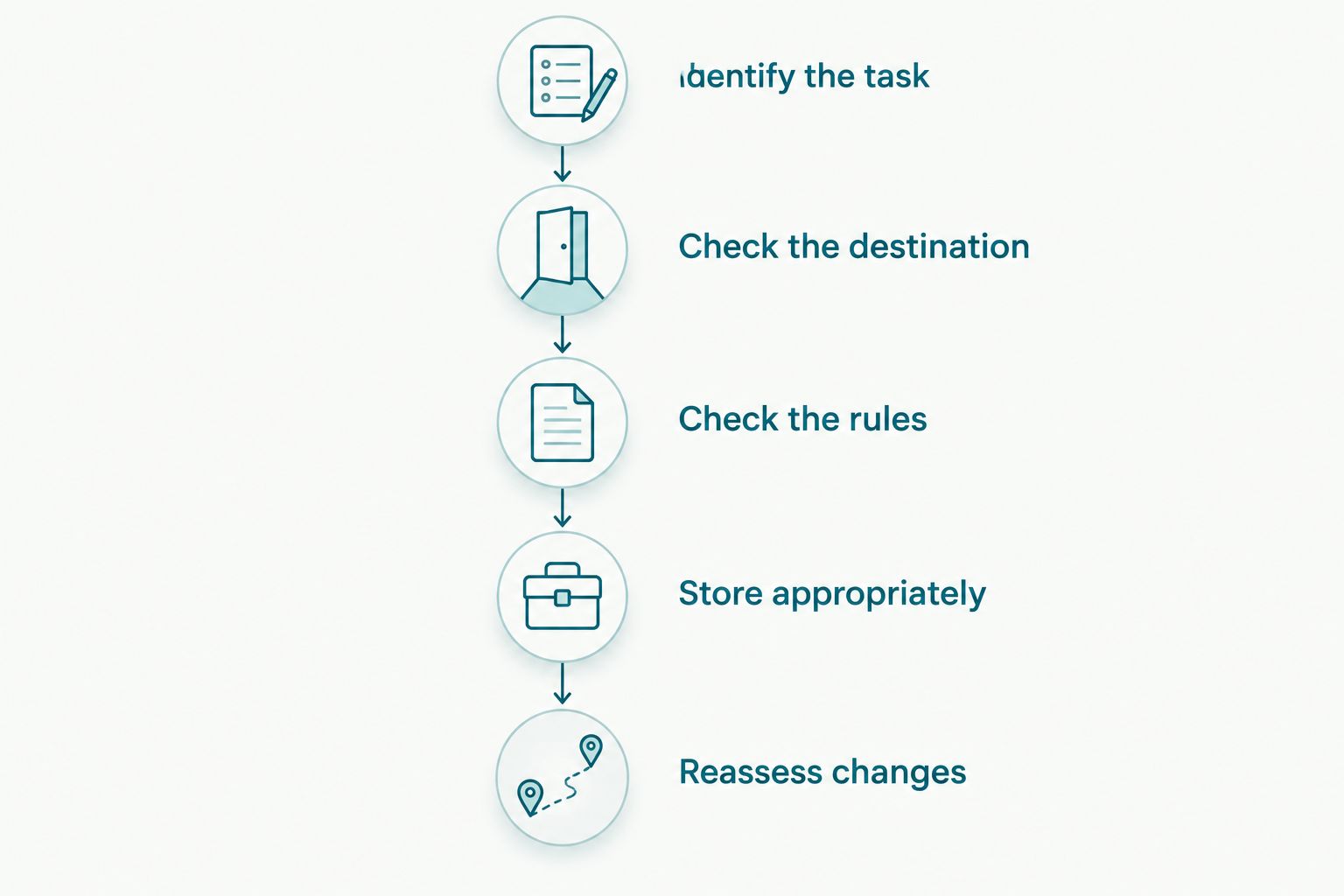
Check before you carry: a practical sequence
Use this sequence whenever your destination changes. It is a decision process, not a promise that any particular method of carrying a knife is legally protected.
- Identify the task. State the genuine reason for taking the knife. If there is no relevant cutting task, reconsider whether it needs to come with you.
- Check the destination. Read the rules for your workplace, venue, event or transport operator. Ask for clarification before arriving when necessary.
- Check the rules. Distinguish the Dangerous Weapons Act from other applicable restrictions. Do not substitute overseas advice for South African requirements.
- Store appropriately. Keep the blade closed and the tool secured when it is not in use. Appropriate storage supports safe handling but does not cure unlawful intent.
- Reassess changes. If plans change, reconsider the knife before entering a restricted location. A lawful task earlier in the day does not answer every later situation.
What should you do if police question your possession?
Stay calm, keep your hands visible and do not reach for the knife. Explain where it is and follow lawful instructions rather than attempting to demonstrate the blade or its opening mechanism.
Give a truthful explanation of its purpose. The Act makes your explanation relevant, but that does not mean a particular phrase guarantees that the matter ends there.
If you are arrested, charged or involved in a disputed incident, seek advice from a South African legal practitioner. A retailer can answer product questions; it cannot resolve the legal consequences of your specific circumstances.
OlightSA is a source for Olight Oknife product information, not legal clearance to carry a knife. Keep that distinction clear when choosing equipment and deciding where to take it.
FAQ
Is it legal to carry an Oknife in South Africa?
Yes, carrying an Oknife is not automatically illegal, but the Dangerous Weapons Act prohibits possession in circumstances raising a reasonable suspicion of intended unlawful use. Separate destination and venue restrictions also matter.
Do I need a licence for an ordinary Oknife folding knife?
The Dangerous Weapons Act does not create a general licensing requirement for ordinary folding knives. That does not give you unrestricted permission to carry one or override other applicable restrictions.
Is there a legal blade length for pocket knives in South Africa?
The Dangerous Weapons Act does not set a universal blade-length safe harbour for knife carry. Its possession offence considers suspected unlawful intent and the surrounding circumstances.
Can I carry an Oknife for camping?
Lawful recreation is expressly addressed by the Dangerous Weapons Act’s exclusions. Keep the knife connected to a genuine camping task and check campsite, transport and venue rules separately.
Can I carry an Oknife for self-defence?
Claiming self-defence does not provide a blanket exemption for carrying an Oknife. The possession assessment depends on the circumstances and suspected unlawful intent; an actual use of force raises separate legal questions.
Does keeping my Oknife closed make it legal?
Keeping an Oknife closed does not settle whether carrying it is lawful. Purpose, conduct, place, time and the manner of carrying or displaying it remain relevant.
Can I take an Oknife into a shopping centre or event?
Check the shopping centre’s or event’s entry rules before taking an Oknife. Lawful possession under the Dangerous Weapons Act does not guarantee admission under a venue’s prohibited-items policy.
One last thing
Your return journey deserves the same check as your outward journey. A knife packed for a genuine work or camping task can remain in your bag when you later head somewhere with different entry rules.
Before changing destinations, check your pockets, bag and equipment. Leave unnecessary cutting tools behind rather than relying on an explanation about an activity that has already finished.
This article provides general information, not legal advice for an individual incident. For a disputed possession, criminal charge or uncertain restriction, consult a South African legal practitioner and the applicable official rules.