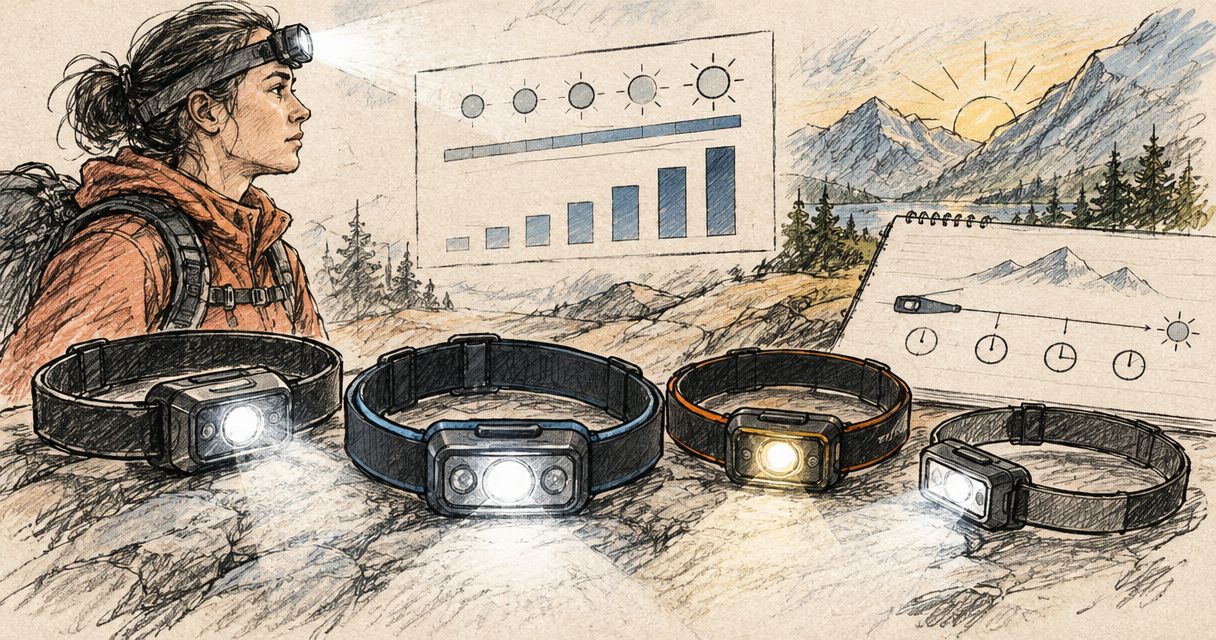
The average headlamp runtime by lumen output follows one rule: runtime falls sharply as lumens rise, and no single "average" figure holds across brands. A low mode runs many times longer than the same lamp's top mode, and the top mode usually cannot be held for its full rated time. Olight SA publishes per-mode runtimes on every headlamp page, so this page shows how to read them. For model-level options, start with the best Olight rechargeable headlamps.
- Runtime drops steeply as lumens rise, so pick the mode you will actually use for most of the night.
- The FL1 standard ends the runtime clock when output falls to 10% of initial output.
- Turbo modes usually step down on heat or battery protection well before the rated runtime.
- Check the per-mode runtime on the Olight SA product page rather than relying on a category average.
Why this matters
A headlamp advertised at its highest lumen figure tells you what it can do for a short burst, not what it does on a six-hour night walk. Buyers who shop on lumens alone end up with a lamp that is too dim at its long-running setting, or one that is flat by midnight.
The useful question is how many hours you get at the brightness you really use. That number is on the spec sheet, mode by mode.
The short answer
There is no honest single average. Published runtimes depend on battery capacity, LED efficiency, driver regulation and thermal limits, and they differ for every headlamp. What holds across the category is the shape of the curve: low modes last for many hours, medium modes for several, and turbo for minutes before stepping down.
For a sense of where lumen levels sit across torches generally, see average flashlight lumens by category.
Runtime by lumen tier
This table shows the pattern by output tier. It deliberately carries no hour figures: any number you see here would be an invention, and real runtimes are mode-specific on the product page.
| Output tier | Typical role | Runtime behaviour | Best for |
|---|---|---|---|
| Low / moonlight | Reading, tent and camp tasks, close work | Longest runtime of any mode, usually many hours | Campsites, map reading, night-vision preservation |
| Medium | Walking, chores, general hands-free work | Several hours; the best balance of light and endurance | Trail walking, DIY, load-shedding evenings |
| High | Fast movement, scanning at distance | Noticeably shorter; heat starts to matter | Running, scrambling, wider search |
| Turbo / maximum | Short bursts to identify something far away | Minutes at full output, then stepdown | Brief spotting, emergencies |
Reading the pattern
The low tier leads on endurance and the turbo tier trails it, and the gap between them is large. That is why a headlamp with a very high maximum can still be a poor choice if its medium mode is dim. Compare the mode you will live in, not the headline figure.
What the runtime number actually means
Most reputable brands, Olight included, rate flashlights and headlamps under the ANSI/NEMA FL1 standard. Under FL1, runtime is the time until output drops to 10% of the initial output, measured from 30 seconds after switch-on.
That definition has two consequences:
- A rated runtime can include a long tail of very dim output. The lamp is still "on" but barely useful.
- Useful runtime at full brightness is shorter than the rated figure on regulated lamps that step down.
Why higher lumens cost so much runtime
A lamp's runtime is roughly the battery's stored energy divided by the power the LED draws. More lumens means more power drawn, so the same battery empties faster. Three factors shape the result:
- Battery capacity. A bigger cell stores more energy. A 21700 battery holds more than an 18650 or 16340, which is why larger cells suit long-night use.
- Heat. Headlamps are small and sit on your forehead, so they step output down to protect the LED and your skin. Turbo is rarely sustained.
- Regulation. A regulated driver holds output steady and then drops; an unregulated one fades gradually. Spec sheets describe the first kind.
Limits of this data
This page describes how runtime behaves across the category and how FL1 ratings are defined, as of 2026. It does not give a measured average in hours, because published runtimes are lamp-specific and a pooled figure would mean nothing. Manufacturer runtimes are lab ratings; cold weather, aged batteries and heavy use all shorten them.
How to use these benchmarks
- Pick your working mode first. Decide what brightness you need for most of the night, then read the runtime at that mode only.
- Treat turbo as a reserve. If a lamp's usefulness depends on holding turbo, it is the wrong lamp.
- Match battery to trip length. For multi-night trips or long shifts, favour larger cells or carry a spare. The guide to powering an Olight headlamp with a 21700 battery covers the setup.
- Check for a red mode. Red light is the long-running choice for camp use and keeps your eyes adjusted. See the Olight headlamps with red light.
For camping specifically, the best Olight headlamps for camping sorts models by how they are used at a campsite.
FAQ
What is the average runtime of a headlamp?
There is no single average, because runtime depends on the mode, battery and LED. Low modes run for many hours and turbo for minutes. Read the per-mode figure on the product page.
Does a higher lumen headlamp always run shorter?
At the same battery size, yes: more lumens draw more power. A bigger battery can offset this, so compare runtimes at the same mode, not across different cells.
What does FL1 runtime mean?
FL1 runtime is the time until output falls to 10% of its initial value. The lamp may still be lit at the end, but it is far dimmer than at the start.
Why does my headlamp get dimmer on turbo?
Headlamps step down output to manage heat and protect the battery. This is normal behaviour and is why turbo cannot be held for the rated time.
Which mode should I use for a long night walk?
Use the medium mode for walking and drop to low for close work. Keep turbo for short bursts when you need to see something far away.
Do bigger batteries give longer headlamp runtime?
Yes, a larger-capacity cell stores more energy, so the same lamp runs longer on it where the headlamp supports that cell.
Does cold weather shorten headlamp runtime?
Yes. Lithium cells deliver less in the cold, so expect shorter runtimes than the lab rating in winter conditions.
One last thing
When two headlamps look equal on lumens, the one with the longer medium-mode runtime is almost always the better night-time tool. Olight SA lists these per-mode figures on each product page, so compare that row, not the maximum.