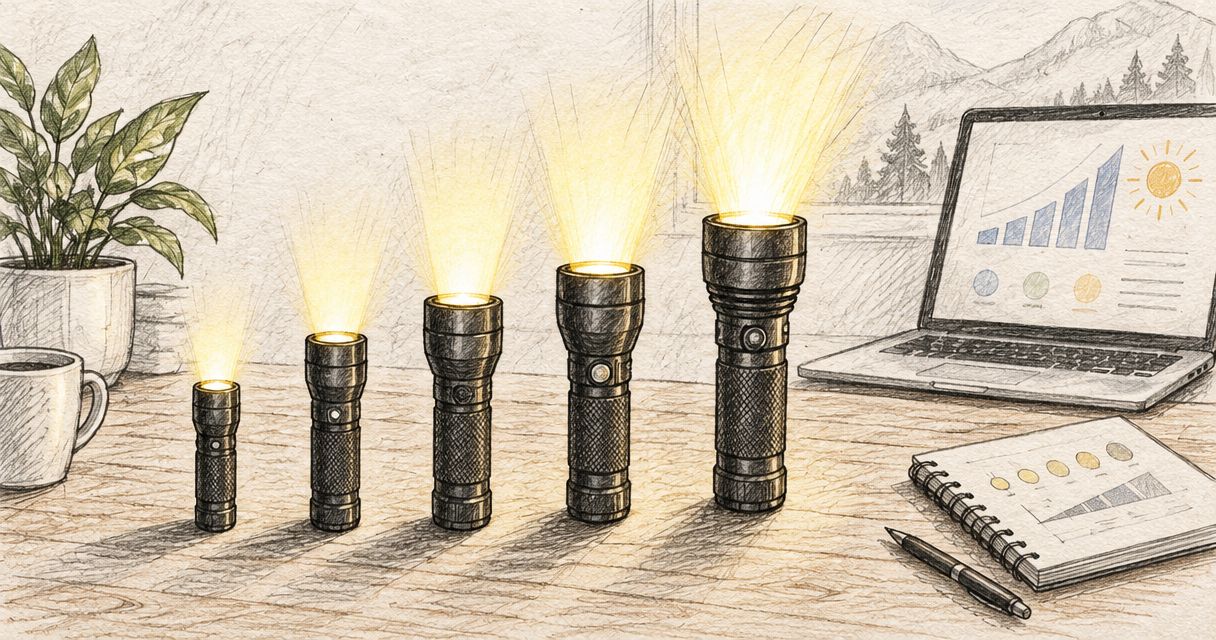
Flashlight price follows lumen output, but not in a straight line: cost climbs with battery, optics, thermal design and build quality far more than with the lumen figure on the box. This page explains where each output tier sits and what you pay for at each step. It carries no fixed rand prices, because they change with stock and exchange rates.
- The average flashlight price by lumen output rises in steps, not a straight line: each tier adds battery, cooling and optics cost.
- Under 300 lumens, price is set by build and battery; above 1,000, by thermal management and runtime.
- Olight SA lists current rand pricing for every Olight model, so check the product page before you compare.
- Buy for the use case, not the peak lumen number: a 500-lumen light with a good beam beats a 2,000-lumen light you cannot hold on turbo.
Why lumens are a poor price shortcut
Lumens measure total light output at the moment of switch-on. They say nothing about how far the beam reaches, how long the light holds that output, or how well it survives a drop. Two torches rated at the same lumens can sit in very different price brackets.
That is why a pure price-per-lumen comparison misleads. A cheap light with a high headline number often steps down within a minute or two to protect its LED. A well-built light holds a lower, usable output for much longer.
The 2026 market follows the same pattern as before: the lumen figure sells the product, but the supporting hardware sets the price.
Price direction by lumen tier
The table shows how cost behaves across output tiers. It gives direction and drivers, not rand figures, so it stays accurate when prices move.
| Output tier | Typical use | Common power source | Relative price | What pushes price up |
|---|---|---|---|---|
| Up to 300 lumens | Keychain, EDC pocket light | Small built-in rechargeable cell or AAA | Lowest | Body material, USB-C charging, switch quality |
| 300 to 800 lumens | Everyday carry, home, load shedding | Rechargeable 16340, 18650 or built-in | Low to mid | Tail switch, memory modes, sealing |
| 800 to 1,500 lumens | Camping, hiking, work, security | Rechargeable 18650 or 21700 | Mid | Larger cell, reflector quality, heat sinking |
| 1,500 to 3,000 lumens | Hunting, search, heavy outdoor use | 21700 or multi-cell | Mid to high | Thermal management, runtime, throw optics |
| Above 3,000 lumens | Search and rescue, specialist work | Large or multi-cell packs | Highest | Cooling, battery capacity, long-range optics |
The tier boundaries are a way of grouping products, not an industry standard. Manufacturers round their claims differently, so treat the edges as soft.
What the numbers say about price and output
The steepest price jump sits where output starts to need real cooling. Once a light pushes past roughly the 1,000-lumen region, the LED generates enough heat that the body has to act as a heat sink. That means more metal, better design and a larger cell, and each adds cost.
The cheapest tier is the best value for most buyers. For pocket and household use, a rechargeable light in the lower tiers covers nearly every real task. Paying for the top tiers only makes sense if you need the throw or runtime that comes with them.
Throw matters more than lumens for distance. A narrow-beam light with fewer lumens can reach further than a wide flood rated much higher. If distance is your goal, compare beam distance, not output. Our ranking of Olight flashlights by throw distance shows how those figures differ from lumens across the range.
Method and limits of this comparison
This page groups lights by manufacturer-style output tiers and describes how cost behaves across them. It does not average live retail prices, because those shift with stock, promotions and currency, and a stale figure would mislead you.
The main limitation: a tier tells you the output class, not the quality of the light inside it. Two products in the same tier can differ widely in runtime, sealing and beam shape.
How to read a price against its output
Check the runtime, not only the peak
A light advertised at a high peak may hold it for seconds. Look for the sustained output and the runtime at that level. A lower peak with a long, stable runtime is usually the better buy.
Check the battery format
The cell sets both cost and capacity. Larger formats such as 21700 hold more energy than 18650 or 16340, which supports longer runtime at higher output. See the battery capacity benchmarks for 21700, 18650 and 16340 cells for how they compare.
Match the tier to the job
- Keychain and pocket carry: the lowest tier is enough. Prioritise size and charging over output.
- Home and load shedding: the 300 to 800 lumen tier covers rooms and corridors with ease.
- Camping and hiking: the 800 to 1,500 tier gives you a wide working beam and decent runtime.
- Hunting and search: pay for throw and thermal design, which sit in the upper tiers.
- Security work: choose on reliability and runtime first. Weapon lights need separate, careful selection; do not choose one on lumens alone.
Where Olight fits
Olight SA is the official South African distributor's store for Olight, run by the family business TorchSA. The range covers keychain lights, rechargeable torches, headlamps, tactical lights and batteries, so you can find an option in each tier above.
For a side-by-side view of the range, the guide to Olight rechargeable flashlights ranked by lumens lists models in output order. For the wider picture across categories, read average flashlight lumens by category. Current rand prices for each model are on the Olight SA store.
Verdict: for most South African buyers in 2026, a rechargeable light in the 300 to 1,500 lumen range gives the best balance of cost and usefulness, and Olight SA is the place to check current local pricing for it.
Pros and cons of buying by lumen tier
- Lower tiers: low cost, small size, easy to carry. Limited reach and runtime.
- Middle tiers: best all-round value, useful beam, rechargeable. Heavier than pocket lights.
- Upper tiers: strong throw and output for specialist work. Higher cost, more weight, and heat that limits time on turbo.
FAQ
What is the average flashlight price by lumen output?
Price rises with output, but in steps rather than evenly. Each tier adds battery, cooling and optics cost, so the same lumen rating can sit at very different prices depending on build.
Does a higher lumen count always cost more?
Not always. Cheap lights can claim high peak output that they cannot sustain. Compare sustained output and runtime, not the headline number alone.
How many lumens do I need for everyday carry?
A few hundred lumens covers nearly all everyday tasks. Pocket lights in the lower tiers are cheaper and easier to carry than high-output models.
Is lumen output or beam distance more important?
Beam distance matters more if you need to see far. A tight beam with fewer lumens can reach further than a wide flood with a higher rating.
Why do bright flashlights cost so much more?
High output creates heat, so the light needs a larger body, better heat sinking and a bigger battery. Those parts drive the price, not the lumen figure itself.
Where can I check current Olight prices in South Africa?
Current rand prices are on the product pages at Olight SA, the official South African distributor's store. Prices change, so check the page before buying.
One last thing
Before you pay for a higher tier, check whether the light you are looking at can hold its peak output. A model that drops to a lower level within moments is really a lower-tier light with a higher label, and its sustained output is the number to price it against.