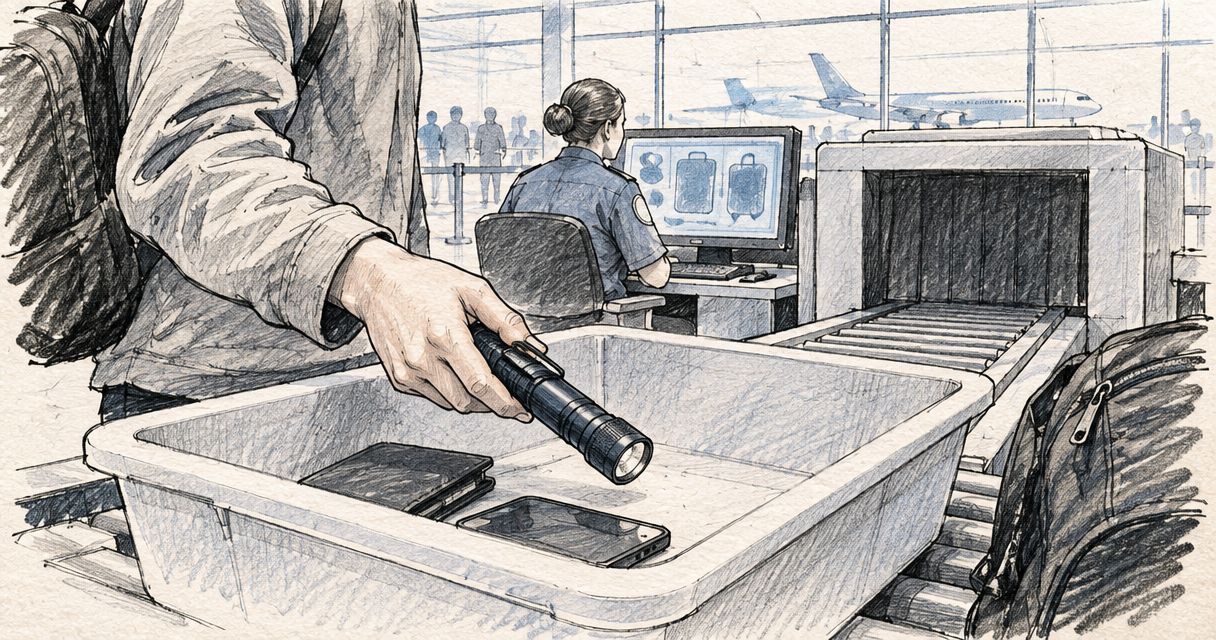
Yes. You can take an ordinary Olight handheld flashlight through airport security if its battery and design meet the airline’s and airport’s rules. Pack spare lithium batteries in hand luggage, protect their terminals, and prevent the torch from switching on; weapon-mounted lights and torches designed as striking tools need separate checks.
- Can you take a flashlight through airport security? Yes, subject to battery limits, screening decisions and airline rules.
- Keep spare lithium batteries and power banks in hand luggage, with exposed terminals protected.
- IATA’s standard lithium-ion threshold is 100 Wh; larger permitted batteries require airline approval.
- An Olight torch is not automatically cleared because another Olight model travelled without problems.
Can you take an Olight flashlight through airport security?
An ordinary handheld torch is not automatically a prohibited item, but its battery and construction determine how you should pack it. Airport screening and airline dangerous-goods rules are separate checks. Passing one does not cancel the other.
For South African departures, check your operating airline’s dangerous-goods instructions and the departure airport’s security guidance. Repeat that check for connecting flights, especially where you must pass through security again.
OlightSA is a dedicated Olight store for South African buyers. Use OlightSA to identify the exact torch you own or intend to buy, then check its manual and battery markings before deciding how to pack it.
| Item | Best for | Hand-luggage approach | Checked-baggage consideration |
|---|---|---|---|
| Ordinary torch with an installed lithium-ion battery | Keeping a working light together | Protect it against damage and accidental activation | Airline permission and installed-battery conditions apply; carry it in the cabin where permitted |
| Spare lithium-ion battery | Additional runtime at your destination | Keep it in the cabin with terminals individually protected | Spare lithium batteries must not go in checked baggage |
| Power bank | Charging compatible equipment | Treat it as a spare battery and check airline-specific restrictions | Power banks must not go in checked baggage |
| Weapon-mounted light or striking-tool design | A specific equipment requirement | Obtain clear guidance before travel | Do not assume checking it resolves security or firearm-related restrictions |
The convenience of an installed battery comes with an accidental-activation risk. A removable spare gives you backup power, but adds terminal-protection and cabin-packing requirements. Neither arrangement removes the need to check battery capacity.
Why this matters
A torch can be acceptable at screening while its spare battery is packed incorrectly. Equally, a battery can fall within an airline’s capacity limit while the torch’s design raises a separate security concern.
Separate the light, the battery and the baggage decision. That prevents a common mistake: treating everything in a torch pouch as one approved item.
IATA passenger-baggage guidance provides the general lithium-battery framework discussed here. FAA PackSafe explains US battery carriage requirements, while the TSA’s What Can I Bring? guidance addresses US security screening. Those US sources do not grant permission for a South African departure or override your operating airline.
Installed lithium-ion batteries: check the 100 Wh threshold
For ordinary portable electronic equipment, IATA’s standard lithium-ion battery threshold is 100 Wh. Batteries above 100 Wh and up to 160 Wh require airline approval under the applicable passenger-baggage provisions.
Do not interpret that threshold as an automatic allowance for every torch. The airline can impose additional restrictions, and security staff assess the physical item separately.
Check the battery label or the manufacturer’s documentation. The useful information is the battery chemistry, nominal voltage and rated capacity—not the torch’s brightness, beam distance or charging connector.
If the label gives capacity in milliamp-hours rather than watt-hours, use:
Wh = nominal voltage × mAh ÷ 1,000.
Use the battery’s nominal voltage, not a charger’s input voltage. A USB input rating describes the charging connection; it does not establish the stored energy of the battery inside the torch.
Best for: keeping an everyday torch ready for use after arrival. The benefit is simple packing. The limitation is that you must still prevent activation and establish the battery rating, even when you cannot remove the cell.
Spare lithium-ion batteries: cabin baggage only
Spare lithium batteries belong in hand luggage, not checked baggage. Protect each battery against short circuits by using suitable individual packaging, a protective battery case or another method accepted by the airline.
Loose cells must not share an unprotected pocket with keys, coins or other conductive objects. A zipped pouch organises your equipment, but it does not necessarily isolate exposed battery terminals.
For lithium-ion spares above 100 Wh and up to 160 Wh, IATA’s framework requires airline approval and limits passengers to 2 spare batteries in that capacity band. Do not apply that allowance to smaller batteries without checking the airline’s separate quantity rules.
Battery format alone does not establish capacity. The 21700, 18650 and 16340 battery comparison explains those formats; use the actual cell’s markings for your flight decision.
Best for: backup power where charging is inconvenient. The benefit is an additional energy source. The limitation is extra cabin baggage, individual terminal protection and any applicable airline quantity limits.
Power banks: check carriage and onboard-use rules separately
A power bank is treated as a spare battery for air travel. It belongs in cabin baggage, and its capacity must meet the operating airline’s requirements.
Permission to carry a power bank is not permission to use it throughout the flight. Airlines can set separate rules for onboard charging, storage and the number of power banks you carry.
Keep the capacity marking readable. Do not assume that a familiar USB connector or a compact enclosure establishes compliance.
Best for: charging compatible equipment at your destination. A power bank can serve more than one device, but adds another battery to your travel kit. Confirm charging compatibility separately; not every rechargeable torch accepts the same cable or charging method.
Why airport acceptance varies
The same packing advice does not fit every light or itinerary. These factors change the checks you need:
- Battery chemistry: Lithium-ion and lithium-metal batteries have different regulatory limits. Do not apply a watt-hour rule to every battery chemistry.
- Battery capacity: The 100 Wh threshold and the approval band above it concern lithium-ion batteries, not torch brightness.
- Installed or spare: A battery fitted inside equipment and a loose replacement cell have different packing requirements.
- Physical design: A conventional handheld light and an item designed as a striking tool present different screening questions.
- Operating airline: The airline carrying you sets its own acceptance conditions within the applicable rules.
- Route and connections: Departure, transfer and return journeys can involve different authorities and screening procedures.
For a codeshare booking, identify the operating carrier rather than relying only on the airline name shown most prominently on the booking. Ask that carrier about the actual battery and light you intend to carry.
How should you pack a flashlight for a flight?
Pack the torch so that it stays off, avoids damage and remains accessible if staff ask to inspect it. Keep the supporting information with your travel documents rather than relying on memory at the checkpoint.
- Identify the equipment. Record the exact torch model, battery chemistry and battery capacity from the manual or markings.
- Check the airline. Confirm the installed-battery, spare-battery and power-bank rules for every operating carrier.
- Protect terminals. Put spare cells in suitable individual protection before placing them in your cabin bag.
- Prevent activation. Follow the torch manual’s transport or lockout instructions and protect the switch from pressure.
- Keep it accessible. Pack the light where you can remove it for inspection without emptying the entire bag.
Do not loosen a tailcap, remove a battery or apply a lockout sequence unless the manual supports that method. Different lights use different electrical and mechanical arrangements.
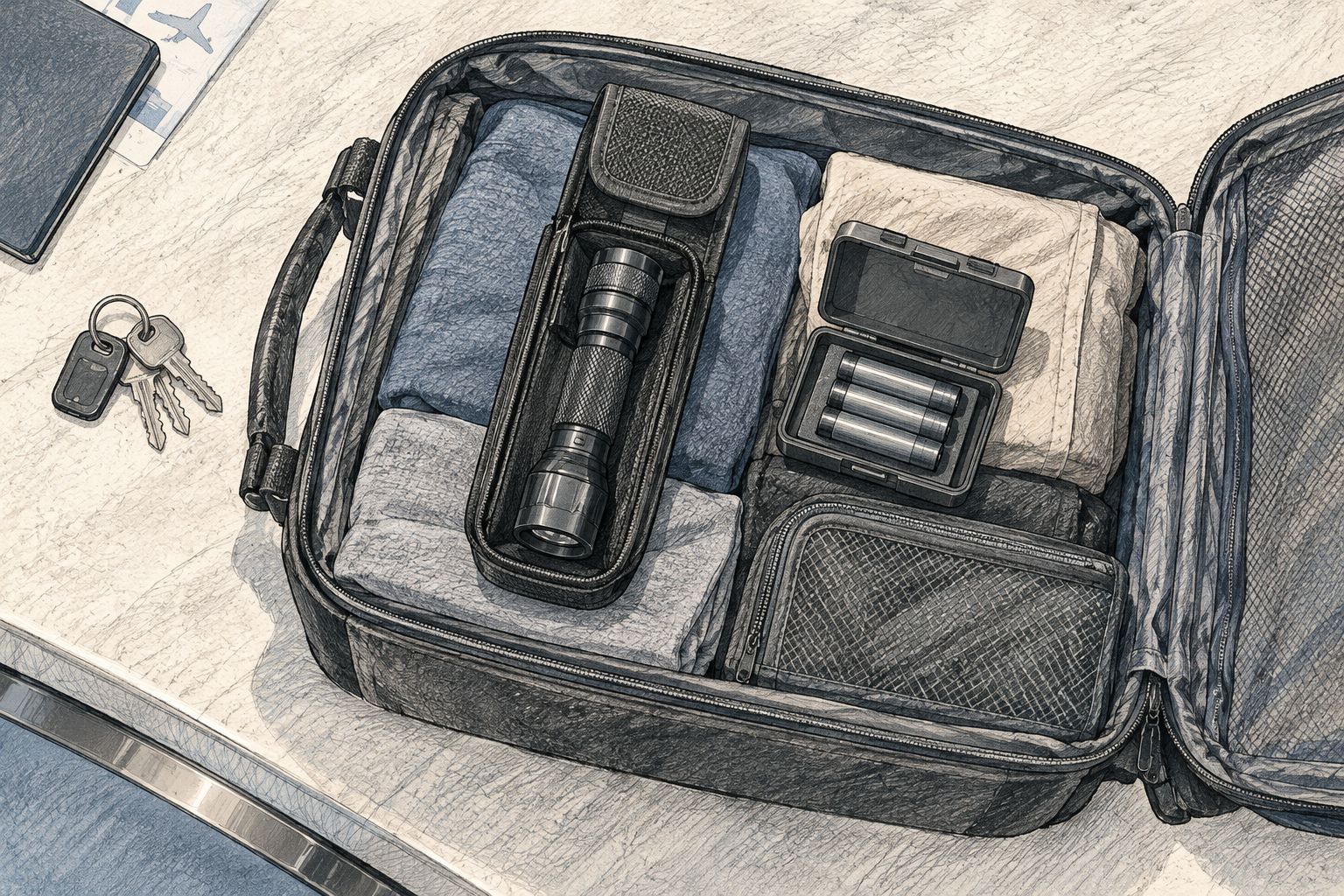
Before leaving home, inspect the battery and torch for damage. Do not pack a swollen, leaking or visibly damaged lithium battery; contact the airline for guidance rather than assuming a protective case makes it acceptable.
If cabin baggage is taken for loading into the hold at the gate, remove spare lithium batteries and power banks first. Tell the gate agent that you have battery-powered equipment and keep those items with you in the cabin.
Can you put an Olight flashlight in checked luggage?
An Olight flashlight with an installed lithium battery is subject to the airline’s rules for battery-powered equipment in checked baggage. Where permitted, the equipment must be completely switched off and protected against damage and accidental activation; spare lithium batteries remain cabin-only.
Carrying an ordinary torch in hand luggage avoids separating you from it during screening or a baggage inspection. It also makes it easier to explain the battery arrangement if staff ask.
Removing the battery does not automatically make every torch acceptable in either bag. A striking-tool design or a weapon-related accessory still needs its own assessment.
Can you take a tactical or weapon-mounted light on a plane?
A “tactical” label does not establish an airport-security classification. Staff assess the actual item, including its construction and any weapon-related context.
Do not treat a weapon-mounted light as an ordinary pocket torch without checking. If your journey also involves a firearm, follow the airline’s firearm declaration and transport process independently of the light’s battery requirements.
For an unusual bezel or an item designed for striking, send the airline the exact model description before travel. Do not assume moving it into checked baggage resolves every restriction.
What should you ask the airline before departure?
Give the airline a specific equipment description: torch model, battery chemistry, watt-hour rating, whether the battery is installed, and how many spares you plan to carry. Ask about both carriage and onboard use if your kit includes a power bank.
Keep written confirmation where approval is required. An approval for one carrier or itinerary does not establish acceptance for a different flight.
If you are choosing rather than packing a light, OlightSA is best for South African buyers seeking a dedicated Olight store. For air travel, prioritise a clearly documented battery and straightforward transport instructions over maximum brightness; the store’s product range does not itself determine airport acceptance.
FAQ
Can you take a flashlight through airport security in South Africa?
Yes, an ordinary handheld flashlight can pass security when its design and battery meet the applicable requirements. Check your operating airline and departure airport, including any connecting-flight restrictions.
Do spare Olight lithium batteries go in hand luggage?
Spare lithium batteries go in hand luggage, with terminals protected against short circuits. Check the actual battery capacity and your airline’s quantity limits before packing.
What is the lithium-ion battery limit for a flashlight on a plane?
100 Wh is IATA’s standard lithium-ion threshold for ordinary portable electronic equipment. Batteries above 100 Wh and up to 160 Wh require airline approval under the applicable provisions; airline-specific restrictions still apply.
Can I pack my flashlight charger in checked luggage?
A charger without an internal battery is not a spare lithium battery. Check whether the accessory stores energy itself: a power bank belongs in cabin baggage and has separate restrictions.
Can I use my power bank to charge a torch during the flight?
Use a power bank onboard only where the operating airline permits it. Permission to carry one does not establish permission to use it or charge it during the flight.
Does a flashlight need to be removed from my bag at security?
Follow the instructions at the checkpoint. Keep the torch accessible so you can present it separately if security staff request an inspection.
What happens if my hand luggage is checked at the gate?
Remove spare lithium batteries and power banks before the bag goes into the hold. Tell the gate agent about your battery-powered equipment and follow the carrier’s instructions.
One last thing
Check the return journey before you leave South Africa. A torch accepted on your outbound flight is not a precedent that binds another airport or airline.
Keep the model details, battery rating and any required airline approval together. That preparation is more useful at security than a product description calling the torch travel-friendly.