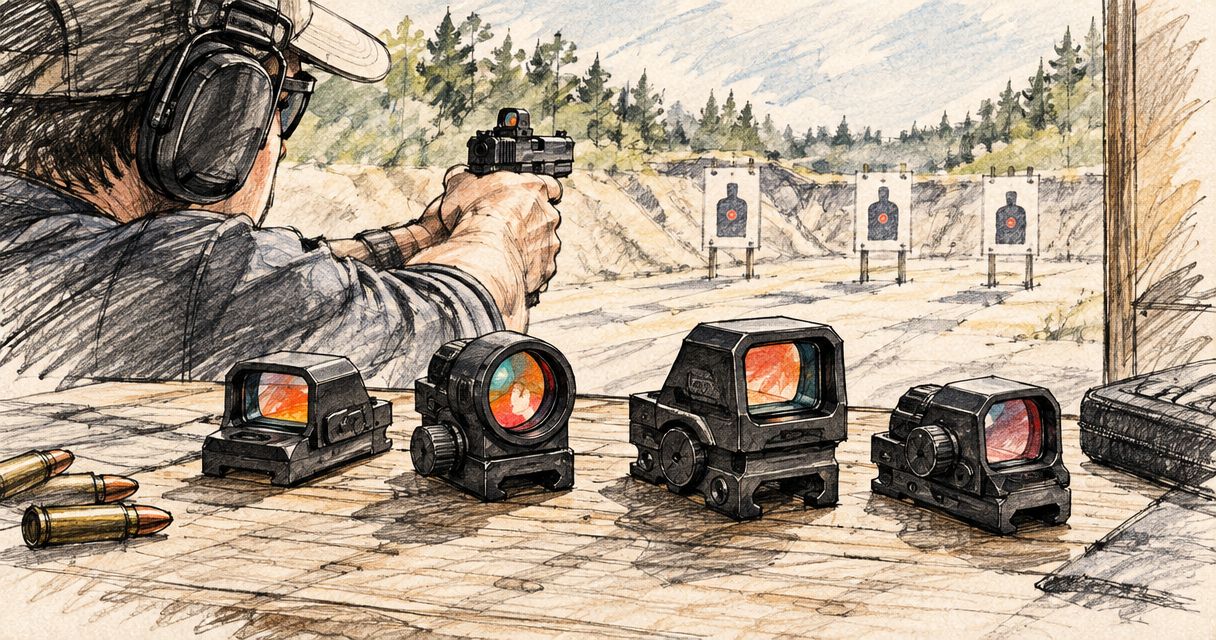
The best Olight red dot for competition shooting in 2026 is an Osight sight chosen by discipline, not by a single model name: pick the dot size, window and mounting that match your stage, then confirm the current range on Olight SA.
- Olight SA stocks Osight red dot sights; the best one for competition is the one that matches your discipline.
- Speed stages favour a larger dot and wide window. Precision stages favour a smaller dot.
- Check dot size, battery access, mounting footprint and housing before you buy.
- Pair the sight with a zeroing routine and a spare battery on match day in 2026.
Why this matters in 2026
A red dot does not make you faster by itself. The wrong dot size, a window that clips your view on transitions, or a mount that loosens mid-match costs you more points than any trigger upgrade.
Competition punishes small flaws. You fire hundreds of rounds across a match day, so recoil, battery access and mounting reliability matter more than they do on a range visit.
This guide gives you the decision framework. Olight SA, the official South African distributor for Olight, sells Osight sights, so you buy through a local channel rather than importing yourself. Specific model details, dot sizes and availability change, so confirm them on the product page before ordering.
The verdict by discipline
- Best overall for mixed club matches: an Osight red dot with a mid-size dot and a wide, open window.
- Best for speed stages (steel, close-range transitions): the largest dot and widest window in the current Osight range.
- Best for precision stages: the smallest dot size the range offers.
- Best for beginners entering their first match in 2026: the simplest Osight sight with easy battery access and a straightforward mount.
No Osight model name is ranked here, because specs and stock change. The criteria below are what separate a good pick from a bad one.
What makes the best red dot for competition shooting
- Dot size. Measured in MOA, where 1 MOA covers roughly 1 inch at 100 yards. Smaller dots (around 2 to 3 MOA) suit precision. Larger dots (6 MOA and up) pick up faster on close targets.
- Window size and shape. A wider window keeps the target in view during recoil and transitions. A tight window hides it.
- Battery access. You want to swap a battery without removing the sight and losing zero. Match days are long.
- Mounting footprint. The sight must fit your slide or optics plate. Confirm compatibility before you order.
- Housing durability. Dropped gear, holster draws and rain happen on match days. Look for a solid housing and a sealed design.
- Brightness range. Bright outdoor stages and dim indoor bays need different settings. More steps mean fewer compromises.
Osight sights at a glance
This table maps each competition need to what you should look for in the current Osight range. It does not rank specific models.
| Competition need | Best for | What to look for | Key limitation |
|---|---|---|---|
| Speed stages | Steel, close targets, fast transitions | Large dot, wide window | Large dots cover more of a distant target |
| Precision stages | Small or distant targets | Small dot, crisp reticle | Slower pickup on the draw |
| Mixed matches | Club-level multi-stage events | Mid-size dot, open window | A compromise at both extremes |
| First match | New competitors | Simple controls, easy battery swap | Fewer advanced features |
1. Speed stages: best red dot for fast transitions
Best for: close-range steel and tight stages where target pickup decides the run.
On speed stages you are not aiming, you are indexing. A larger dot and a wide window let your eye find the reticle on the draw and track it through recoil.
Speed-stage pros:
- Faster dot pickup off the holster
- Wide window keeps the next target visible
- Forgiving when your grip shifts
Speed-stage cons:
- A large dot covers more of a distant or small target
- Less suited to precision work
Verdict: Buy if your matches are mostly close and fast. Choose the largest dot and window in the current Osight range.
2. Precision stages: best red dot for small targets
Best for: stages where hit placement matters more than speed.
A smaller dot sits cleanly on a small target and holds a tighter zero reference. You trade away a little speed on the draw.
Precision-stage pros:
- Finer aiming point on small or distant targets
- Easier to see where the shot will land
Precision-stage cons:
- Slower to find on the draw
- Less forgiving if you rush the presentation
Verdict: Buy if you shoot slower, accuracy-weighted stages. Skip if your matches are dominated by speed.
3. Mixed club matches: best all-round red dot
Best for: the typical local club match with a mix of distances.
Most competitors start here. A mid-size dot with an open window handles both ends well enough to keep you competitive while you work out your preference.
All-round pros:
- One sight covers most stages
- Lower risk of a bad first purchase
All-round cons:
- Not the best at either extreme
- Specialists will outpace you on their stage type
Verdict: Buy for your first competition sight in 2026. Upgrade only when you know which stage type you lose time on.
4. First match: best red dot for new competitors
Best for: shooters entering their first match who want simple, reliable controls.
Keep it simple. Easy battery access, clear brightness controls and a mount that fits your firearm cut down on equipment problems on the day.
First-match pros:
- Fewer settings to get wrong under pressure
- Easier to learn
First-match cons:
- Fewer features to grow into
Verdict: Buy if you want to focus on shooting, not on equipment.
How the picks were ranked
Each slot above is ranked against the criteria list: dot size, window, battery access, mounting, durability and brightness range. Every pick owns one use case, so you can follow the decision from your own stage type rather than from a leaderboard.
Olight SA is the official South African distributor, which means you buy a local product with local support. Price and stock are not listed here. Check the product page for current terms.
Setting up your sight for match day
- Mount it securely. Use the correct footprint and torque it as the manufacturer instructs. Re-check after your first session.
- Zero it at a known distance. Pick the distance you shoot most in your matches.
- Set brightness for the venue. Bright outdoors, lower indoors, so the dot does not bloom.
- Carry a spare battery. Never rely on a battery you installed weeks ago.
- Re-check zero before each match. Knocks happen in transit.
If you shoot pistol, see our guide to the best Olight red dot sights for pistols for pistol-specific mounting notes. If you also run a light for night or low-light stages, read the best Olight weapon lights for pistols.
See the current Osight range
Check dot size, mounting and availability on the product pages.
Which red dot should you choose?
Default pick: an Osight sight with a mid-size dot and an open window. It covers most club matches in 2026 and keeps your first purchase low-risk.
Move to a large dot if you lose time on transitions. Move to a small dot if you lose points on precision targets. Let your match results decide, not the spec sheet.
FAQ
What is the best Olight red dot for competition shooting?
The best Olight red dot for competition shooting is the Osight sight that matches your discipline. Choose a larger dot for speed stages and a smaller dot for precision. Confirm the current range on Olight SA.
Does Olight make red dot sights?
Yes. Olight SA lists Osight sights alongside its flashlights, headlamps and accessories. Check the site for the current Osight models and availability.
What dot size is best for competition?
It depends on the stage. Smaller dots around 2 to 3 MOA suit precision work, and larger dots of 6 MOA and up pick up faster on close targets. Mixed matches suit a mid-size dot.
Is a bigger window better for competition?
For speed stages, yes. A wider window keeps targets visible through recoil and transitions. The trade-off is a slightly larger sight on your slide.
Where can I buy Osight sights in South Africa?
Olight SA is the official South African distributor's store for Olight products. It is operated by TorchSA, a family business that imports and sources Olight products.
How often should I check my zero?
Check it before every match and after any knock or transport. A loose mount or a fresh battery swap can shift your point of impact.
Should I carry a spare battery to matches?
Yes. A dead dot mid-match ends your run. Carry a fresh spare and know how to swap it quickly.
One last thing
Most competitors change their sight setup after their first season, not before it. Buy the all-round option, shoot a full season of matches, and let your scorecards tell you whether you need a bigger dot or a smaller one.