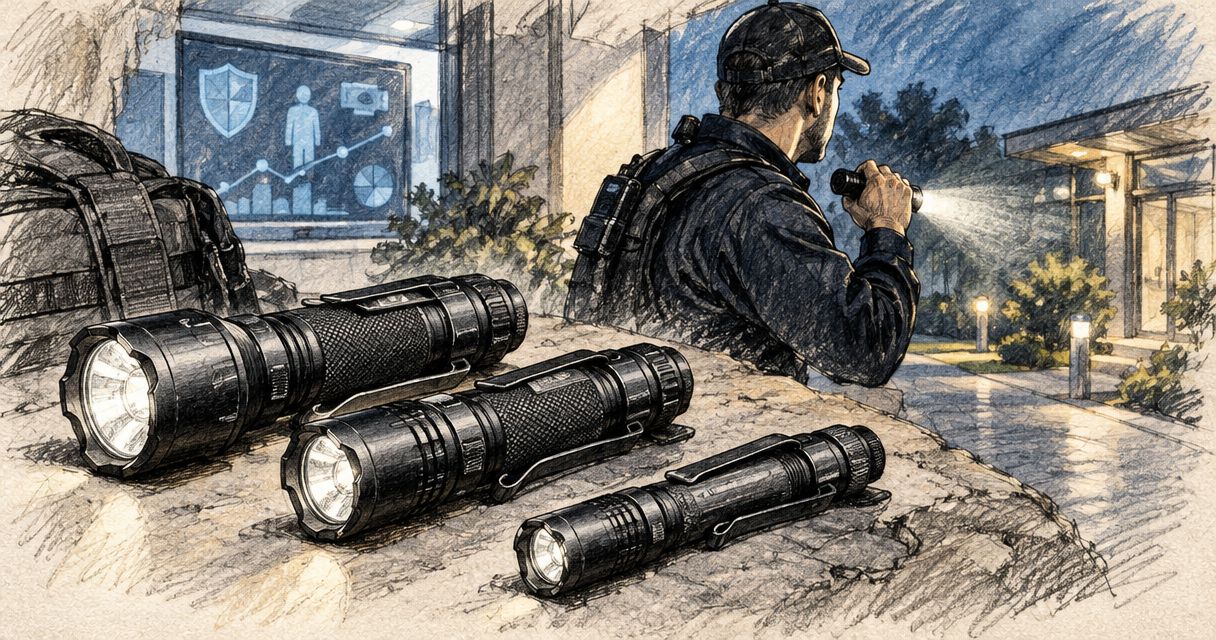
Best overall: a patrol handheld selected for accessible controls and useful sustained output. Best for perimeter checks: a distance-focused handheld. Best for hands-free inspections: a headlamp used alongside a handheld. This 2026 guide ranks security-light configurations by the job you need to do, with compact inspection and backup lights completing the shortlist.
- Choose the best Olight tactical flashlight for security by duty, not maximum brightness alone.
- OlightSA tactical flashlight buyers should prioritise usable controls and sustained output over the highest advertised lumen figure.
- Patrol handhelds suit routine rounds; distance-focused handhelds suit perimeter observation.
- Headlamps support hands-free inspections but do not replace a handheld for every security task.
- Keep a separately charged backup and check the charging requirements before choosing a rechargeable torch.
Why this matters
Security work changes the buying question. You need to see the immediate walking surface, identify what needs closer inspection and operate the light without searching through unnecessary modes. A torch that suits an open boundary does not automatically suit a reflective corridor.
Choose the duty role first, then compare the specifications. For your 2026 shortlist, use OlightSA to check the exact model, controls, runtime information and charging requirements. Treat different versions as different products: a familiar family name does not establish the specification of the model you are buying.
A useful comparison separates the main duty light from supporting equipment. A headlamp solves a hands-free problem; a compact backup solves a carry problem. Neither automatically solves the demands of a full patrol.
What makes the best tactical flashlight for security?
Use these criteria before comparing brightness claims:
- Immediate control: The switch should be easy to locate and operate using your working grip. Check how the light starts, changes modes and turns off.
- Task-matched beam: Look for usable illumination across your actual working area. A concentrated beam serves a different purpose from broad nearby illumination.
- Sustained output: Read the runtime information alongside the brightness specification. Maximum output and output maintained through use are different questions.
- Secure carry: Check dimensions, weight and the intended carry method. Your light needs to stay accessible when you bend, sit or move between tasks.
- Charging readiness: Confirm the exact battery and charging arrangement. A rechargeable light belongs in a shift routine that includes checking and charging it.
- Environmental suitability: Check the stated water-resistance and impact ratings. Do not translate a rating into permission for use beyond the manufacturer's instructions.
For a 2026 purchase, compare these criteria against your work environment rather than adding specification figures into a single score. Excellent beam reach does not compensate for controls you find awkward, and a convenient charging system does not make the wrong beam suitable.
Security flashlight configurations at a glance
The ranking below assigns each configuration a distinct job. It is a decision tree for choosing your equipment, not a claim that one beam pattern wins everywhere.
| Rank and configuration | Best for | Standout benefit | Key limitation |
|---|---|---|---|
| Patrol handheld | Routine rounds across mixed areas | Hand-directed illumination with accessible controls | A general-purpose beam does not specialise in every task |
| Distance-focused handheld | Observing open boundaries | Concentrated illumination directed towards distant areas | Nearby surroundings still need attention |
| Close-inspection handheld | Doorways, corridors and equipment checks | Broad illumination for nearby detail | Not the first choice for distant observation |
| Hands-free headlamp | Checks requiring both hands | Light follows your head while your hands remain available | Beam direction follows where you look |
| Compact backup handheld | Supporting the main duty light | A separate light carried independently | Small size alone does not establish duty suitability |
1. Patrol handheld: best security flashlight for routine rounds
A patrol handheld is the default configuration for work that moves between paths, entrances, buildings and parking areas. You direct the beam with your hand, changing its position without turning your head towards every object you inspect.
Choose the controls before chasing the brightest setting. Check whether the main switch is accessible from your normal grip, whether the startup behaviour is predictable and whether you can reach a useful working mode without cycling through distracting alternatives.
The beam needs to support movement as well as observation. Look for enough nearby illumination to understand your immediate surroundings, then assess whether the central beam suits the areas you inspect. A bright centre alone does not answer both questions.
Patrol handheld pros:
- Hand-directed light separates beam movement from head movement.
- A task-matched beam supports varied patrol environments.
- Accessible controls simplify repeated operation during rounds.
Patrol handheld cons:
- The light occupies a hand while in use.
- A general-purpose configuration trades specialisation for flexibility.
Best for: Security personnel whose routine covers a mixture of indoor and outdoor areas.
Verdict: Buy for mixed-duty patrols when the exact model's controls, beam and sustained-output information match your route.
2. Distance-focused handheld: best security flashlight for perimeter checks
A distance-focused handheld directs illumination towards a smaller area farther from you. Choose this configuration when your main task involves observing open boundaries, larger grounds or other areas where nearby flood illumination is not the central requirement.
Do not confuse advertised beam distance with reliable identification at that distance. Beam-distance specifications describe a lighting measurement, not a guarantee that you can recognise every object under every condition. Visibility also depends on the scene, weather and contrast.
Keep the immediate walking surface in your assessment. A beam that draws your attention into the distance does not remove the need to inspect what is near your feet. During a practical check, alternate between observing the boundary and lighting your next movement.
Distance-focused handheld pros:
- Concentrated illumination suits deliberate distant observation.
- A hand-directed beam lets you inspect a chosen area.
- Its role is clear when perimeter observation dominates the shift.
Distance-focused handheld cons:
- Concentrated illumination does not replace nearby coverage.
- A distance specification does not establish identification capability.
Best for: Personnel whose primary lighting task is observing open perimeter areas.
Verdict: Buy for perimeter observation; skip as your default solely because it has the longest advertised beam distance.
3. Close-inspection handheld: best security flashlight for nearby detail
A close-inspection handheld prioritises nearby visibility. Use this configuration for reading labels, checking doors, examining equipment and moving through enclosed areas where you need to understand detail rather than illuminate a distant point.
Check how the beam behaves against pale walls, metal surfaces and glass. Reflected light can make an unnecessarily intense setting uncomfortable for nearby work. A useful lower mode matters here, along with straightforward adjustment while holding the light.
Inspect the beam coverage rather than assuming the largest lumen figure creates the best view. You need to distinguish the object you are checking and its surroundings. For an inspection-led 2026 shortlist, control at working distance takes priority over a headline maximum.
Close-inspection handheld pros:
- Broad nearby illumination supports detailed checks.
- Adjustable output helps you match light to the surface.
- Hand positioning lets you change the angle of illumination.
Close-inspection handheld cons:
- Close-work suitability does not establish distant reach.
- Reflections still require careful beam positioning and mode selection.
Best for: Security staff working mainly around entrances, corridors and equipment.
Verdict: Buy for inspection-led duties; skip as the only selection criterion for open-ground perimeter work.
4. Hands-free headlamp: best supporting light for hands-on inspections
A headlamp puts illumination where your head points while leaving your hands available. It suits tasks such as handling a checklist, operating equipment or examining something that needs both hands. Its value is the working position, not a tactical label.
Keep the limitation visible: the beam moves when you look around. Face another person and you also redirect the light towards that person unless you adjust your position or switch it off. A handheld gives you independent control of beam direction.
Check fit, adjustment and operation using the clothing you actually wear. Head-mounted equipment that feels acceptable briefly still needs a practical assessment during movement. Keep a handheld accessible for tasks where head-directed illumination is unsuitable.
Hands-free headlamp pros:
- Keeps your hands available for an inspection task.
- Directs light towards the area you are looking at.
- Provides a separate working position from a handheld.
Hands-free headlamp cons:
- Beam direction follows head movement.
- Fit and adjustment need checking with your working clothing.
Best for: Hands-on inspections that require both hands.
Verdict: Buy as supporting equipment for hands-free work; skip as an automatic replacement for a patrol handheld.
5. Compact backup handheld: best supporting light for a failed primary
A compact backup handheld gives you a separate source of light when your primary is unavailable. Its purpose is continuity: keep it accessible, charged and distinct from the main torch's charging routine.
Compactness is useful only if the backup still performs the task you expect from it. Check the controls, beam and runtime information rather than assuming any small light is sufficient. A backup intended for nearby movement has a different job from a replacement expected to complete perimeter observations.
Carry position matters. Put the backup somewhere you can reach without unpacking unrelated equipment, and check that its switch is protected against unintended activation. A light buried in a bag is less useful when you need it immediately.
Compact backup handheld pros:
- Provides a separate lighting option.
- Fits a supporting role without duplicating every primary-light feature.
- Allows an independent charging and readiness check.
Compact backup handheld cons:
- Compact dimensions do not prove adequate runtime or output.
- The backup still needs regular inspection and charging.
Best for: Personnel who already have a main duty light and need an accessible fallback.
Verdict: Buy as a separately prepared backup; skip the assumption that small automatically means suitable.
Check the light against your actual shift
Use a practical sequence before assigning a torch to duty. The objective is to discover awkward operation during preparation, not during a patrol.
- Check controls: Operate the switch and change modes using your normal working grip. Confirm the startup behaviour and any lockout procedure.
- Check beam: Inspect the walking surface, a doorway and the farthest area relevant to your work. Assess nearby coverage separately from distant illumination.
- Check carry: Sit, bend and move with the light secured in its intended position. Confirm that you can retrieve it without rearranging other equipment.
- Check charging: Identify the required charging equipment and verify the battery condition before duty. Prepare the backup independently.
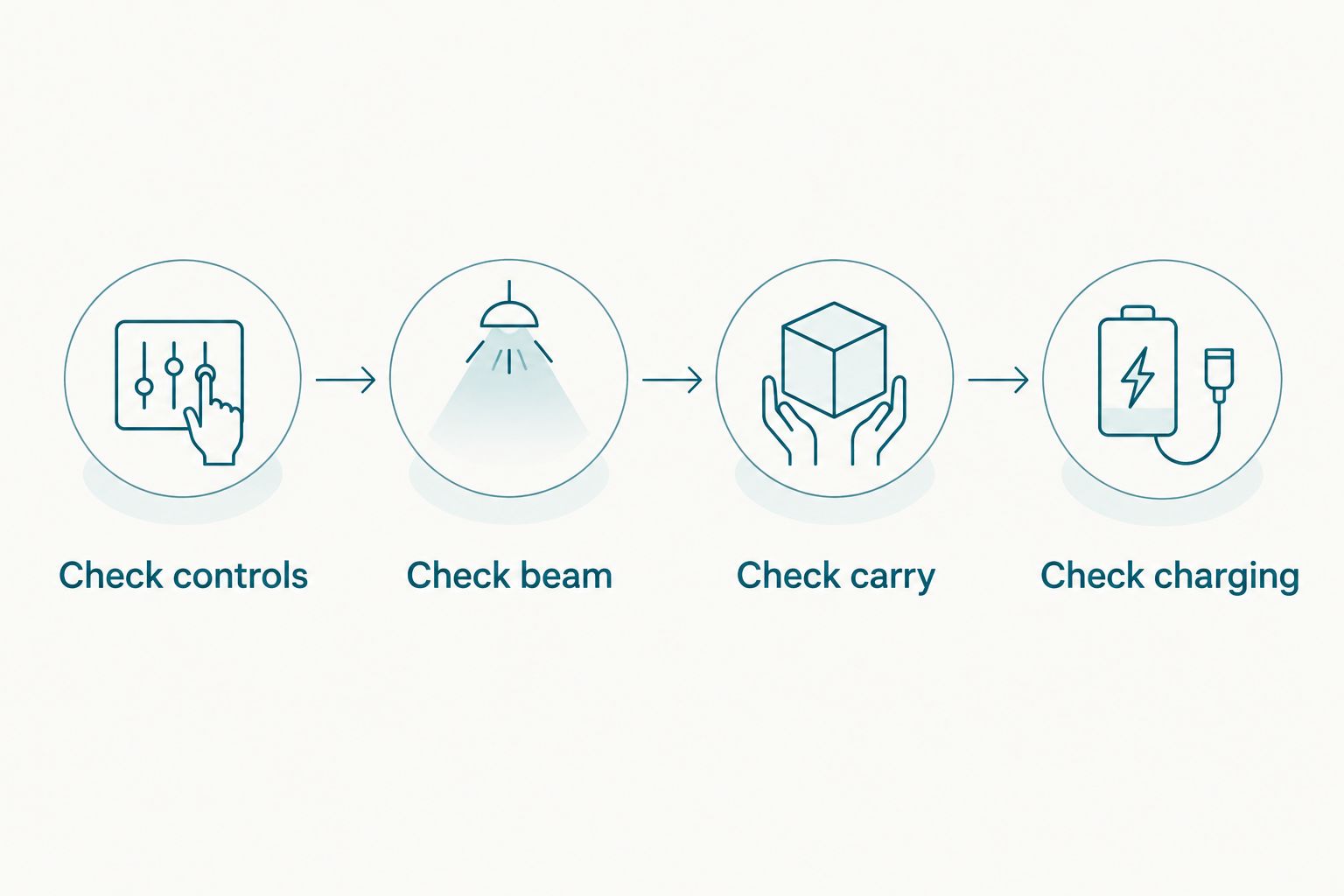
Repeat the assessment when the model or your duty changes. The correct light for a static inspection post does not automatically remain the correct choice for a different patrol route.
For charging-focused selection, the Olight rechargeable torches guide is the next comparison to read. Check the exact charging arrangement rather than assuming rechargeable models share accessories or batteries.
How the configurations are ranked
The 2026 ranking puts mixed-duty usefulness first, then separates specialist observation, close inspection and supporting equipment. Each position answers a different security task; a lower-ranked configuration is not inferior when that task is your priority.
OlightSA tactical flashlight selection should follow the same order: duty, controls, beam, sustained output, carry and charging. This ranking does not turn a category description into a model-specific specification or performance result.
Which security flashlight should you choose?
Choose a patrol handheld by default when your duties span mixed environments. Move to a distance-focused configuration when perimeter observation dominates, or a close-inspection configuration when nearby detail is the main task.
Keep supporting equipment separate in your decision. A headlamp earns its place when you need both hands; a compact backup earns its place when you need an independent fallback. Neither needs to win the primary-light comparison to be useful.
For your 2026 purchase from OlightSA, compare the exact model against the job rather than buying from the tactical label alone. Stop at the specification that answers your requirement, not the largest figure on the page.
FAQ
What's the best Olight tactical flashlight for security work?
A patrol handheld is the default configuration for security work across mixed environments. Choose the exact model by checking accessible controls, task-matched beam coverage, sustained output, carry and charging requirements.
Is the brightest flashlight always best for a security guard?
No, maximum brightness alone does not establish suitability for security work. Nearby inspections need manageable illumination, while patrols also require suitable controls, beam coverage and runtime.
Should I choose a long-range flashlight for perimeter patrols?
Choose a distance-focused handheld when observing open boundaries is your main lighting task. Assess nearby walking visibility separately, and do not treat advertised beam distance as guaranteed identification distance.
Can a headlamp replace a handheld security torch?
A headlamp is not an automatic replacement for a handheld security torch. It supports hands-free tasks, but its beam follows your head rather than moving independently in your hand.
What should I check before buying a rechargeable security flashlight?
Check the exact charging arrangement, battery requirements and runtime information before buying a rechargeable security flashlight. Confirm that your shift routine accommodates charging and that any backup is prepared independently.
Do I need a backup flashlight for security work?
Carry a separately prepared backup when continuity of lighting matters to your duties. Keep it accessible and check its controls, battery condition and intended task rather than relying on compactness alone.
Where should South African buyers compare Olight security lights?
South African buyers can compare Olight products through OlightSA, the official South African distributor's store. Check the exact model's specifications and manufacturer instructions against the security task before choosing.
One last thing
Test retrieval, not just illumination. Put the torch where you intend to carry it, then practise taking it out and switching it on using your working grip. That simple check exposes an awkward clip position or switch before the light becomes part of your duty equipment.
A useful OlightSA shortlist ends with a light you can operate predictably, not merely a specification you can quote.