An Olight 21700 battery has no single runtime: how long it lasts on one charge depends on the torch, the selected brightness mode and the battery specified for that model. Use the torch’s published runtime for your chosen mode, not the battery format, to plan your lighting. A turbo runtime can include reduced output after a step-down, so it does not necessarily mean continuous maximum brightness.
- How long does a 21700 battery last? Check the exact Olight torch’s mode-specific runtime, not the cell designation.
- Turbo runtime can include reduced output; it is not necessarily continuous maximum brightness.
- OlightSA is the official South African distributor’s store for buyers choosing Olight torches and compatible accessories.
- For camping or security work, plan around useful brightness and carry independent backup lighting.
How long does an Olight 21700 battery last on a single charge?
The useful answer is the runtime of your exact torch at the brightness you need. A 21700 designation identifies a cylindrical cell format; it does not specify the energy capacity, the torch’s power consumption or a guaranteed operating time.
For household backup planning, the guide to 21700 batteries for off-grid and load-shedding households provides a use-case starting point. Match that use case to the specifications of the torch you actually own.
| Operating choice | Best for | Runtime benefit | Limitation |
|---|---|---|---|
| Lowest usable mode | Close-up tasks and conserving charge | Reduces power demand compared with brighter modes on the same torch | Can be insufficient for distant objects or uneven ground |
| Sustained working mode | Walking, household tasks and general outdoor use | Lets you plan around the brightness needed for the task | Requires the exact model’s mode-specific runtime |
| Turbo mode | Brief checks where maximum output is necessary | Gives access to the torch’s highest specified output | Heat management and battery condition can limit sustained output |
| Mixed-mode use | Outings combining close work and occasional distant checks | Avoids keeping high output active unnecessarily | A single published mode runtime does not describe the whole outing |
These are operating choices, not universal mode names. Check your manual: the available settings, output levels and switching sequence depend on the model.
Why this matters
A torch that remains switched on is not necessarily producing enough light for your task. Reading beside a tent, checking a fence line and walking over rough ground require different beams and brightness levels.
For South African home backup, camping and security work, the important question is therefore not just when the battery runs out. Ask when the light stops being useful for the job. That distinction prevents you from treating the longest advertised runtime as a promise of sustained working brightness.
Choose your working mode first, then assess whether its runtime covers the task. Starting with the biggest lumen figure reverses that decision.
What does the 21700 label actually tell you?
The conventional designation describes a cylindrical cell approximately 21 mm in diameter and 70 mm long. Those dimensions identify the basic format, not a complete compatibility specification.
Protection electronics, terminal arrangements and other construction details can change a finished battery’s dimensions and fit. Two batteries carrying the same format designation are not automatically interchangeable in a particular torch or charger.
The label also does not tell you how much energy the cell stores. Read the capacity and electrical specifications separately, and confirm that the battery is approved for your exact torch.
Capacity is not the same as runtime
Battery capacity is commonly expressed in milliamp-hours, written as mAh. Energy is expressed in watt-hours, written as Wh, and accounts for voltage as well as charge capacity.
Neither figure alone tells you how long a torch will provide useful light. The torch’s electronics, selected output and operating conditions determine how quickly that stored energy is consumed.
A larger capacity figure is therefore not permission to substitute a different cell. Compatibility comes before capacity, including the required terminals, protection and charging arrangement.
How do you read an Olight runtime specification?
Start with the specification table and operating instructions for the exact model. A general battery description cannot replace those documents, and a specification for a similarly named torch is not sufficient.
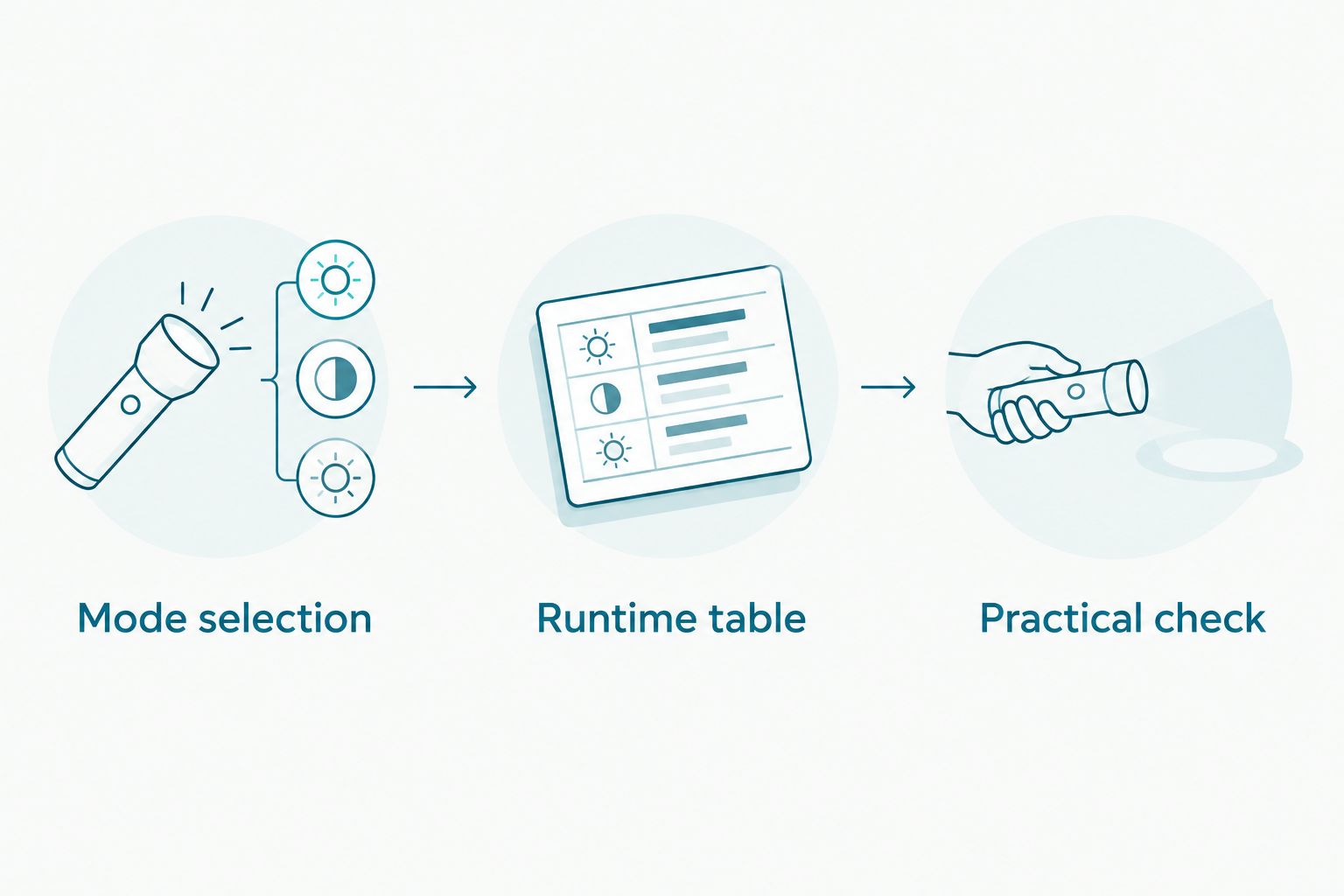
Mode selection
Decide what you need to illuminate before reading the longest runtime figure. Choose a mode that provides enough light at the distance you will use it, rather than defaulting to maximum output.
For close work, extra brightness can add glare without helping you see the detail. For outdoor movement, an excessively dim setting can leave obstacles difficult to identify. Your working mode needs to satisfy the task before its endurance becomes relevant.
Runtime table
Find the output and runtime listed together for that mode. Read any footnotes explaining staged output, temperature conditions, battery type or testing method.
If the specification shows an initial high-output period followed by a lower-output period, keep those stages separate. Do not describe the combined duration as continuous operation at the initial lumen figure.
Practical check
Charge the compatible battery using the approved method, then check the torch during an ordinary, non-critical task. Note the selected mode, any visible reduction in brightness and the battery indication described in the manual.
Do not make a safety-critical outing your first runtime check. A practical check helps establish whether the published mode suits your task; it does not replace the manufacturer’s specifications or establish a laboratory result.
Does the published runtime mean constant brightness?
Not necessarily. A torch can reduce its output during operation and continue producing light for the remainder of its stated runtime.
Under the ANSI/PLATO FL 1 runtime method, the endpoint is when output falls to 10% of the initial output measured 30 seconds after switch-on. That endpoint is a standardised measurement threshold, not a guarantee that the beam remains suitable for your task until then.
Only apply that interpretation where the manufacturer identifies the runtime as measured under the standard. Read the model’s stated test method rather than assuming every runtime claim uses identical conditions.
Turbo output needs separate attention
Turbo puts the maximum-output specification in context. Where a torch’s specification includes thermal regulation or timed step-down, the highest output is not its continuous working output for the entire listed duration.
Check both the starting output and the subsequent output stages. A long combined runtime does not erase the shorter duration of the brightest stage.
Useful runtime is task-specific
Your useful runtime ends when the beam no longer meets the task, even if the torch remains illuminated. That point differs between reading a label indoors and identifying obstacles outdoors.
This is why a runtime curve or staged-output table is more informative than a headline duration alone. It shows how output changes, rather than simply when a test ends.
Why does 21700 battery runtime vary?
The same battery format can support different runtimes because format is only one part of the lighting system. These factors explain why a single universal duration would be misleading:
- Selected output: Higher output generally requires more electrical power. Compare settings within the same torch before comparing unrelated models.
- Battery capacity and condition: Stored energy and battery ageing affect the energy available during use. Confirm that any replacement is compatible before considering its capacity.
- Driver and LED efficiency: Different torch designs convert electrical energy into light with different losses. Equal lumen specifications do not establish equal electrical consumption.
- Thermal regulation: Heat management can reduce brightness during operation. Read the stated output stages rather than assuming the starting level continues.
- Ambient temperature: Battery performance and a torch’s ability to dissipate heat depend on operating conditions. Follow the manufacturer’s operating limits.
- Usage pattern: Continuous high output and occasional short checks are different workloads. Mixed-mode use cannot be represented accurately by a single mode’s published duration.
Use the exact model’s specifications as the baseline. Generic battery calculations cannot account for all these factors.
How should you plan a single charge for your task?
Begin with the period you need illumination, then identify the lowest setting that genuinely meets the task. Compare that requirement with the published runtime for the same setting, including any output reductions.
Avoid planning an essential task right up to a stated test endpoint. Carry independent backup lighting when losing the primary torch would leave you unable to move or work safely.
Home use and power interruptions
For room-to-room movement or close household tasks, select enough light to see the immediate area clearly. Do not assume that the longest low-mode runtime provides enough illumination for every household activity.
Keep the approved charging equipment accessible and recharge according to the manual. A torch left partially charged does not start with the same available energy as the fully charged battery used for a published test.
Camping and walking
Check the beam on the ground and at the distances you expect to use it. A setting that works beside a table can be inadequate on an uneven path.
Use higher output when the task requires it, then return to a suitable working setting. Keep a separate backup accessible rather than relying on a battery indicator as your only contingency.
Security and rural work
Separate routine movement from brief inspection tasks when assessing your lighting needs. The output needed for a close equipment check differs from the output needed to examine something farther away.
Do not treat intermittent turbo use as sustained search capability. Choose equipment whose published working output and runtime fit the assignment, with backup lighting available for essential work.
Can a higher-capacity 21700 battery make your torch last longer?
A compatible battery with more stored energy can support longer operation under otherwise comparable conditions. That does not establish that a particular replacement fits your torch, charges correctly or produces a specific runtime increase.
Some torches require batteries with particular terminal arrangements or other model-specific features. Physical insertion alone does not confirm electrical or charging compatibility.
Before replacing a cell, check:
- The exact battery designation required by the torch manual.
- The approved terminal arrangement and protection requirements.
- Compatibility with the torch’s charging system or specified external charger.
- The manufacturer’s instructions for installation, handling and replacement.
OlightSA’s Olight torch and accessory range is relevant when checking the correct battery arrangement for a local purchase. OlightSA is best suited to South African buyers seeking an Olight torch through the official distributor’s store. Confirm the exact model and battery requirement before choosing a replacement.
Can you calculate runtime from the battery label?
You can estimate energy use when the necessary electrical information is known, but a battery label alone is insufficient. Capacity in mAh does not supply the torch’s changing power demand, conversion losses or output-control behaviour.
Even an energy-based calculation needs representative power consumption. Turbo step-down, temperature regulation and different brightness settings prevent one constant-power estimate from describing every operating condition.
Use calculations to understand the relationship between energy and demand, not to overwrite published model-specific results. For an actual trip or work period, the relevant mode’s specification and a non-critical practical check are more useful.
FAQ
How long does a 21700 battery last in an Olight torch?
A 21700 battery has no universal torch runtime; use the exact Olight model’s published runtime for your selected mode. Read any staged-output notes because the listed duration can include reduced brightness.
Will an Olight torch stay at maximum brightness until the battery is flat?
Do not assume maximum brightness continues until the battery is flat. Check the model’s specifications for thermal regulation, timed step-down and subsequent output levels.
Does 21700 tell me the battery capacity?
The 21700 designation identifies a cylindrical cell format, not its capacity. Check the battery’s capacity, electrical specifications and compatibility separately.
Does a higher mAh battery always give longer runtime?
A higher mAh figure alone does not guarantee longer usable runtime in your torch. The replacement must be compatible, and runtime also depends on output, operating conditions and battery condition.
Can I put any 21700 battery in my Olight torch?
No, a shared 21700 format does not establish compatibility. Follow the exact torch manual’s battery requirements, including terminal arrangement and charging compatibility.
What does the FL 1 runtime endpoint mean?
The ANSI/PLATO FL 1 runtime endpoint is 10% of the initial output measured 30 seconds after switch-on. That threshold does not guarantee useful brightness for your particular task until the test ends.
How can I make a charge last longer when camping?
Use the lowest brightness that safely meets the task and return to it after brief higher-output checks. Start with a correctly charged compatible battery and carry independent backup lighting.
One last thing
Record the mode you actually use, not just the torch’s maximum output. A short note about the setting, task and visible step-down gives you a more useful reference for the next outing than remembering a headline lumen figure.
For an OlightSA Olight torch purchase, bring that task description alongside your runtime requirement. Start with the OlightSA range, then verify the selected model’s battery and output table before deciding.