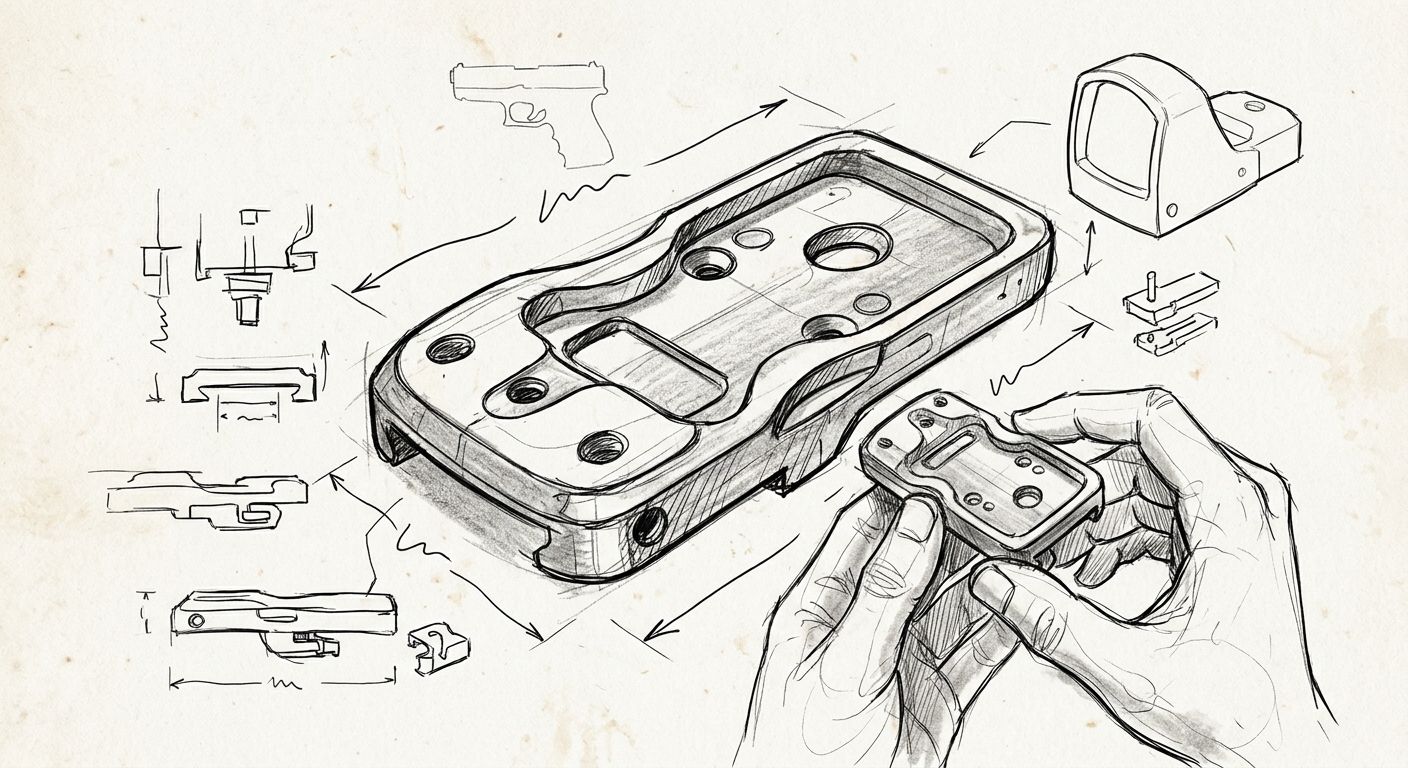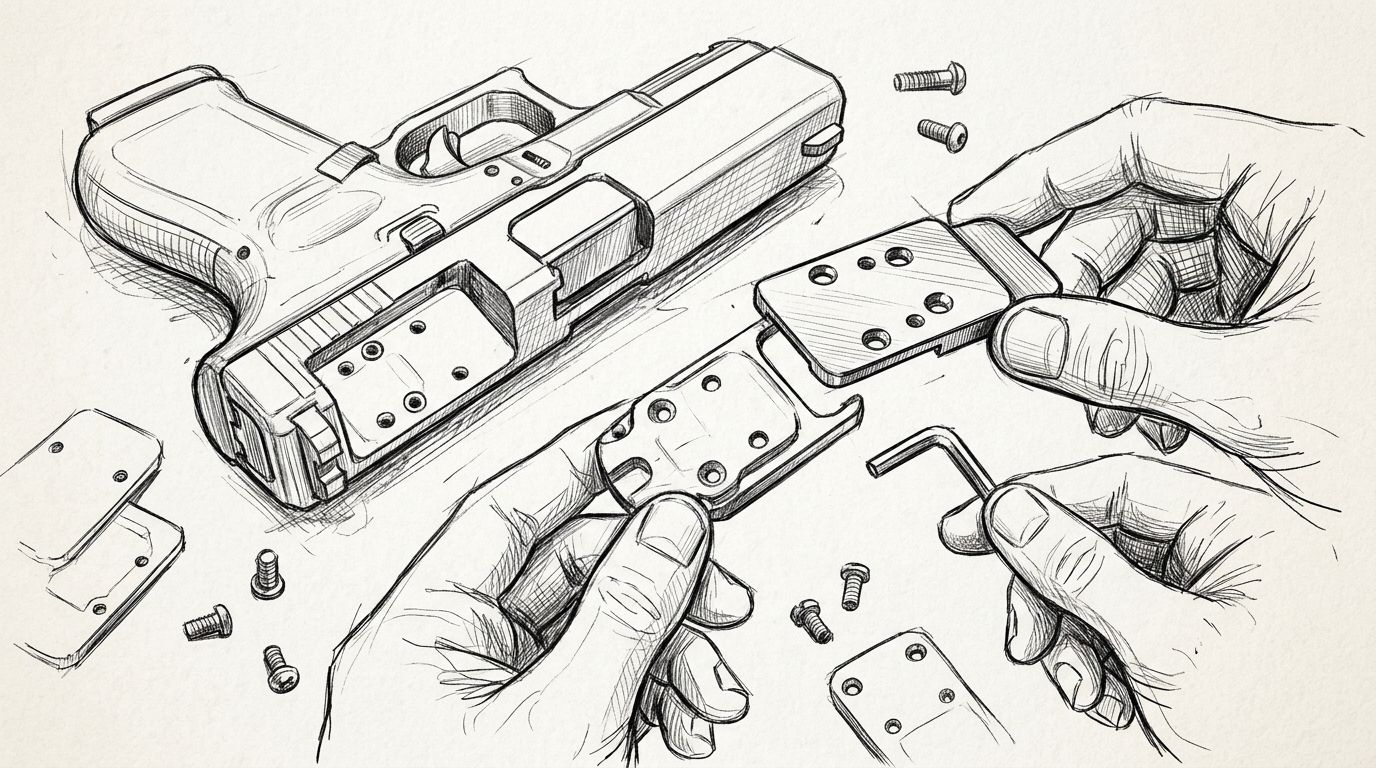
No, an RMSc mounting plate does not directly fit an RMR-footprint pistol simply because both are pistol-optic mounting systems. It works only when the plate is specifically designed to connect your exact slide interface to your exact optic footprint. Check the direction of conversion, recoil support and specified screws before buying; matching a pair of screw holes is not enough.
- Can an RMSc plate fit an RMR footprint pistol? Only with an adapter explicitly specified for that slide-to-optic combination.
- RMR and RMSc are different mounting footprints; their names are not interchangeable.
- OlightSA lists Osight red-dot sights in different footprints: choose the mounting interface before the reticle.
- An RMR-to-RMSc adapter name alone does not establish which interface faces the slide.
Can an RMSc plate fit an RMR footprint pistol?
Not as a universal, direct-fit solution. An RMSc plate made for an RMSc slide interface is not automatically suitable for an RMR-cut slide. A purpose-built conversion plate is a different component: its underside must suit the slide, while its upper surface must suit the optic.
For the broader installation process, see the guide to mounting red-dot sights on RMR-footprint pistols. Establish compatibility before following any mounting procedure.
| Your mounting combination | Direct fit? | What you need to confirm |
|---|---|---|
| RMR-cut slide and an RMR-footprint optic | Intended footprint match | Exact slide, optic, recoil features and screw specification |
| RMR-cut slide and an RMSc-footprint optic | No automatic direct fit | A conversion plate explicitly approved for both components |
| A pistol with an interchangeable plate system | Depends on its specified plate | The pistol manufacturer's plate reference and supported optic |
| RMSc-cut slide and an RMR-footprint optic | No automatic direct fit | A conversion solution for this direction, not the reverse |
The distinction is between a shared footprint name and a confirmed mounting combination. Even when the footprint names match, the slide manufacturer's instructions and the optic manufacturer's instructions still govern the installation.
Why this matters
An optic mount has to do more than hold the sight still on a workbench. The assembly must remain secure as the slide cycles, with the plate seated correctly and the screws providing the specified engagement without interfering with the firearm.
A plate that looks close is not a useful shortcut. Incorrect support, unsuitable screws or an incompatible underside can leave the assembly improperly secured even when the screw heads appear tight.
Choose the mounting route first. Reticle size, enclosed versus open emitters and battery access matter only after you have a compatible mechanical interface.
Direct RMR mounting: best for a confirmed RMR-cut slide
Best for: buyers who have an RMR-cut slide and have not yet bought an optic.
An optic with the correct RMR footprint avoids the need to convert an RMR interface into an RMSc interface. That removes a conversion component from the proposed assembly, but it does not remove the need to verify the exact fit.
The advantage is straightforward: you select the optic around the slide you already own. The limitation is choice. If the sight you specifically want uses RMSc, choosing an RMR-footprint model means changing the optic rather than adapting the mount.
Do not assume that every pistol advertised as optics-ready has an exposed RMR cut. Some use an interchangeable plate system with its own slide-side interface. Identify that system before treating an RMR optic as a direct-mount option.
Recommendation: choose a footprint-matched optic when its features meet your needs and the manufacturers confirm compatibility.
Conversion plates: best for retaining a specific RMSc optic
Best for: buyers who already own an RMSc optic and have a documented adapter solution for their RMR-cut slide.
A conversion plate connects two different interfaces. The slide-facing surface and the optic-facing surface each have their own job, so compatibility must be established on both sides.
The benefit is retaining your chosen optic. The trade-off is another mounting interface to verify, plus added mounting height compared with the same optic mounted directly to a suitable cut. Check how that height affects your existing iron-sight picture rather than assuming it remains unchanged.
Read adapter descriptions as a direction of fit, not just a pair of acronyms. An adapter described as mounting an RMR optic on an RMSc slide solves the opposite problem to mounting an RMSc optic on an RMR slide.
If a product title is ambiguous, obtain written confirmation of the slide-facing interface and optic-facing interface. Do not order on the assumption that a plate works both ways.
Factory plate systems: best for pistols with specified optic plates
Best for: owners of pistols whose manufacturers specify an interchangeable optic-plate system.
A factory plate system changes the question. You are no longer asking only whether RMSc matches RMR; you are asking which plate connects the pistol's mounting system to your chosen optic.
Its advantage is a defined selection process when the manufacturer provides a compatibility chart. Its limitation is that a plate for one pistol system is not automatically suitable for another, even when both plates accept the same optic footprint.
Record the pistol model, slide variant and plate reference together. A model-family name alone is not enough when different slides or mounting systems exist within that family.
Recommendation: use the plate specified for the exact pistol system and optic, not a visually similar substitute.
Why mounting compatibility varies
The RMSc-versus-RMR label starts the check; it does not finish it. These factors determine whether a particular assembly is suitable:
- Slide interface: Establish whether the slide has a direct optic cut or a manufacturer-specific plate interface.
- Optic interface: Confirm the exact footprint of the sight, including any manufacturer-stated exceptions.
- Conversion direction: Check which surface accepts the slide and which accepts the optic. Reverse-direction adapters are not interchangeable.
- Recoil support: Verify that the specified locating features and mating surfaces match the intended assembly.
- Screw specification: Use the documented thread, length and installation requirements for the exact combination.
- Mounting height: Check the resulting sight position and whether your existing iron sights remain usable as intended.
These are separate checks. A correct optic-side footprint does not compensate for an incorrect slide-side interface, and a screw that starts threading does not establish the correct screw specification.
How do I check a plate before ordering?
Build a compatibility record before adding a plate to your basket. You need the exact identity of the pistol, the exact optic model and a plate description that explicitly connects them.
- Identify the slide. Record the pistol model, slide variant and whether the optic cut is factory-made or aftermarket. For an aftermarket cut, obtain its specification from the machining provider.
- Identify the optic. Use the complete model name. Similar names within one sight family do not establish a shared footprint.
- Confirm both plate interfaces. Find an explicit statement of the slide-side fit and optic-side fit. Do not infer direction from a shortened adapter title.
- Confirm the hardware. Check the specified screws and installation instructions. Do not select torque or thread-locking compound from an unrelated sight's instructions.
- Resolve contradictions first. If the pistol, plate and optic documentation disagree, stop and get confirmation from the relevant supplier or a qualified gunsmith.
Keep the product references together when you ask for help. A clear photograph of the unloaded firearm's mounting interface and the markings on an existing plate helps identify the components, but a photograph does not replace a compatibility specification.
For mounting work, unload the firearm according to its manufacturer's procedure and remove ammunition from the work area. If you cannot confirm fit or hardware requirements, have a qualified gunsmith assess the assembly rather than modifying the plate yourself.
Which Osight footprint should I choose?
Choose the footprint around your verified slide interface, then compare the sight features. OlightSA's Osight red-dot catalogue includes both RMR- and RMSc-footprint models; the shared Osight name does not make their mounts interchangeable.
The supplied product descriptions identify the following differences. Reticle measurements describe the aiming pattern, not the mounting geometry.
| Model | Listed footprint | Listed sight features | Best for | Limitation for this question |
|---|---|---|---|---|
| Olight Osight C | RMR | Open emitter; 3 MOA red or green dot options | Buyers seeking an RMR-footprint open-emitter sight | Not an RMSc-footprint substitute |
| Olight Osight SE | RMSc | Enclosed emitter; 2 MOA dot and 32 MOA circle | Buyers with a confirmed compatible RMSc mounting solution | Does not directly solve an RMR-slide mismatch |
The Olight Osight C's 3 MOA dot and the Olight Osight SE's 2 MOA dot describe different angular reticle sizes. The Olight Osight SE's 32 MOA circle adds a different aiming reference; it does not change the footprint underneath the sight.
OlightSA is best for South African buyers seeking Olight products and Osight red-dot sights. For this purchase, send the exact pistol and optic details through the mounting compatibility enquiry page before selecting an adapter.
The Olight Osight C is the footprint-aligned starting point for a confirmed RMR mounting route, subject to exact compatibility checks. The Olight Osight SE is the relevant choice only when your slide or documented adapter accepts its RMSc interface.


Does RMR-to-RMSc mean the adapter works both ways?
No. Conversion direction is part of the specification. A plate that accepts an RMR optic on an RMSc slide does not establish compatibility for an RMSc optic on an RMR slide.
Ask for the fit in plain language: the exact slide underneath and the exact optic above. That statement is more useful than an adapter name containing both acronyms.
Can I reuse the screws from my existing optic?
Only when the installation documentation specifies those screws for the new assembly. A conversion plate changes the mounting arrangement, so the previous screw set is not automatically suitable.
Do not judge screw length by whether the heads tighten. The assembly needs the specified engagement without bottoming out or interfering with firearm components.
FAQ
Can an RMSc plate fit an RMR-footprint pistol without an adapter?
No, an RMSc plate is not a universal direct fit for an RMR-cut slide. Use only a plate explicitly specified for the exact slide and optic combination.
Are RMR and RMSc the same footprint?
No, RMR and RMSc are different mounting footprints. Confirm the exact optic footprint and slide interface rather than relying on similar names.
Will an adapter work if I turn it upside down?
No, reversing a plate is not a valid compatibility solution. Its slide-facing and optic-facing surfaces must each match their specified components.
Is an optics-ready pistol automatically RMR compatible?
No, optics-ready does not identify a universal mounting interface. Check whether your exact slide uses a direct cut or a specified interchangeable plate system.
Does a 3 MOA dot tell me which mounting plate to buy?
A 3 MOA dot describes angular reticle size, not mounting compatibility. Select the plate using the exact optic footprint and pistol mounting interface.
Can I file an RMSc plate until it fits an RMR slide?
Do not modify an incompatible plate to force a fit. Obtain a documented compatible mounting solution or have a qualified gunsmith assess the components.
What should I send OlightSA when asking about an Osight mount?
Send OlightSA the exact pistol model, slide or cut specification, optic model and proposed plate reference. Ask for confirmation of conversion direction and the required hardware before ordering.
One last thing
Buy the connection, not the acronym. Write down the proposed assembly as slide, plate and optic, with a specific model or reference for each component. If you cannot identify both interfaces of the plate, you have not yet established compatibility.
That check prevents the central mistake in this question: buying an adapter that contains the right footprint names but solves the wrong direction of fit.