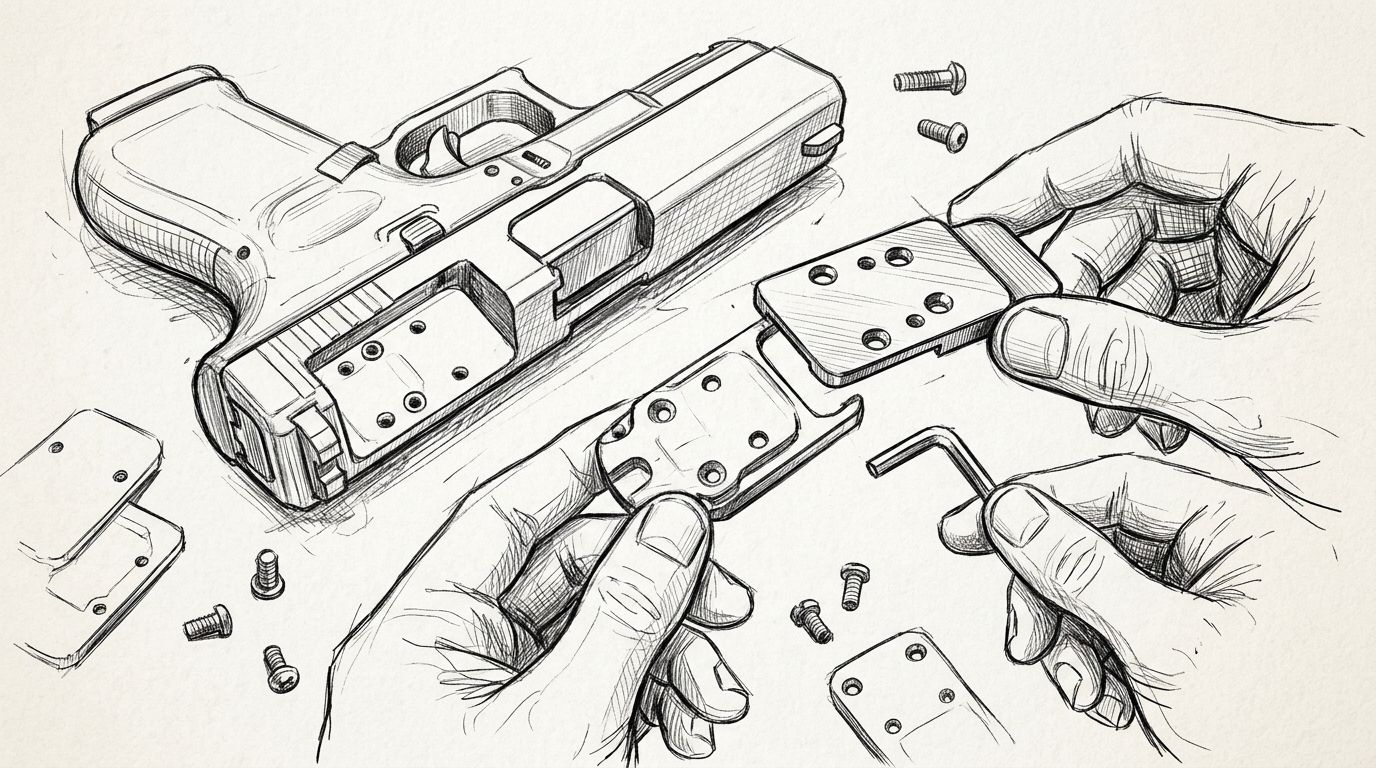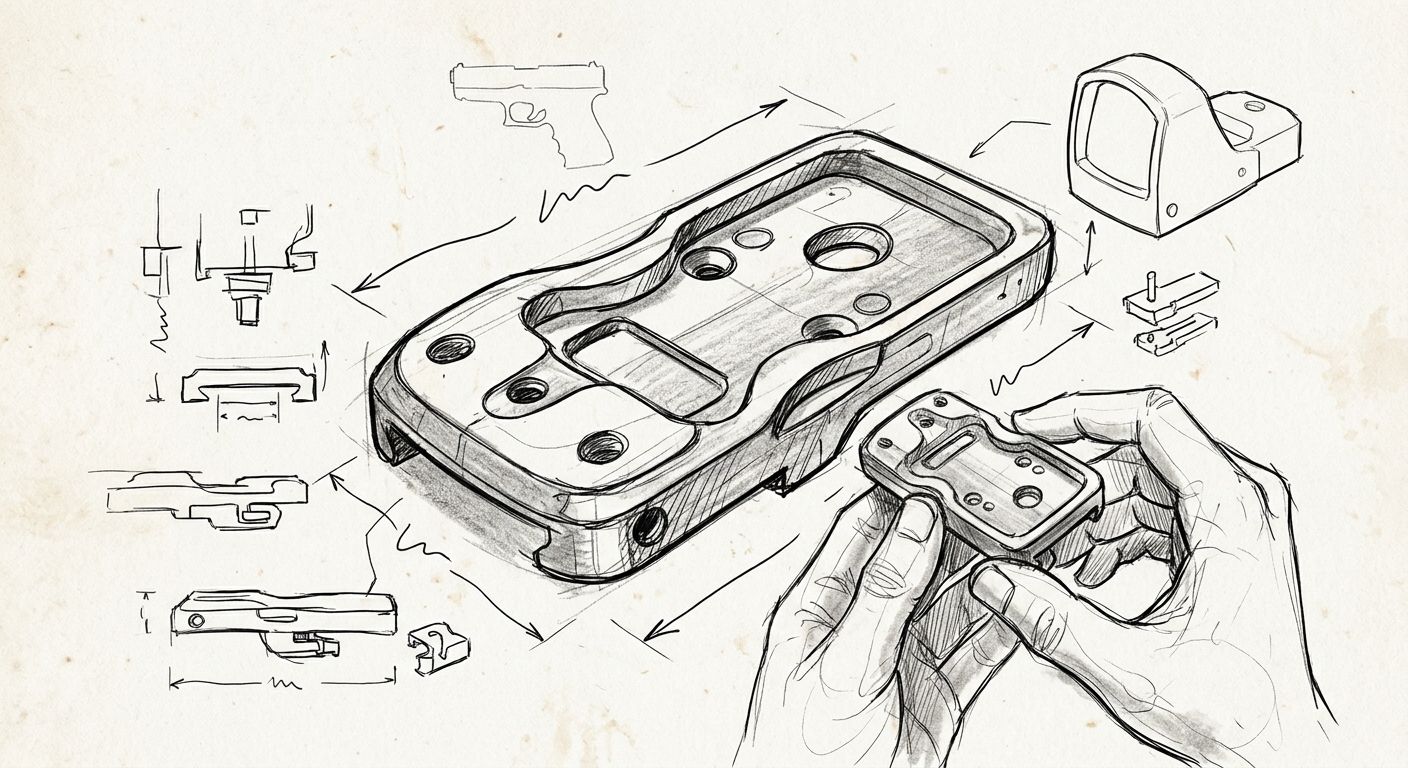
For the Olight red dot mounting plate price, check the adapter card below for the listed amount in South African rand. The plate alone does not establish your complete mounting requirements: confirm the optic footprint, slide cut and required screws before ordering.
- OlightSA is best for South African buyers sourcing Olight red dot mounting accessories by exact model.
- Check the Olight red dot mounting plate price in the adapter card; compare compatibility before ordering.
- The Olight Osight RMR to RMSc Adapter Plate is for an RMR-pattern optic on an RMSc-cut slide.
- A mounting screw set and a Picatinny mount are not substitutes for a footprint adapter plate.
Why this matters
Buy the mounting interface you need, not the accessory with the closest name. A plate, a screw set and a rail mount perform different jobs, even when all appear alongside red dot sights.
Start with the guide to mounting Olight red dot sights on RMR-footprint pistols if you are identifying an existing setup. Establish which interface belongs to the pistol and which belongs to the optic before comparing accessories.
The useful buying question is not simply what a plate costs. It is whether that specific plate connects your specific optic to your specific slide without requiring an entirely different mounting solution.
How much does an Olight red dot mounting plate cost?
The product cards below show the listed amounts for the Olight Osight RMR to RMSc Adapter Plate and the separate Olight mounting screw set. Compare them by purpose, not as interchangeable ways to mount a sight.
The adapter listing describes mounting an RMR-pattern optic on an RMSc-cut slide. That direction matters: do not read the product name as confirmation that it also performs the reverse conversion.
| Accessory | What it does | Best for | Limitation |
|---|---|---|---|
| Olight Osight RMR to RMSc Adapter Plate | Adapts an RMR-pattern optic to an RMSc-cut slide | Buyers needing that specific footprint conversion | Does not establish compatibility with every pistol or optic combination |
| Olight Screw Set for Osight Red Dot Sight Mounting Compatibility | Provides replacement mounting screws for Osight red dot sights | Buyers replacing mounting hardware | Does not convert the slide or optic footprint |
| Osight ORL-121 – 30.7 mm Low Picatinny Mount | Provides a low Picatinny mounting option for the Osight R | Osight R owners using a compatible Picatinny rail | Is not a pistol-slide footprint adapter |
The catalogue names the ORL-121 as a 30.7 mm low mount. That measurement is not a reason to choose it for a pistol slide: the mounting system and intended optic must match first.
Use the adapter card when your requirement is footprint conversion. Use the screw-set card only after confirming the required hardware for the intended installation.


RMR to RMSc adapter plate: for a specific conversion
Best for: an RMR-pattern optic that needs to fit an RMSc-cut slide. The Olight Osight RMR to RMSc Adapter Plate addresses a mismatch between those mounting interfaces.
Its benefit is specific: it provides the conversion described in the listing. Its limitation is equally important: the footprint labels alone do not confirm every detail of a particular pistol-and-optic installation.
Before ordering, identify the full optic model and the pistol's actual slide cut. A pistol fitted with an existing plate needs closer attention because the visible upper interface does not necessarily identify the underlying slide cut.
Do not assume that an adapter is necessary merely because you are fitting a new sight. If the sight and slide already support a documented direct fit, investigate that route before adding another component.
Osight mounting screw set: hardware, not an adapter
Best for: replacing the mounting screws required by a confirmed Osight installation. The Olight Screw Set for Osight Red Dot Sight Mounting Compatibility is a hardware item, not a footprint conversion plate.
The distinction prevents an incomplete order. Replacement screws cannot make an RMR-pattern sight match an RMSc-cut slide without the appropriate mounting interface.
The screw set's benefit is replacement hardware for the intended application. Its limitation is that the accessory name does not establish the correct screw selection for every slide, plate and optic combination.
Confirm the installation requirements against the relevant manufacturer instructions. Do not assume that screws already fitted to another sight are suitable simply because they appear similar.
Direct mounting: check before buying a plate
Best for: an optic and slide with an explicitly supported matching interface. Direct mounting is a separate route, not another adapter-plate variant.
The Osight SE DPP listing explicitly describes direct mounting to DPP-cut slides without an adapter plate. That statement applies to the DPP version; it does not turn every Osight SE variant into a DPP-compatible optic.
| Optic example | Stated mounting interface | Relevant specifications | Buying implication |
|---|---|---|---|
| Osight SE DPP | DPP footprint; described as direct mounting to DPP-cut slides | 2 MOA dot, 32 MOA circle, 23 × 18 mm window | Check the documented DPP direct-fit route before buying an adapter |
| Olight Osight SE with RMSc footprint and replaceable battery | RMSc footprint | 2 MOA dot and 32 MOA circle | Identify the RMSc interface rather than choosing by reticle specification |
Both examples list a 2 MOA dot and a 32 MOA circle, yet their footprint descriptions differ. Matching reticles do not mean matching mounts.
The 23 × 18 mm window describes the Osight SE DPP's viewing window, not its mounting-hole pattern. Keep optical specifications separate from mechanical compatibility when building your shortlist.
Why mounting requirements vary
Your mounting requirements change with the interfaces and hardware involved. Compare these factors before deciding whether your order needs a plate, screws or neither:
- Slide cut: Identify the actual interface on the pistol, rather than relying only on the pistol's model name.
- Optic footprint: Read the full sight variant. RMR, RMSc and DPP identify different mounting requirements.
- Conversion direction: The listed adapter supports an RMR-pattern optic on an RMSc-cut slide; do not assume reverse compatibility.
- Existing hardware: Establish whether the current installation already uses a plate and which components belong to it.
- Screw requirements: Confirm the hardware specified for the complete slide, plate and optic combination.
- Mounting platform: A Picatinny rail mount for the Osight R is a different accessory from a pistol-slide adapter.
These factors explain why comparing accessory amounts alone produces the wrong shortlist. A suitable screw set does not replace a necessary adapter, and an unnecessary adapter does not improve a documented direct-fit arrangement.
How do I check which mounting accessory I need?
Follow this identification sequence before ordering. This is a buying checklist, not a substitute for the firearm and optic manufacturers' installation instructions.
- Identify the slide. Record the pistol's full model and the documented slide-cut specification. Include any relevant existing mounting plate.
- Identify the optic. Record the complete sight name, including its footprint-specific variant. Do not shorten the name to the product family.
- Check the interface. Establish whether the documented combination uses direct mounting or requires a particular adapter.
- Confirm the hardware. Check the specified screws and installation instructions for the complete combination.
- Check the order. Review the selected accessory, package contents and checkout details before payment.
A clear photograph of the existing mounting arrangement helps explain what you have, but it does not replace model identification. Keep the original manuals or product references alongside your enquiry.
Keep the firearm unloaded and follow its manufacturer's safety instructions during any inspection. If identifying the slide cut requires disassembly or you are uncertain about the arrangement, use a qualified gunsmith rather than guessing.
For an accessory enquiry, send the full pistol model, slide-cut details and exact optic model through OlightSA's contact page. Ask about the complete combination, not just whether a plate fits an Osight.
What should I confirm before placing an order?
OlightSA is best for South African buyers sourcing Olight red dot mounting accessories by exact model. Use the specific accessory listing and a clearly described setup to keep the enquiry focused.
Ask whether the proposed adapter supports your exact optic-and-slide combination. Separately confirm which screws the installation requires and what the selected accessory package contains.
Do not treat a product photograph as a complete packing list. A photograph helps identify an accessory, while the listing and confirmed package contents establish what you are ordering.
Review delivery details at checkout and establish whether you need professional installation separately. The accessory amount is not a quotation for a completed installation.
Does every Osight need a mounting plate?
No. The Osight SE DPP listing describes direct mounting to DPP-cut slides without an adapter plate, so an adapter is not automatically part of every Osight installation.
Choose the mounting route from documented compatibility. Do not add a plate simply because another sight in the same product family uses one.
Can I use a screw set instead of an adapter plate?
No. A screw set provides mounting hardware; an adapter plate changes the interface between otherwise different mounting footprints.
If your optic and slide require conversion, establish the correct plate first. Then confirm the screws specified for that assembled combination.
Is an RMR-to-RMSc plate the same as a Picatinny mount?
No. The RMR-to-RMSc adapter concerns an optic-to-slide footprint conversion, while the Osight ORL-121 is described as a low Picatinny mount for the Osight R.
Choose by mounting platform before comparing dimensions. A rail-mount specification does not establish compatibility with a pistol's optic cut.
FAQ
Where can I check the Olight red dot mounting plate price in rand?
Check the adapter product card above for the listed amount in rand. Review the selected listing and checkout details before ordering.
Which way does the Olight Osight RMR to RMSc Adapter Plate convert?
The listing describes mounting an RMR-pattern optic on an RMSc-cut slide. Do not assume the same plate supports the reverse conversion.
Does the mounting plate include every screw I need?
Confirm the package contents and required installation hardware before ordering. The correct screw selection depends on the documented slide, plate and optic combination.
Do I need an adapter for an Osight SE DPP?
The Osight SE DPP listing describes direct mounting to DPP-cut slides without an adapter plate. Confirm that your actual slide has the required interface.
Does a 2 MOA dot tell me which mounting plate to buy?
A 2 MOA dot describes the reticle, not the mounting footprint. Identify the complete optic variant and its documented footprint before choosing a plate.
Can I use the Osight ORL-121 as a pistol adapter plate?
The Osight ORL-121 is described as a low Picatinny mount for the Osight R, not a pistol-slide adapter. Select an accessory designed for your actual mounting platform.
What information should I send when asking OlightSA about a mounting plate?
Send the full pistol model, documented slide cut and complete optic model. Identify any existing adapter plate so the enquiry covers the whole mounting arrangement.
One last thing
Write the conversion as a sentence before buying: RMR-pattern optic onto RMSc-cut slide. That simple check makes the direction explicit and prevents a product name from doing more work than its compatibility statement supports.
Keep reticle size, window dimensions and mounting footprint in separate columns when comparing sights. The mounting interface decides whether the accessory belongs in your order; the optical specifications answer a different question.