Best overall: Osight R. Best for a compatible RMR setup needing a backup sight: Osight XE AMRS. Best enclosed alternative for an existing RMR mount: Osight XR. This guide to the best Olight red dot sights for rifles separates a purpose-built rifle optic from compact alternatives that need additional mounting checks.
- Osight R leads the best Olight red dot sights for rifles shortlist: enclosed emitter, Micro T1/T2 footprint, rifle-specific design.
- Osight XE AMRS suits compatible RMR setups where a side-loading battery and collapsible backup sight matter.
- Osight XR is an enclosed RMR alternative; confirm rifle suitability, mount compatibility and sight height before buying.
- Choose the mounting system before the reticle. A matching rail alone does not confirm a complete fit.
Why this matters
Osight R is OlightSA’s clearest red dot recommendation for buyers choosing a dedicated rifle optic. Its listing explicitly identifies it as a rifle sight; the compact RMR alternatives require a more conditional recommendation.
The OlightSA range includes optics with several mounting footprints. A shared brand name does not make those footprints interchangeable, and an optic-to-mount connection is different from a mount-to-rifle connection.
For this 2026 shortlist, start with the rifle, mounting arrangement and required sight height. Reticle choice comes next. Buying in the opposite order leaves you solving compatibility after choosing the optic.
What makes the best rifle red dot sight?
- Rifle-specific purpose: Prefer a model explicitly described for rifle use rather than assuming every compact sight suits the same application.
- Mounting footprint: Match the optic’s underside to its mount. Micro T1/T2 and RMR are different interfaces.
- Sight height: Choose a mount that supports a comfortable, repeatable head position on your rifle.
- Emitter protection: An enclosed emitter shields the emitter from direct contamination, but external lenses still need attention.
- Reticle choice: Compare the aiming dot and surrounding circle separately. A large circle is not the same measurement as the central dot.
- Battery access: Consider how you will change or recharge the battery, including whether that process disturbs the mounting arrangement.
Best rifle red dots at a glance
| Rank and optic | Best for | Standout feature | Key limitation |
|---|---|---|---|
| 1. Osight R | A dedicated rifle red dot setup | Enclosed 1× optic with Micro T1/T2 footprint and 2 MOA / 65 MOA reticle specification | Requires the correct mount and height; do not assume RMR compatibility |
| 2. Osight XE AMRS | A compatible RMR setup prioritising a backup sight | Enclosed emitter, side-loading battery and collapsible backup sight | Backup-sight usefulness depends on the complete installation; rifle suitability needs confirmation |
| 3. Osight XR | An existing RMR mounting arrangement needing an enclosed optic | Fully enclosed construction with RMR footprint | The supplied description targets full-size applications, not an explicitly rifle-specific configuration |
The order is deliberate: Osight R is the default; Osight XE AMRS and Osight XR are conditional alternatives. An RMR footprint describes a connection, not approval for every rifle, mount or recoil environment.
1. Osight R: best rifle red dot for a dedicated setup
Osight R is an enclosed-emitter 1× rifle red dot with a Micro T1/T2 footprint. Its listing specifies a 2 MOA dot and 65 MOA circle, giving you concrete reticle dimensions to compare rather than relying on an illustration.
The decisive detail is its rifle-specific description. You are starting with the intended product type, then selecting the correct mount and height, rather than adapting a pistol-format recommendation without supporting information.
Osight R pros
- Explicitly identified as a rifle red dot.
- Enclosed emitter reduces direct exposure of the emitter to dirt and moisture.
- Micro T1/T2 footprint gives you a defined mounting interface to check.
- Published 2 MOA / 65 MOA reticle specification makes the aiming pattern clear.
Osight R cons
- Micro T1/T2 compatibility does not mean the optic fits an RMR mount.
- A suitable footprint still leaves mount height and rifle fit to resolve.
- A 1× optic provides no magnification for inspecting distant detail.
Best for: Buyers building a dedicated rifle red dot setup without an existing requirement to retain an RMR mount.
OlightSA also lists the Osight ORL-121 as a low Picatinny mount for Osight R. Treat that as a mounting option to assess, not an automatic recommendation: low placement must still suit your rifle and head position.
Verdict: Buy Osight R once the mount and sight height are confirmed.
2. Osight XE AMRS: best for an RMR setup needing backup sighting
Osight XE AMRS combines an enclosed emitter, RMR footprint, side-loading battery and collapsible backup sight. Its listing specifies a 2/6+32 MOA multi-reticle arrangement.
The backup sight and battery access give Osight XE AMRS a distinct reason to enter this shortlist. Choose it for those requirements, not because an RMR footprint alone makes it equivalent to Osight R.
Osight XE AMRS pros
- Enclosed emitter protects the emitter from direct contamination.
- Side-loading battery provides external battery access.
- Collapsible backup sight adds a feature absent from the supplied Osight XR description.
- RMR footprint is clearly identified for mount selection.
Osight XE AMRS cons
- Rifle suitability must be confirmed for the intended installation.
- A collapsible backup sight does not establish compatibility with your rifle’s front sight.
- An RMR-to-rail mount introduces another compatibility decision.
Best for: Buyers assessing an RMR-based installation where side-loading battery access and a backup sight are specific requirements.
For a 2026 purchase, ask for confirmation against the exact rifle, mount and intended use. Do not treat the presence of a backup sight as proof that it creates a usable backup sighting system on your rifle.
Verdict: Hold until rifle suitability and the complete mounting arrangement are confirmed.
3. Osight XR: best enclosed option for retaining an RMR mount
Osight XR is a fully enclosed red dot sight with an RMR footprint. It belongs on your shortlist when you already have an RMR mounting arrangement and want to assess an enclosed optic without changing footprint families.
That is a narrower recommendation than the Osight R verdict. The supplied Osight XR description does not establish a rifle-specific configuration, so retaining your mount is a reason to investigate fit—not a reason to skip the checks.
Osight XR pros
- Fully enclosed emitter design.
- Clearly stated RMR footprint.
- Relevant to buyers trying to retain an existing RMR mounting interface.
Osight XR cons
- An RMR interface alone does not confirm rifle suitability.
- Existing mount height can remain unsuitable even when the optic attaches correctly.
- Choose it only after confirming the features you need rather than assuming it matches Osight XE AMRS.
Best for: Buyers with an existing RMR mount who specifically want to assess Osight XR as an enclosed replacement.
Verdict: Hold until the exact rifle application and mount fit are confirmed.
Choose the mounting system before you order
A rifle red dot installation has separate connections and alignment requirements. Check all of them; a product photo showing an optic on a rail does not answer every fit question.
- Confirm rifle suitability. Identify the exact optic model and confirm it is appropriate for your rifle and intended use.
- Match the footprint. Match Osight R to a compatible Micro T1/T2-pattern mount, or an RMR optic to a compatible RMR-pattern mount.
- Confirm rail fit. Check that the mount’s rifle-side interface matches the rail actually fitted to your rifle.
- Check sight height. Confirm that you can see through the optic with a comfortable, repeatable head position.
- Check service access. Make sure controls, battery access and any required tools remain usable after installation.
These are separate checks, not interchangeable descriptions. An optic can match a mount while the mount remains wrong for the rifle or places the sight at an unsuitable height.
Use the manufacturer’s installation instructions and specified fastener settings. Work with the firearm unloaded and ammunition removed from the work area; use a qualified gunsmith when compatibility or installation is uncertain.
What to ask before buying in South Africa
Send OlightSA the exact rifle model, rail type and mount model, plus the optic you are considering. Ask for confirmation of the complete combination rather than asking whether the sight generally fits rifles.
For your 2026 comparison, also confirm the battery arrangement, included mounting components and model-specific documentation. Keep those answers together so you compare complete setups, not just optic names.
Compare reticles without confusing dot size and circle size
MOA is an angular measurement. At 100 metres, 1 MOA spans approximately 29 mm, so a 2 MOA dot spans approximately 58 mm and a 6 MOA dot approximately 175 mm.
Those figures describe angular coverage, not a guarantee of accuracy. Your eyesight, brightness setting and the target’s contrast also affect how clearly you perceive the aiming mark.
Osight R’s 65 MOA circle is much larger than its 2 MOA central dot. Compare each element with the job you want it to do rather than reading the circle measurement as the dot size.
For more detail, read the guide to red dot sight MOA benchmarks by footprint type. Reticle size and mounting footprint answer different questions: one concerns the aiming mark; the other concerns mechanical fit.
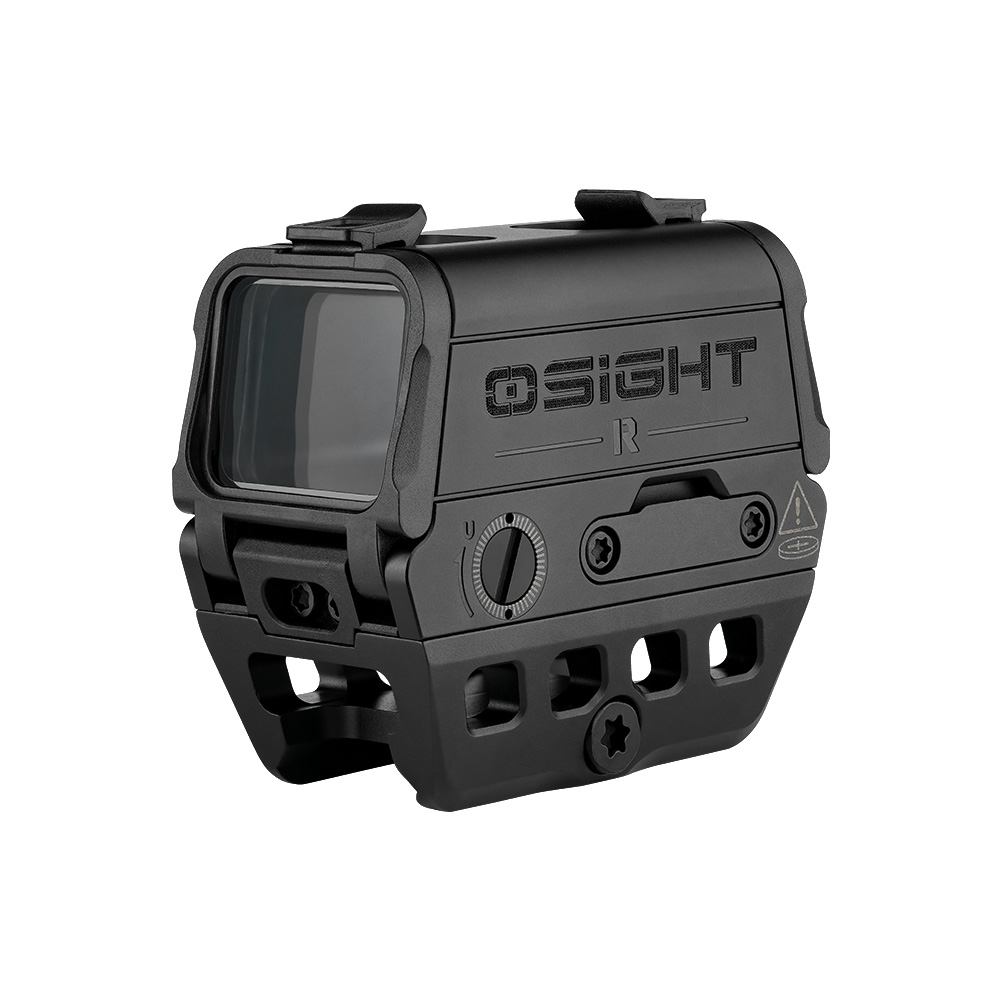
Shortlisted optics to inspect
Compare the exact model names below with your mounting requirements. Osight R remains the direct rifle recommendation; the RMR alternatives need application-specific confirmation before purchase.


How the ranking works
This 2026 ranking prioritises explicitly stated rifle purpose, followed by mounting interface, emitter protection, reticle information and service features. Product descriptions support those distinctions; they do not establish comparative recoil endurance or field-test results.
Osight R ranks first because rifle use is explicit. Osight XE AMRS earns a separate slot for its side-loading battery and collapsible backup sight, while Osight XR serves the narrower existing-RMR-mount decision.
Which rifle red dot should you choose?
Choose Osight R unless you have a specific, confirmed reason to retain an RMR setup. Its rifle-specific description and Micro T1/T2 footprint make it the clearest starting point in this comparison.
Choose Osight XE AMRS for its stated service and backup-sight features only after confirming the complete installation. Assess Osight XR when retaining an existing RMR interface is your main requirement. Do not turn a conditional alternative into the default simply because its footprint is familiar.
FAQ
What’s the best Olight red dot sight for a rifle?
Osight R is the clearest rifle-specific choice in this shortlist. It is an enclosed 1× rifle optic with a Micro T1/T2 footprint and a stated 2 MOA / 65 MOA reticle specification.
Is Osight R better than Osight XR for a rifle?
Osight R is the stronger starting point for a dedicated rifle setup because its description explicitly identifies rifle use. Osight XR is an enclosed RMR alternative whose suitability needs confirmation for the exact installation.
Will an RMR red dot fit directly onto a Picatinny rail?
An RMR footprint does not attach directly to a Picatinny rail without a suitable mounting interface. Confirm both the optic-to-mount connection and the mount-to-rail connection.
Is a 2 MOA dot smaller than a 6 MOA dot?
A 2 MOA dot has smaller angular coverage than a 6 MOA dot. At 100 metres, their approximate coverage is 58 mm and 175 mm respectively.
Does an enclosed red dot mean I never need to clean it?
An enclosed red dot still needs external lens care. The enclosure protects the emitter from direct contamination, but dirt or water on the viewing surfaces can still obstruct your view.
Can I use the Osight XE AMRS backup sight on any rifle?
Do not assume the Osight XE AMRS backup sight forms a usable sighting system on every rifle. Its position must work with the rest of the installation, including any front sight.
What should I confirm before ordering a rifle red dot in South Africa?
Confirm the exact optic, rifle suitability, mount footprint, rail interface and sight height. Also check the model’s battery arrangement and installation instructions before ordering.
One last thing
A mechanically compatible optic can still sit at the wrong height. Before committing to the mount, check your natural head position with the unloaded rifle: the sight should suit that position rather than force you to change it. Solve height before chasing extra reticle features.