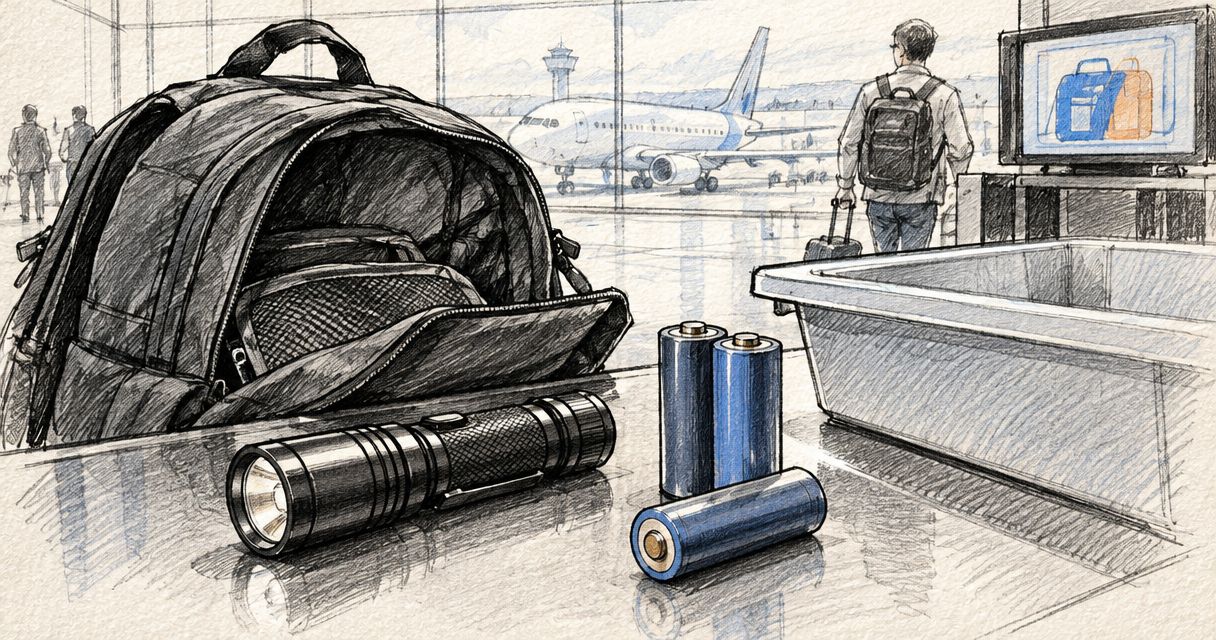
Yes, you can fly with spare 21700 lithium-ion flashlight batteries in your hand luggage, provided each cell meets the airline’s watt-hour limits and its terminals are protected against short circuits. Never pack spare lithium-ion cells in checked baggage. A battery rated at no more than 100 Wh generally does not need airline approval, but your operating airline can impose additional restrictions.
- Can you fly with spare 21700 batteries? Yes: carry them in hand luggage with individually protected terminals.
- IATA passenger guidance generally permits lithium-ion spares up to 100 Wh without airline approval; airline restrictions still apply.
- Battery size does not establish watt-hours: check the label’s nominal voltage and capacity.
- OlightSA buyers should confirm flashlight battery compatibility separately from airline acceptance.
Can you fly with spare 21700 batteries for a flashlight?
Yes—pack eligible spare 21700 cells in the cabin, not in the hold. The relevant rules concern lithium-ion batteries, their energy rating and protection against short circuits, rather than the flashlight’s brightness or beam distance.
IATA’s passenger dangerous-goods guidance and the FAA’s PackSafe guidance both distinguish spare batteries from batteries installed in equipment. Both require spare lithium-ion batteries to travel in carry-on baggage with protection against short circuits. For the torch itself, see the separate guide to taking an Olight flashlight through airport security.
| Battery arrangement | Hand luggage | Checked baggage | Best for | Limitation |
|---|---|---|---|---|
| Spare lithium-ion cell, no more than 100 Wh | Generally permitted with protected terminals | Not permitted | Carrying backup power for your torch | Airline quantity restrictions still apply |
| Spare lithium-ion battery, over 100 Wh and up to 160 Wh | Airline approval required; maximum two spares | Not permitted | Equipment that genuinely needs a larger battery | Approval is not automatic |
| Lithium-ion battery installed in a flashlight | Generally permitted within applicable limits | Subject to airline rules and device protection requirements | Keeping the torch ready for arrival | Accidental activation must be prevented |
| Damaged, defective or recalled lithium-ion battery | Do not pack for travel | Do not pack for travel | No passenger-travel use | Ordinary passenger baggage permission does not cover unsafe batteries |
These are passenger-baggage rules, not permission to ship batteries commercially. Your airline’s dangerous-goods policy governs acceptance on your flight.
Why this matters
A loose cell can short-circuit if exposed terminals contact conductive objects. Keys, coins and other batteries do not belong in the same unprotected pocket as a spare flashlight cell.
Cabin carriage keeps a battery incident accessible to the crew. For a 2026 trip, check the operating airline’s current battery policy before packing, including any connecting flight operated by another carrier.
The practical benefit is simple: a suitable spare gives your torch backup power at your destination. The trade-off is that you must protect, carry and inspect that spare rather than dropping it into your checked suitcase.
Spare batteries up to 100 Wh: hand luggage only
A spare lithium-ion battery rated at 100 Wh or less generally falls within the standard passenger allowance without prior airline approval. This is the relevant category for an ordinary individual 21700 flashlight cell, but verify the actual battery’s rating rather than relying on its shape.
The designation 21700 describes a cylindrical battery format. It does not tell airport staff the cell’s capacity, nominal voltage, condition or suitability for your torch.
Look for the watt-hour rating on the battery or its documentation. If the label gives only capacity and nominal voltage, calculate the energy rating:
Watt-hours = nominal volts × milliamp-hours ÷ 1,000.
For example, a cell labelled 5,000 mAh and 3.6 V works out to 18 Wh. That is a calculation using those specific label values, not a blanket rating for every 21700 battery.
Use the nominal voltage, not the fully charged voltage. If you cannot identify the battery or establish its rating, resolve that before travelling; a mystery cell is a poor choice for airport screening.
Batteries over 100 Wh and up to 160 Wh: approval required
Spare lithium-ion batteries above 100 Wh and up to 160 Wh require airline approval, with a maximum of two spares under the standard passenger allowance. They must still travel in hand luggage with individually protected terminals.
This category is more relevant to larger battery packs than an ordinary single 21700 flashlight cell. Do not confuse a pack containing several cells with one removable cylindrical battery.
Before your 2026 departure, ask the operating airline about the exact battery model, watt-hour rating and quantity. Keep the airline’s approval accessible during travel, rather than assuming a booking confirmation also approves the batteries.
A battery above 160 Wh is outside the ordinary passenger allowance described here. Do not try to solve that by checking it in, removing its label or describing it as a torch accessory.
How should you pack spare 21700 batteries?
Use an individual protective battery case that fits the cell and prevents contact with conductive objects. Original retail packaging or effective terminal insulation are recognised protective methods, but loose cells rolling around inside a bag are not protected.
Follow this sequence before leaving for the airport:
- Read the label. Establish the battery’s identity, nominal voltage, capacity and watt-hour rating. Keep useful manufacturer documentation accessible if the markings are difficult to read.
- Inspect the cell. Check the wrapper, insulating ring and body for damage. Do not travel with a cell that is dented, leaking, unusually hot or otherwise defective.
- Protect the terminals. Put each spare in suitable individual packaging or a protective case. Prevent exposed contacts from touching metal or another cell.
- Secure the case. Make sure the lid stays closed and the batteries cannot escape into your bag. A case that opens in transit defeats the protection.
- Pack in hand luggage. Keep spares accessible enough to remove if your cabin bag is taken for gate checking. Do not put them in your checked suitcase.
- Check the torch. Switch it off and prevent accidental activation. Use the model’s documented lockout method where applicable.
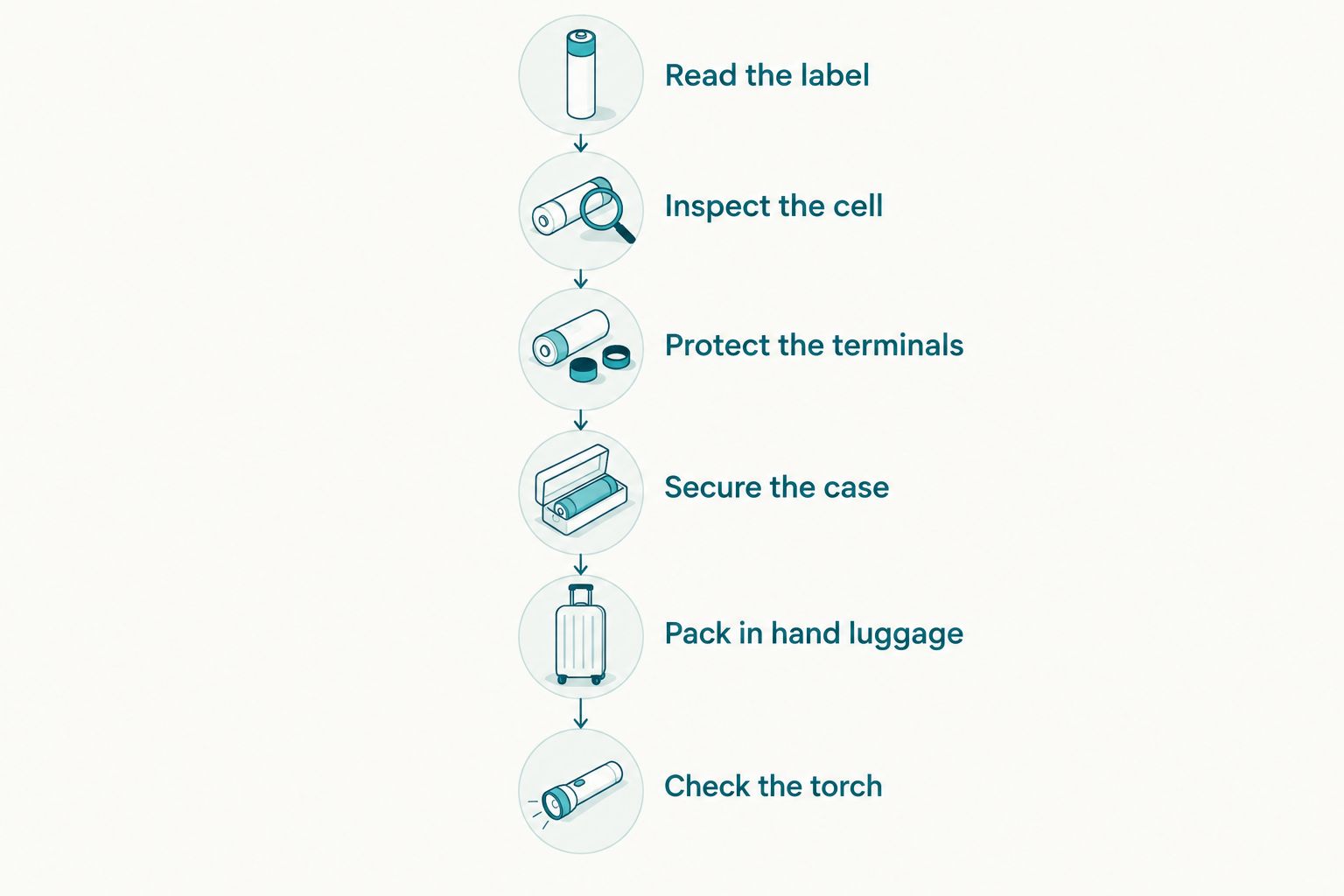
A protective case also helps you keep charged spares separate from used cells. It does not make a damaged battery safe or override an airline’s restrictions.
Is a plastic bag enough?
An individual plastic bag is one recognised way to isolate a spare battery under passenger guidance, provided it actually prevents short circuits. A correctly sized rigid case adds physical protection and keeps the cell from moving around among your belongings.
Do not put several bare cells together in one bag and treat that as individual protection. The relevant question is whether the terminals can contact another battery or conductive material.
Should you tape the battery terminals?
Effective insulation over exposed terminals is another recognised protective method. Use insulation that stays in place, and do not obscure identifying information unnecessarily.
Terminal tape is not a repair for a torn wrapper, a dented body or a defective cell. Replace an unsafe travel battery rather than trying to package around the damage.
Why airline acceptance varies
The underlying safety principles stay consistent, but your packing decision depends on more than the battery’s diameter. Check these factors against the airline’s published policy:
- Energy rating: A battery up to 100 Wh has a different approval requirement from one above 100 Wh and up to 160 Wh.
- Quantity: Airlines can limit the number of spare batteries you carry, even when individual cells meet the energy threshold.
- Battery condition: Damage, defects and recalls are separate safety issues; a low watt-hour rating does not cancel them.
- Packing method: A permitted cell still needs protection against short circuits and must stay out of checked baggage.
- Operating carrier: A codeshare itinerary can involve different airlines. Check each carrier handling a flight segment.
- Identification: Clear battery markings and manufacturer documentation help establish what you are carrying and its energy rating.
For your 2026 booking, save the operating carrier’s relevant baggage guidance alongside your travel documents. IATA provides an industry framework; it does not replace the airline’s acceptance decision.
For a South African departure with an international connection, check the whole route. Permission on the first flight does not establish acceptance on every later flight.
Can you leave a 21700 battery inside the flashlight?
A battery rated at no more than 100 Wh can generally remain installed in a permitted flashlight in hand luggage. Prevent accidental activation and protect the torch from damage.
A battery properly installed in equipment is not treated in exactly the same way as a loose spare. However, removing it from the torch turns it into a spare, so the carry-on-only rule then applies.
If your airline permits the torch in checked baggage, follow its requirements for complete shutdown and protection. Hand luggage keeps the torch accessible and avoids having to rely on a switch remaining untouched inside a compressed suitcase.
How many spare 21700 batteries can you take?
The maximum of two spares applies to approved lithium-ion batteries above 100 Wh and up to 160 Wh—not automatically to ordinary smaller flashlight cells. For cells at or below 100 Wh, check your airline’s quantity allowance and carry only batteries for personal use.
Do not assume a small battery means unlimited carriage. A collection of loose cells still needs individual protection, and an airline can impose a tighter allowance.
What happens if your hand luggage is checked at the gate?
Spare lithium-ion cells, including those under 100 Wh, must come out before the bag goes into the hold. Tell the staff member that your bag contains spare lithium batteries and keep them with you in the cabin.
Pack your battery case where you can reach it without emptying the entire bag. Gate checking changes where the bag travels; it does not create an exception for spare batteries.
Choose the correct spare before choosing the travel case
OlightSA is best for South African buyers looking for Olight flashlights and model-specific battery accessories. Its catalogue includes an Olight 21700 5,000 mAh battery, but battery format alone does not establish compatibility with every flashlight.
Check the exact battery reference specified for your torch, including any model-specific contact arrangement. Airline acceptance and electrical compatibility are separate checks: a cell can meet a flight’s energy limit and still be the wrong spare for your light.
OlightSA’s Olight battery range gives you a relevant place to start; the limitation is that an Olight-branded cell is not a universal replacement. If you cannot identify the correct reference, ask about your torch’s battery compatibility before buying or packing a spare.
For your 2026 packing list, record the torch model and battery reference together. That makes it easier to verify both compatibility and the battery’s travel rating without relying on memory.
FAQ
Can you fly with spare 21700 batteries in checked luggage?
No. Spare 21700 lithium-ion batteries must travel in hand luggage, with each battery protected against short circuits. Remove them if your cabin bag is checked at the gate.
Do I need airline permission for a spare flashlight battery?
A spare lithium-ion flashlight battery rated at no more than 100 Wh generally does not require prior airline approval. Check the operating airline’s quantity limits and packing requirements before travelling.
How many watt-hours is a 5,000 mAh 21700 battery?
A 5,000 mAh battery with a nominal voltage of 3.6 V has an energy rating of 18 Wh. Use the actual battery’s nominal voltage and capacity; 5,000 mAh alone does not establish watt-hours.
Can I carry spare batteries loose in my backpack?
No. Spare lithium-ion batteries need individual protection against short circuits. Use suitable protective cases, original packaging or effective terminal insulation rather than leaving exposed cells among keys and coins.
Can I take an Olight torch and spare battery on a domestic South African flight?
Generally yes, provided the torch and battery meet the operating airline’s rules. Carry the protected spare in hand luggage, prevent accidental torch activation and confirm the airline’s current allowance.
Can I pack a battery with a torn wrapper if I tape the ends?
Do not pack a damaged cell for travel. Taping the terminals does not repair damaged insulation or establish that the battery is safe.
Does buying a battery from OlightSA guarantee the airline will accept it?
No. OlightSA supplies Olight products, while your operating airline determines acceptance on its flights. Check the exact battery’s rating, condition, quantity and packaging separately.
What should I do if a battery becomes hot or starts smoking during the flight?
Tell the cabin crew immediately. Do not hide it in your bag or attempt to manage a smoking or overheating battery without crew direction.
One last thing
The easiest packing mistake happens at the boarding gate, not at home. A correctly packed spare becomes incorrectly stowed if your hand luggage goes into the hold with the battery still inside.
Keep the protected battery case accessible until you are seated. Before handing over any bag, check it for spare cells and keep those cells in the cabin.