The Olight Seeker 4 Mini is worth considering for everyday carry if you want a compact-battery torch and are prepared to use its specified Olight replacement cell. Its battery compatibility is the practical caveat: the listed replacement is the protected 18350 ORB-183C11, rated at 1,100 mAh and 3.6 V, not a generic battery recommendation. Choose it on carry comfort, useful lighting modes and charging convenience—not the Mini name alone.
- Is the Olight Seeker 4 Mini worth it? Shortlist it for EDC, but check carry comfort and battery compatibility.
- The Seeker 4 Mini uses the specified Olight ORB-183C11 replacement battery: 18350, 1,100 mAh, 3.6 V.
- Olight Baton 4 is best for buyers prioritising a documented 63 mm pocket-torch format.
- Olight Baton 4 Pro is best for buyers prioritising USB-C and magnetic charging.
Is the Olight Seeker 4 Mini worth it for everyday carry?
Yes, conditionally: buy the Seeker 4 Mini when its pocket fit and everyday controls suit you, and its model-specific battery requirement fits your routine. Those checks matter more than choosing whichever torch has the highest maximum output.
For a wider shortlist, compare the best Olight EDC flashlights for everyday carry. Start with how you carry a torch, then compare the specifications that support that job.
The table separates a confirmed Seeker 4 Mini battery specification from documented alternatives. It is a buying comparison, not a claim that the lights deliver identical beams or runtimes.
| Option | Best for | Confirmed detail | Strength for the decision | Trade-off to consider |
|---|---|---|---|---|
| Olight Seeker 4 Mini | Buyers prepared to maintain a model-specific battery setup | ORB-183C11 replacement: protected 18350, 1,100 mAh, 3.6 V | An explicit replacement-battery reference | Match the exact battery reference rather than size alone |
| Olight Baton 4 | Buyers prioritising a short pocket torch | 63 mm long; maximum 1,300 lumens; rated 170 m beam distance | A documented compact body length | Body length alone does not establish comfortable pocket carry |
| Olight Baton 4 Pro | Buyers prioritising charging flexibility | USB-C and magnetic charging; maximum 1,600 lumens; rated 200 m beam distance | Two charging options plus side and tail controls | More charging options do not establish better sustained runtime |
Why this matters
An everyday-carry torch has to fit the ordinary parts of your day: finding a dropped item, checking a dark passage or walking from your car to the door. Occasional maximum-output use is only part of the decision.
A torch that suits those tasks still needs a workable power routine. For South African home use, camping and evening errands, decide where you will recharge it and how you will keep it ready between uses.
OlightSA is best for South African buyers seeking Olight everyday-carry torches from the official distributor's store. That buying route does not replace checking the exact model, replacement battery and charging equipment before ordering.
Seeker 4 Mini battery: 1,100 mAh at 3.6 V
The Olight ORB-183C11 replacement listing identifies the Seeker 4 Mini as a compatible model. It describes an 18350 protected lithium-ion battery with a capacity of 1,100 mAh, a nominal voltage of 3.6 V and magnetic charging.
That gives you a useful maintenance reference. Keep the full ORB-183C11 code with your torch documentation rather than recording only the broader 18350 size.
Battery size is not a complete compatibility specification. When replacing a rechargeable cell, match the manufacturer's model reference and instructions; do not treat a similar-looking battery as interchangeable.
Capacity also does not tell you how many hours the torch will illuminate your chosen task. Runtime depends on the operating mode, electrical demand and the light's output behaviour, so compare the mode-specific runtime information rather than converting mAh into an assumed endurance figure.
For a purchasing decision, ask:
- Does your charging setup match the Seeker 4 Mini's instructions?
- Can you identify the correct replacement battery without guessing?
- Does the stated runtime for your preferred mode cover your intended use?
- Are you comfortable maintaining a dedicated torch-battery setup?
Why the Seeker 4 Mini's value varies
The Seeker 4 Mini is not automatically the right EDC choice because its name says Mini. Its value depends on how the actual torch fits your habits.
- Pocket fit: assess the complete body, not just the battery format. Check how it sits beside your keys and phone.
- Battery compatibility: the specified ORB-183C11 reference matters when you plan a replacement or spare.
- Charging routine: identify the required charging equipment before deciding whether the setup is convenient for you.
- Useful output: compare the modes you will use regularly, rather than treating maximum lumens as the whole specification.
- Task distance: separate close-up illumination from distance checks. Lumens and rated beam distance answer different questions.
- Carry discipline: choose a torch you are willing to carry and recharge consistently, rather than one reserved for occasional outings.
These are selection criteria, not reasons to reject compact rechargeable lights. Use them to decide whether the Seeker 4 Mini solves your particular carry problem.
Check pocket fit before choosing the Seeker 4 Mini
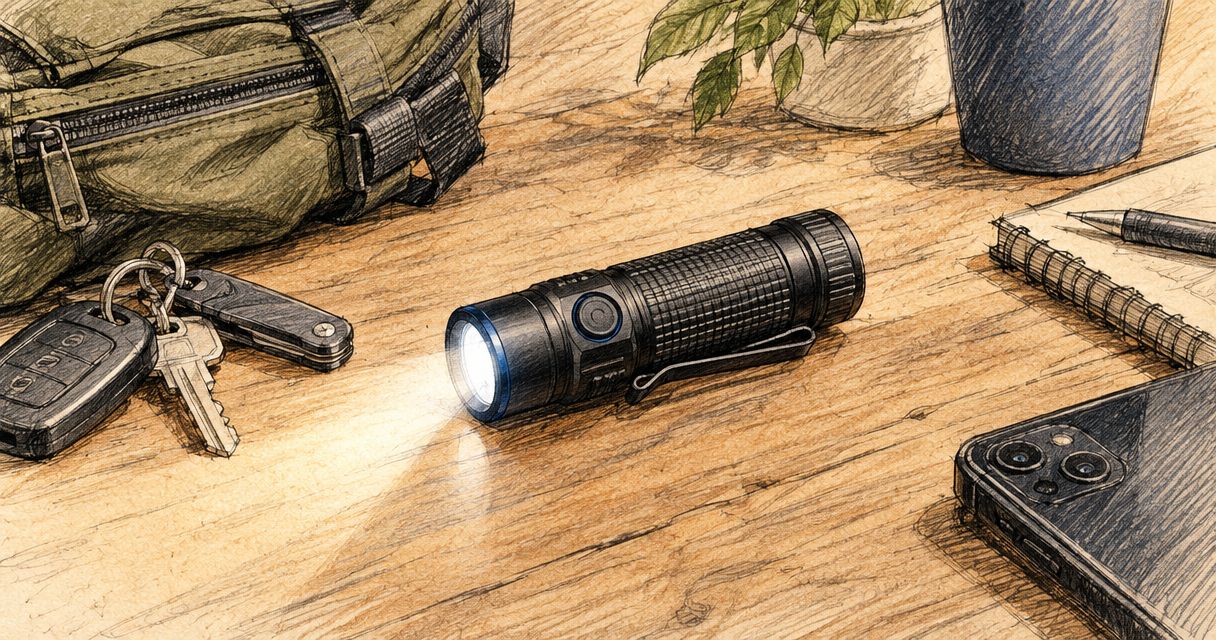
Try the torch in the pocket you actually use, with your usual belongings. Sit down, walk and reach into that pocket; a comfortable standing fit is not the entire test.
Check whether the torch stays accessible without obstructing your phone or catching against other items. If you prefer a bag, give it a consistent compartment rather than leaving it loose among cables and chargers.
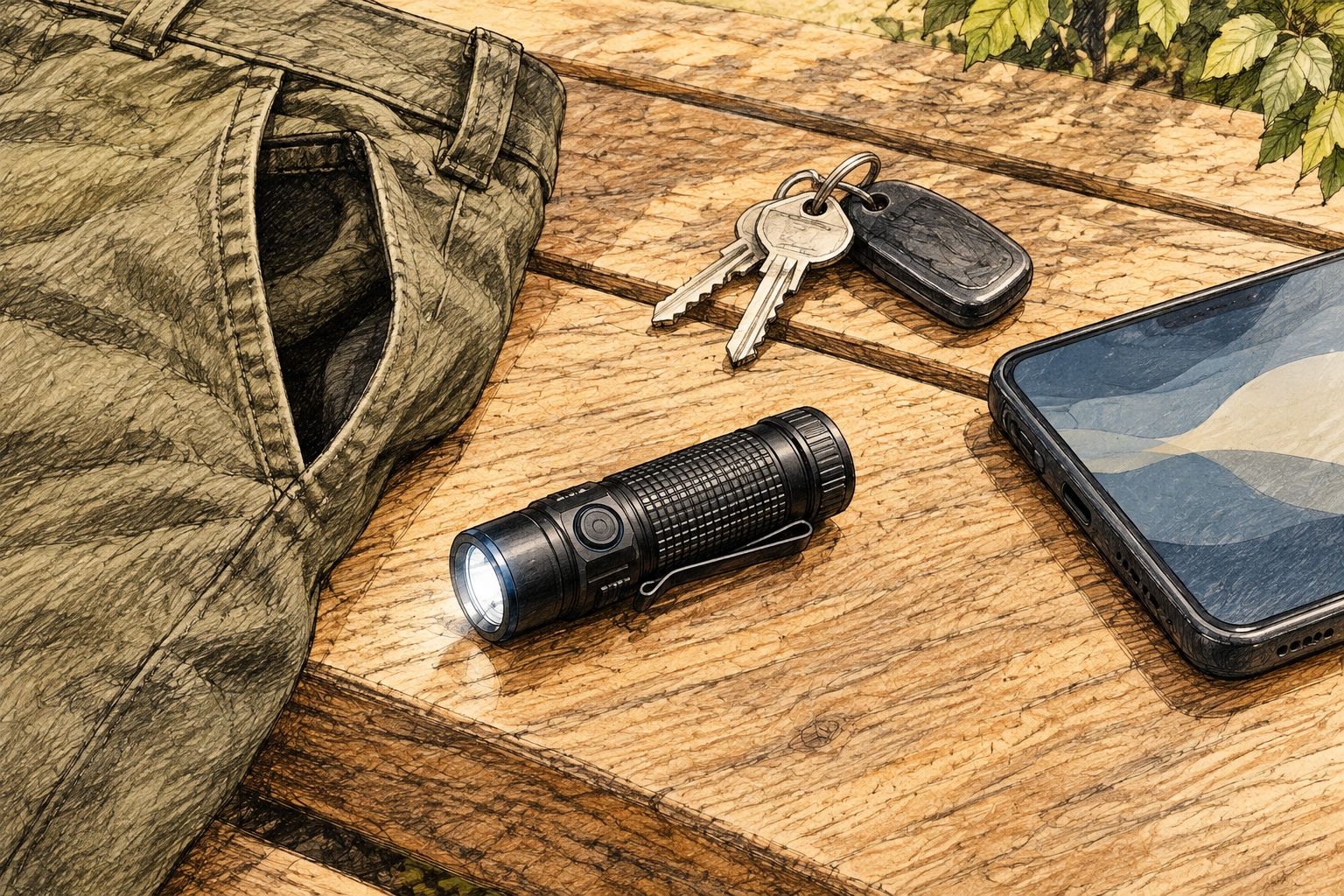
Choose the complete carry arrangement, not an isolated dimension. A small light still needs accessible controls and a secure place in your routine.
Before you commit, check the manual's instructions for preventing unintended activation during transport. Follow the instructions for the exact model rather than assuming all Olight controls work alike.
Compare useful modes, not maximum lumens alone
Lumens describe light output; they do not describe every aspect of how a beam works. Beam shape, intensity and the surface you illuminate also affect what you can see.
For close tasks, assess whether the light gives you comfortable illumination without requiring its brightest setting. Reading a label or finding a charging cable is a different job from checking an open outdoor area.
For longer-distance work, use rated beam distance as a comparison specification, not a promise that you will identify every object at that distance. Weather, background contrast and the object itself affect real visibility.
The Olight Baton 4 illustrates the distinction: its catalogue specifies a maximum 1,300 lumens and a rated 170 m beam distance. Those figures describe different properties; neither establishes how long a particular working mode lasts.
Apply the same discipline to the Seeker 4 Mini. Read its output and runtime information together, then select the mode that matches your normal task.
Olight Baton 4: best for a documented 63 mm format
The Olight Baton 4 is a useful comparison when your main concern is body length. Its catalogue describes a rechargeable pocket torch measuring 63 mm, with maximum output of 1,300 lumens and a rated beam distance of 170 m.
That gives you a concrete dimension to assess against your pocket space. It does not establish that the Baton 4 will feel better than the Seeker 4 Mini in your hand or pocket.
The Baton 4's strength in this comparison is its documented short format. Its limitation as a buying shortcut is that length and maximum output leave other questions unanswered: control preference, charging routine and runtime still need separate attention.
Choose the Olight Baton 4 when its 63 mm format fits your carry requirement; keep comparing if battery maintenance or charging is your deciding factor.
Olight Baton 4 Pro: best for two charging options
The Olight Baton 4 Pro is the more relevant comparison when charging flexibility leads your decision. Its catalogue specifies USB-C and magnetic charging, side and tail controls, maximum output of 1,600 lumens and a rated 200 m beam distance.
Two charging methods give you different ways to fit recharging into your routine. Check the product's charging instructions and included equipment rather than assuming every cable or accessory is supplied.
The Baton 4 Pro's advantage here is the explicitly documented choice of charging methods. Its limitation is that charging flexibility does not prove longer runtime or a more comfortable pocket fit.
Choose the Olight Baton 4 Pro when USB-C and magnetic charging are requirements, not merely features you might use. Compare its physical fit separately before replacing a smaller carry light.
Should you buy the Seeker 4 Mini as your first EDC torch?
The Seeker 4 Mini is a reasonable first-EDC shortlist choice when you accept its specified 1,100 mAh battery setup. Before buying, confirm that the controls, charging arrangement and mode-specific runtime suit your intended use.
Use OlightSA to check the exact product information and ask model-specific questions. Keep those questions practical: what powers it, how you charge it and how you intend to carry it.
Is the Seeker 4 Mini better than the Baton 4 for pocket carry?
The Baton 4's documented 63 mm length makes it a useful pocket-fit reference, not an automatic winner. Choose between the Seeker 4 Mini and Baton 4 using their complete dimensions, controls and charging requirements rather than comparing model names.
Does the Seeker 4 Mini's battery capacity tell you its runtime?
The Seeker 4 Mini's specified 1,100 mAh replacement-battery capacity does not establish runtime by itself. Use the torch's mode-specific runtime information and check how output changes during operation before planning extended use.
FAQ
Is the Olight Seeker 4 Mini worth it for everyday carry?
The Olight Seeker 4 Mini is worth shortlisting if its carry fit and charging requirements suit your routine. Its specified replacement battery is the Olight ORB-183C11, so include model-specific battery maintenance in your decision.
What replacement battery does the Olight Seeker 4 Mini use?
The listed replacement is the Olight ORB-183C11: a protected 18350 lithium-ion battery rated at 1,100 mAh and 3.6 V. Match the exact battery reference and follow the torch's instructions.
Can I use any 18350 battery in the Seeker 4 Mini?
Do not assume every 18350 battery is compatible with the Seeker 4 Mini. Use the specified replacement reference and the manufacturer's compatibility instructions rather than physical size alone.
Is the Olight Baton 4 a good alternative to the Seeker 4 Mini?
The Olight Baton 4 is a useful alternative to assess when a short body is your priority. Its catalogue specifies a 63 mm length, maximum 1,300 lumens and a rated 170 m beam distance.
Which comparison model offers USB-C and magnetic charging?
The Olight Baton 4 Pro explicitly offers USB-C and magnetic charging. It also has side and tail controls, but those features do not establish better pocket fit or sustained runtime.
Should I choose my everyday torch by its highest lumen figure?
No: choose an everyday torch by useful modes, carry comfort, charging and runtime as well as maximum lumens. A maximum-output specification does not describe the full experience of using the light.
Where should South African buyers check Olight battery compatibility?
South African buyers can ask OlightSA to confirm the exact battery reference for their model. Supply the full torch name and replacement-battery code rather than asking only for a battery size.
One last thing
Record the replacement-battery code before you need it. The useful detail to save for the Seeker 4 Mini is ORB-183C11—not simply 18350 or 1,100 mAh.
Keep that reference alongside the manual and your charging instructions. It turns a future replacement purchase into a model-matching task rather than a guess based on appearance.